The Race to Debase. Competitive Devaluation of Global Currencies
The Global Race to the Bottom |
Blog & more> |
Monitoring the progress of debasement as they unfold; Country by country, currency by currency. Nations turn red on this map when their central planners announce policies to debase, either directly (eg. monetization of debt) or indirectly (eg. interest rate reduction, bank reserve ratio reduction, etc).
Mouse over the red nations & click for details

The race to debase. Competitive devaluation of global currencies entered it’s last lap with the coordinated actions of major central banks. The ECB took off on September 6 with the announcement of unlimited purchase of government bonds. According to Bundesbank President Jens Weidmann, the bond program is “tantamount to financing governments by printing banknotes”.
Not to be left behind, Federal Reserve Chairman Ben S. Bernanke announced a $40 billion per month purchase of agency mortgage-backed securities (MBS) on September 13. Unlike previous QE programs, both these money printing operations are open ended.
Six days later, the Bank of Japan said it would expand its asset purchase program by ¥10 trillion to about ¥80 trillion to boost its slowing economy. All eyes now are on China, the UK and other major economies. The race is on, and it cannot stop until fiat currencies die, as they always do, resulting in hyperinflation (The Hanke-Krus hyperinflation table & how it looked liked in Zimbabwe).
Competitive devaluation or “Currency War” is more of a process than an event. Nations take turn to debase, back and forth, until the purchasing power of their currencies approaches zero. Of course the war has been on-going for a very long time; This map tracks when the first salvo was fired since Sep 6, 2012, the day we enter the last lap.
How long will it take before the World turns Red is anyone’s guess. Insofar as timing is concerned, I’ll go with Vladimir Lenin’s estimates “There are decades where nothing happens; and there are weeks where decades happen”
As fiat currencies the world over debase against each other, they also debase against gold & silver – the recognized form of money for millennia, until that fateful day on August 15, 1971. Check out the table below.
Click table for full list.
Real time gold & silver in major world currencies available here
-
-
| ^ Top |
On the Radar Screen |
Top ^ |
03 May 2013 Last week CCTV, the predominant state television broadcaster in China, aired an overview of Bitcoin explaining both how some folks have made money from the new currency and how many see it as a speculative bubble. The Chinese government, which has more than a dozen agencies regulating media and information flow, clearly wants its population to know about Bitcoin despite the successful global use of the currency to circumvent capital controls and undermine central authority – governmental aspects China takes quite seriously.
04 Apr 2013 The Bank of Japan unleashed the world’s most intense burst of monetary stimulus on Thursday promising to inject about $1.4 trillion into the economy in less than two years, a radical gamble that sent the yen reeling and bond yields to record lows.
01 Apr 2013 A Venezuelan government foreign currency auction for local importers has triggered a de facto currency devaluation, the second in less than 50 days, analysts said.
02 Mar 2013 China is “fully prepared” for a currency war should one happen, central bank Deputy Governor Yi Gang said in Beijing yesterday, the official Xinhua News Agency reported. “China is prepared,” Yi was quoted as saying by the agency, which gave no further details about where he spoke. “In terms of both monetary policies and other mechanism, China will take into full account the quantitative easing policies implemented by central banks of foreign countries.”
20 Feb 2013 NZ dollar falls on intervention comments. Graeme Wheeler, governor of the Reserve Bank of New Zealand, said the so-called Kiwi was now “significantly overvalued” due to recent heavy inflows of capital from foreign investors and that the central bank was prepared to intervene to influence the value of the currency..
03 Feb 2013 Falling yen set to spark renewed currency wars. History shows currency disputes can escalate from rhetorical spats into disastrously counter-productive economic conflict. In September 2010, the Brazilian Finance Minister, Guido Mantega, pointed a rhetorical finger at the United States and accused the world’s largest economy of conducting a “currency war”. Suggesting that emerging markets were being unfairly squeezed by a falling dollar, which makes US exports more competitive, Mantega lit the touch paper on a controversy that won’t go away.
07 Jan 2013 It may be only a matter of weeks before the Pound’s next great decline begins… With all the usual provisos about the danger of making predictions, I say that UK savers should be ready for an escalation in the cost of your favourite imports, starting soon, and expect it to accelerate as the market prepares for January 2015. It may be only a matter of weeks before Chinese positioning for a seat at the top financial table spells a turbulent near term future for the Pound.
03 Jan 2013 Switzerland and Britain are now at currency war. It seems you can’t debase your coinage these days even if you try. The Bank of England is straining every sinew to drive down sterling with quantitative easing, and what happens? The Swiss National Bank trumps Threadneedle Street with an outright blitz of Gilt purchases. They just print it, and buy. The Swiss and UK central banks are effectively fighting a “low intensity” currency war against each other. It has come to this.
29 Dec 2012 Japan Lashes Out Over Dollar, Euro. Japan’s new finance minister upped the ante in the country’s war of words against the strong yen, lashing out at the U.S. and Europe for letting their currencies weaken dramatically and calling on the U.S. to strengthen the dollar. The tirade from Taro Aso, Prime Minister Shinzo Abe’s point person on currency strategy, underscores the increasingly pugnacious stance of the fledgling Abe government against what it sees as a global trend of currency devaluations..
04 Dec 2012 The South Korean central bank said foreign reserves rose by $2.6 billion last month to a record $326.09 billion, extending its record-breaking streak to a fourth consecutive month. It attributed the increase to investment gains but the data came after reports by traders of dollar-buying intervention by South Korean authorities during the month to curb the won’s rapid appreciation. On Nov. 22 alone, currency traders estimated authorities bought up to $1 billion in the local currency market to temper a stronger won, which hurts the competitiveness of South Korean exporters. Central bank officials declined to comment on the talk of intervention..
01 Nov 2012 The Hong Kong Monetary Authority (HKMA) stepped into the currency market for a second time on Thursday by selling HK$2.3 billion ($300 million) in Hong Kong dollars as the local currency repeatedly hit the strong end of its trading range. It was the eighth intervention from the HKMA in two weeks.
31 Oct 2012 The People’s Bank of China (PBOC) conducts record reverse repos to ease liquidity. The central bank injected a record high of 395 billion yuan (62.7 billion U.S. dollars) into the financial system via reverse repos in order to ease a cash squeeze at the end of the month, according to a statement from the PBOC’s website. Shi Lei, an analyst at Ping’an Securities, said PBOC’s massive repo injection demonstrates its intention to stabilize market rates and bring them down to its target range.
25 Oct 2012 Asian economies turn to yuan. TA “renminbi bloc” has been formed in East Asia, as nations in the region abandon the US dollar and peg their currency to the Chinese yuan — a major signal of China’s successful bid to internationalize its currency, a research report has said. Seven out of 10 economies in the region — including South Korea, Indonesia, Malaysia, Singapore and Thailand — track the renminbi more closely than they do the US dollar. Only three economies in the group — Hong Kong, Vietnam, and Mongolia — still have currencies following the dollar more closely than the renminbi, said the report, posted on the institute’s website.
24 Oct 2012 The Hong Kong Monetary Authority (HKMA) has intervened in the currency market four times since Oct. 19, selling a total HK$14.4 billion ($1.85 billion) of Hong Kong dollars to protect its 29-year-old peg to the U.S. dollar. In its fourth intervention in less than a week, the HKMA sold $395 million worth of Hong Kong dollars on Wednesday, as the local currency hit the upper limit of its peg to the U.S. dollar of 7.75.
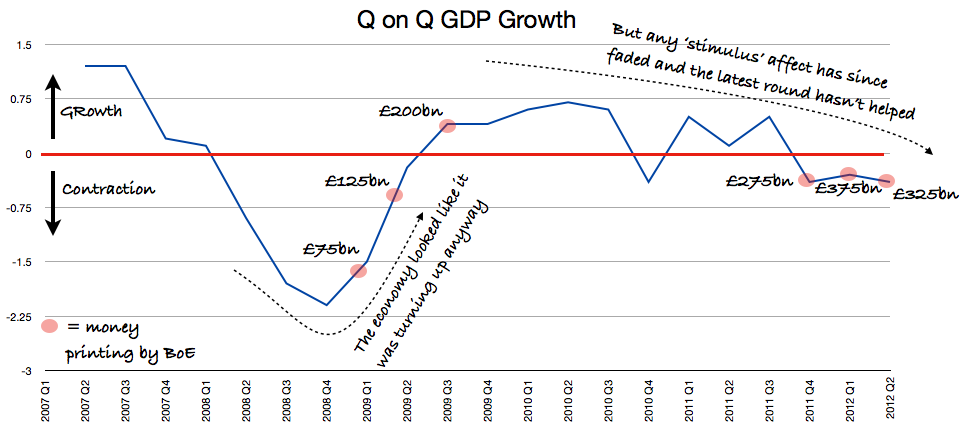
4 Oct 2012 Bank of England’s Monetary Policy Committee (MPC) has decided at its monthly meeting not to introduce any new stimulus measures. It has kept interest rates at their record low of 0.5% and not to raise the amount of quantitative easing (QE) from the current level of £375bn. Thomas Paterson, chief economist at Gold Made Simple thinks the next round of QE may come in November/December and argues why it will have no effect in “stimulating” the economy. The chart below clearly shows how the most recent 3 out of 6 QEs since the financial crisis failed to lift the GDP.
22 Sep 2012 New Zealand First leader Winston Peters launched a Private Members Bill that would broaden the Reserve Bank’s role so that it could intervene to cheapen the NZ dollar when necessary. The bill has the support of Labour party. “It was very important at the time to focus solely on inflation, but at the moment we face competitive devaluation abroad. This is hurting our exporters – ordinary New Zealanders who are losing their jobs and leaving to Australia as a consequence” says Labour Finance spokesman David Parker.
Barely one week after the statement, the Reserve Bank of Australia beat them to the race by cutting interest rates for precisely the same reason – to cheapen the Aussie Dollar to help exporters.
-
Chronological order of debasements since Sep 16, 2012
![]() |
Feb 08, 2013 Venezuela Devalues Its Currency. Venezuela just undertook a massive currency devaluation, re-pegging the bolivar to a value of 6.3 per U.S. dollar from its previous official exchange rate of 4.3 bolivars per dollar. The government also announced that it would shutter the Venezuelan currency exchange system known as SITME.Gold:$1,671 Silver:$31.49 ^Back to top |
![]() |
Oct 02, 2012 The Reserve Bank of Australia cuts interest rates by 25bps today to 3.25 %, almost as low as the level reached at the height of the global financial crisis. Reason? Trade deficit reached the widest since 2008. Weaker Aussie needed to boost exports. Unlike the US or UK, where interest rates are already near zero, Australia can continue fighting debasement via interest rate cuts instead of direct QE. Gold:$1,771 Silver:$34.66 ^Back to top |
![]() |
Sep 19, 2012 Japan’s central bank has joined the Fed and the ECB in new emergency stimulus measures that together could spark a currency war with other nations. The BoJ would expand its asset purchase program to about ¥80 trillion to boost its slowing economy. Gold:$1,771 Silver:$34.66 ^Back to top |

![]() |
Sep 13, 2012 The Fed announced it would purchase agency mortgage-backed securities (MBS) at a pace of $40 billion per month until the labor market improves substantially. This open-ended QE3 program is in addition to existing easing policies. Gold:$1,769 Silver:$34.68 ^Back to top |

![]() |
Sep 6, 2012 European Central Bank President Mario Draghi announced an unlimited bond- purchase program to regain control of interest rates in the euro area and fight speculation of a currency breakup. It is an open-ended QE program. Gold:US$1,700 Silver:32.72 ^Back to top |
-
-
-
-
-
-


niejoka, for the purpose of?? Is this a way of sticking it to bond holders? Allowing the people to pay off mountains of debt which is impossible task. Then what? I have only more questions. Is this the way to get people to succumb to one world government? Is that the goal?
niejoka Countries are made up of people, governments represent people, governments incur debt, governments are people, governments acting as countries buy the debt of other countries, people buying debts of people. Central Banks provide the exchanges and the currencies.Central Banks have metals gold and silver and base as well as other commodities. Since people and debt is a common theme and the central Banks “run the game” The people of the world end up owning the debt which can be called any time the central Bank deems fit Much as a Ponzi scheme. Last one holding the debt gets screwed. No wonder some presidents in US were killed while trying to end the central bank. The banks were not yet ready to “end the game”.