Archive

Posts Tagged ‘BullionVault’

40 days and 40 nights of the quietest gold market since the crisis began…

May 4, 2012 Leave a comment

Submitted by Ben Traynor | BullionVault

-

HOW COMMON is it for Gold Prices to be this range bound? asks Ben Traynor atBullionVault.

At Wednesday afternoon’s London Gold Fix, Dollar Gold Prices were $1648 an ounce. This marked the fortieth trading day in a row that gold fixed between $1600 and $1700.

The last PM Fix outside this range was on March 5 ($1705 an ounce). Spot GoldPrices did manage to poke their head above the $1700 mark later that same week, but since then gold has gone pretty much nowhere. Is it common to see such a protracted period of sideways trading?

One way of gauging how much (or indeed how little) Gold Prices have moved in that time is to calculate the coefficient of variation (CV) – simply the standard deviation divided by the mean average – and compare it with rolling 40 day periods.

The chart below does exactly that, going back to 1968, the year the London Gold Pool collapsed. The vertical green lines represent the final day of any 40 day period with a lower CV than the 40 trading days just gone, with the Gold Price shown over the top (left hand axis):

By the CV measure, gold has not had a quieter 40 days since mid-2007, right at the start of the financial crisis.

A block of six trading days – August 30 to September 6, 2007 – each marked the end of quieter 40-day periods than the one we have just had. There is a similar cluster of four days in July 2007.

As you can see from the chart, these days have tended to come in consecutive blocks – which makes sense since we are taking rolling statistical measures. This allows us to pick out specific quiet periods when Gold Prices were not really doing much.

Over the last 10 years, there have been only five 40-day periods quieter than the one we have just had – the two in 2007, another two in 2005, and one towards the end of 2002.

By contrast, the 1990s saw loads of periods quieter than the current one. So too did the late 1960s and early 1970s, as we would expect since gold was, until August 1971, still officially tied to the Dollar at $35 an ounce (though a two-tier market allowed for a fluctuating price for non-central bank transactions).

Of course, 40 trading days is a rather arbitrary span of time to pick. But similar patterns emerge when we look at other rolling periods.

Wednesday 2 May 2012 also marked the quietest 20 trading day period by the CV measure. Here’s the chart for rolling 20-day periods going back to 1968:

The quietest 60-day period so far this year was actually that ended on April 13. Nonetheless, for ease of comparison, here is the chart showing 60-day periods with lower CVs than the period ended Wednesday this week:

We can draw a few observations from the above:

  • Gold Prices have rarely been this quiet since the current financial crisis began
  • When the last bull market ended in 1980, it didn’t end quietly – hence the big gaps between the late 1970s and mid-1980s
  • If history repeats, these relatively flat Gold Prices could be a precursor to the Big Move (as was the case in the mid-1970s), or they could herald a long, slow decline (see mid-to-late 1980s)

Something else happened this week. As my BullionVault colleague Adrian Ash notes, spot market Gold Prices on Monday ended a calendar month lower for the third month in a row – a rare event indeed in a bull market.

It is also worth checking out Adrian’s log scale chart (reproduced below), which shows that Gold Prices over the last ten years have made a much smaller proportionate gain (shown as the vertical distance moved) than they did in the ten years to 1980:

Putting this all together, both bulls and bears could make a case. The bulls might argue that it is just too quiet for this to be the beginning of a sustained downtrend, and that Gold Prices are taking a breather before making another move up.

Bears might counter that since this bull market has seen a gentler rise, it may well be followed by a gentler decline, which could be what we are seeing right now.

Ultimately, Gold Prices over the long run are determined by fundamentals. One of the key fundamentals is real interest rates i.e. nominal rates minus the rate of inflation. And the key central bank to watch is, of course, the Federal Reserve.

There have been signs in recent weeks that the US economy is picking up. This has dampened expectations of further quantitative easing, and has also raised the prospect that the Fed could raise its policy interest rate sooner than previously expected. Few would go so far as to declare the crisis over, but doubts have crept in about how accommodative the Fed will remain.

I believe this uncertainty is the main reason trading volumes have been low, and Gold Prices have been stuck in a range. It doesn’t help that we are headed towards summer, when the gold market tends to be much quieter (2011 notwithstanding).

If the tentative US recovery continues, more investors will likely surmise that QE will not happen, and that a rate hike will be sooner rather than later. On the other hand, if the recovery stalls, QE could shoot back up the agenda.

Sooner or later, Gold Prices will break out of this range. Whether it will a break higher or a break lower depends a great deal on the health of the US economy.

Buying Gold? Get the safest gold at the lowest prices with BullionVault

Compulsive Hoarding is an affliction, an illness

April 19, 2012 Leave a comment

Submitted by Adrian Ash | BullionVault

Just because you hoard money or Gold Bullion, doesn’t mean you’re sick or wrong…

-
It disables the sufferer and those around them, presenting a health hazard as stuff piles up and the home turns into a trash can.

“Hoarding and anxiety go hand-in-hand,” says one struggling survivor. “For many people, including hoarders and non-hoarders, fear keeps us from letting go of objects we don’t need.” Beating fear is a tough ask, however, and “clean-up usually provokes intense anxiety,” says another report.

Anyone helping the hoarder – even a professional cleanup crew – should be gentle, always caring and encourage the person to deep breathe and relax.

Now, given these sensitivities – and seeing how the causes of hoarding include dementia, depression, and obsessive compulsive personality – you might expect people to be a bit nicer when trying to get hoarders to stop. But no.

“Companies’ growing cash piles are irking shareholders and stunting growth,” barked the Financial Times in late January. “Politicians and policymakers are going to have to ask the question,” declared David Bowers of Absolute Strategy Research in London – “How much longer are we going to allow companies to run themselves for cash?

Two weeks later, Martin Wolf was at it in the same pages. “Britain needs to whittle down corporate cash piles,” he announced, also quoting approvingly a London finance type, this time Andrew Smithers of Smithers & Co. “If the fiscal deficit is to disappear…there needs to be a mixture of lower profits, higher investment, and significantly smaller current account deficits.

“Increases in government investment and private housebuilding would also help,” said Wolf, parroting UK and US economic policy since the Second World War. But the slaughter of corporate hoarders is new. Because the phenomenon is new, and “highly indebted UK households should not run large deficits again.” Or to quote The Times this Monday, “Consumers cannot lead recovery. Britain needs business to stop ‘stashing the cash’.”

Now “Companies must stop hoarding cash and start investing instead,” says – choke! – Will Hutton in The Guardian, quoting this week’s same press release from the same think-tank, Ernst & Young’s ITEM Club. “David Cameron and George Osborne have still not developed a full-throated industrial policy that would encourage companies to spend money on investment and innovation.”

“Business investment has picked up nicely in the US,” says ITEM’s chief economic advisor, Peter Spencer, apparently missing the $1.24 trillion in US corporate cash piles stacked up by end-2011 – well over half of it outside Uncle Sam’s borders according to Moody’s, as emerging-market growth plus onerous US tax treatment drives businesses to avoid remitting profits back home.

“But UK companies remain extremely risk-averse, which is sapping strength from the economy. Until these companies…start increasing levels of investment and dividends, the economy will remain on the critical list.”

Perhaps if everyone shouts loudly enough, the hoarders will snap out of it? But then, they are trying already, albeit at gun point. US equities have been paying a higher yield than Treasury bonds for the first time in six decades. “Total dividends paid by UK companies hit a record £67.8 billion in 2011 [$110bn] a rise of almost 20% on 2010,” says Hargreaves Lansdowne, the retail-investor brokerage. “Encouragingly, dividend growth was seen across all industry sectors.”

And it’s not like corporate US and Britain didn’t do their bit in fighting the war of debt vs. recession starting in the mid-1990s either. Over the 12 years ending spring 2009, for instance, private-sector UK companies outside the financial sector spent 124 months growing their bank debt net-net. Yes, UK households  fought harder (141 out of 144 months), but they began to rein in their borrowing sooner and actually saved money right when the canon fodder were called on for a last “big push” in late 2007.

But so what? “British companies are running a cash surplus of some 6% of GDP, the largest in the world,” says Hutton, gasping at people making a profit and daring to keep it.

[They] are refusing to spend that cash on investment or innovation, preferring to hoard it, preserve profit margins or buy back their own shares.

Oh the monsters! Refusing to spend…stashing the cash…hoarding what should be shared for the good of us all! It must not be allowed. And luckily the financial press began softening up public opinion at the start of the year, when the FT first ran that story about what it called “the $1,700bn problem. Companies in the US are flush with cash and are paying out a smaller proportion of their earnings as dividends than ever before. Much the same can be said for western Europe. Governments and households on both sides of the Atlantic are meanwhile strapped for cash. This cannot persist much longer.”

“Businesses run ‘for cash’, rather than spending in an attempt to boost revenues, do not promote growth,” said the Pink ‘Un.  The government should do something to stop it!

The battle front today is against the hoarding of currency. No one will deny that if the vast sums of money hoarded in the country today could be brought into active circulation there would be a great lift to the whole of our economic progress.

So said Herbert Hoover, then US president, in early 1932, and quoted in Murray Rothbard’s America’s Great Depression (Princeton, 1963). “We are making war on depression. War against a lack of confidence. Our people must have something tangible to do in the fight. There is no use to go out and say ‘Have confidence, courage and faith.’ They must have something positive to bite on.

They can bite on the question of hoarding.

Hoover’s war on the hoarders presaged Roosevelt’s war on fear, with a task force of opinion and business leaders enlisted to make hoarding cash – then outside the banks, under the mattress, for fear of default – socially unacceptable. “It [hoarding] began in April last year in consequential amounts,” Hoover told a private White House gathering of newspaper editors and other luminaries that February. “The disturbances in Austria, which finally culminated in the German panic, showed paralleled increases of hoarding in the United States, which rose at one time to about seventy or one hundred million a week…[Then came] the disturbance in Great Britain which finally resulted in the British abandonment of the gold standard.

“Instantly, within 24 hours after the Bank of England ceased paying gold, hoarding jumped in the United States to $250,000 a week.”

This was unsurprising. Because then, as now, people kept hold of their money – hoarded it, if you must – for fear of losing it to one of the catastrophes striking so many others around them. And then, as now, US citizens also had the option of what would soon prove a rare privilege, of hoarding Gold Bullion too. In the early 1930s, however, people kept their cash at home, out of deposit accounts, for fear of banking collapse. Gold meantime really was money.

Keeping gold at home – out of circulation and safely away from bank credit – was therefore bad for the nation. It could not be allowed to persist, and Hoover’s successor, F.D.R., wasted no time in making Gold Bullion illegal for everyone but the State, nationalizing private gold holdings at $26 per ounce, raising the official price to $35 per ounce, and thereby enforcing on the United States the very Dollar devaluation which gold hoarders had feared.

Bite on that. Or to put it another way, just because you hoard gold or fear bank credit today, doesn’t mean you are in need of treatment or tough love.

Buying Gold today? Make it simple, secure and low cost…starting with a free gram of Zurich bullion right now…at BullionVault

BullionVault & GoldMoney: So different, yet so similar

April 17, 2012 Leave a comment

-
If you’ve checked out the Compare AFE, BullionVault & GoldMoney page, you’d have noticed that BullionVault & GoldMoney packaged their bullion dealership and custodian services very differently. It’s interesting to note how the same service can be approached in such a contrasting manner.

There is however, one other significant difference not highlighted in the comparison. It’s not so much about differences in the companies’ services. Rather, it’s over differing opinions of the founders in the much debated the matter of Gold Cartel and Gold Price Manipulation.

In a recent interview by Chris Martenson, Paul Tustain of BullionVault said:

I am not really strongly in the manipulation camp but I do agree that market manipulation tends to happen in futures contracts. This is not anything to do with gold or silver specifically, it is to do with the way futures contracts work.

-
London AM & PM Fix

There are many gold and silver market abnormalities that have been cited as supporting evidence of gold price suppression by the “manipulation camp”. One of the more interesting ones is the phenomenon where the London AM fix has almost always been higher than the PM fix for over a decade. When asked concerning the above, Paul responded:

But I think there is a rational market explanation and I do not think that market manipulation by governments is in fact it. I think it is much simpler than that.

-
It appears that he is using the Occam’s Razor, which is a principle urging one to select among competing hypotheses that which makes the fewest assumptions and thereby offers the simplest explanation of the effect. Put another way, it admonishes us to choose from a set of otherwise equivalent models of a given phenomenon the simplest one. It should be noted however, that simplest available theory need not be most accurate. Listen to Paul’s take on this issue and make your own conclusion after reading a detailed analysis of this phenomenon by Adrian Douglas. Paul also goes into great detail showing how other perceived market abnormalities or statistical aberrations can be explained away without invoking the manipulation theory, including the much discussed bullion banks’ short position in the futures market. A transcript of the interview can be found here.

Gold trading is influenced by government intervention

On the other corner of the gold price manipulation ring, we have James Turk, founder of GoldMoney, director of GoldMoney Foundation and consultant at Gold Anti-Trust Action Committee (GATA). James’ work exposing the gold price suppression scheme is all over the web.

In his April 13 article Some Answers to Doug Casey’s Questions James wrote:

The investigation into the inner workings of the gold market that are out of public view and decided behind closed doors in central banks is an ongoing effort. It has been that way for years, and fortunately, the Gold Anti-Trust Action Committee has been there relentlessly compiling the mounting evidence that something is amiss, that gold trading is influenced by government intervention aimed at keeping the price from rising to its fair value. Or to put it another way, by allowing the gold price to climb higher year after year in what I have dubbed a “managed retreat”, governments hope that people will not notice what is happening to the ongoing debasement of the US dollar…

That was his conclusion at the end of his argument for the case that gold (& silver) price manipulation by central planners  has been and still remains a strategic policy to keep the dollar and the banks that support it alive. Read the full article here.

In his presentation at the GATA 2008 conference, James explained why central banks interfere in the gold market. Interesting to note how he foresaw the Lehman Brothers bankruptcy by predicting another Bear Stearns collapse was only several months away.

So there you have it – two innovative entrepreneurs, two great companies, very contrasting views on PMs market manipulation but they share one very important thing in common – Their relationships with their clients are on a Bailee/Bailor basis and not on a Debtor/Creditor basis. Both companies vouch in no uncertain terms that their clients have complete ownership of physical bullion in their custody. Their At the end of the day, I think that’s what matters most.

-

Further Reading:

GoldMoney & BullionVault clients of all people most to be pitied?

April 13, 2012 3 comments

-

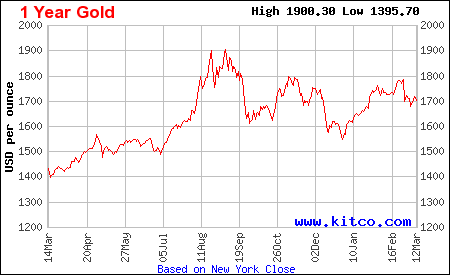
Gold priced in US$ has been declining from its high in August 2011. Wall street has it that it’s because the euro zone debt crisis is now under control, the US economy is recovering, inflation is low and the US unemployment situation is improving. Oh, not to forget there has been no more money printing and the Dow has gained some 20% since gold’s peak. In short, improving outlook has caused investors to move out of gold’s safe haven into riskier assets.

Less demand leads to lower gold prices as reflected in the chart below. Some analysts say the 11-year bull market in gold is over, gold is in a bubble that has or is about to bust.

Gold 1 year chart

If that be the case, clients of GoldMoney & BullionVault (two of the more established and popular physical gold dealer and custodians) have got it all wrong and hence are “of all men most to be pitied”. Look at how their collective gold holdings have been increasing relentlessly, even during periods of sharp price declines.

Gold Holdings Comparison: GoldMoney VS BullionVault

This short term chart covering the period since gold’s intermediate top in August 2011 shows steady increase of total holdings from quarter to quarter. The growth at BullionVault is particularly impressive.

GoldMoney & BullionVault: Quarterly Change in Gold Holdings

-
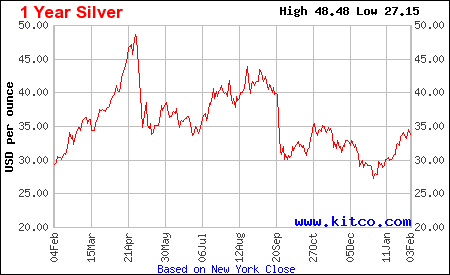
The same goes for silver.

Silver 1-year chart

Silver Holdings Comparison: GoldMoney VS BullionVault

GoldMoney & BullionVault: Quarterly Change in Silver Holdings

What then can be said of the apparent dichotomy between the declining trend in gold & silver prices and the increasing demand seen in the metal purchases? Just two words:

Paper & Physical

Prices reflected in the charts come about mainly by “traders” trading paper gold & silver. Traders is put between quotes because they are not the normal traders you’d expect to find in a free market. Most of the trades that determine the price trends are placed by very few large bullion banks and High Frequency Trading (HFT) machines. Yes, the prices are greatly influenced by trades initiated by machines preprogrammed with sophisticated algorithms to set the price which ever way the owners wanted them to go. In case you’re wondering, who may be the people on the other side of these trades? It’s people like this, who sets up trades hoping to beat the supercomputers on the other side only to get sucked in and forced to dump when their stops are hit.

On the other hand, real humans are behind the accumulation of physical metals at BullionVault, GoldMoney and many other private vaults. These are the same humans that do not believe the spin of the MSM, but hold on to the view that the financial crisis is not yet behind us. They believe that the worse is yet to come. I’m one of them. We understand that holding our savings and retirement funds in paper assets and paper money is most likely to result in a massive loss of purchasing power through hyperinflation when the real crisis hits.

We’re not 100% sure it will happen, neither can we be 100% sure it won’t happen.

What about you? Paper or physical?

-

Data source

-

Related Articles:

-

Peaks and Troughs

February 6, 2012 Leave a comment
Machu Picchu
-
While I was travelling over the Andean mountains soaking in the majestic sceneries and virtually out of touch with the financial world for over 10 weeks, the PMs market seemed to be having its own mountain-valley experience.  Unknown to me, gold and silver took a 15 and 24 percent plunge respectively against the USD towards the end of the year. While they were down against most fiat currencies, it did not affect me, nor others who’ve saved and done their accounting in ounces of gold and silver. Not one bit. Neither did they do us much good when their USD prices soared 11% and 19% respectively in January. Life goes on while the powers that be continue to play their paper shenanigans.

For the benefit of readers who continue to do their accounting in units of fiat currencies, I’ve summarised the performance of gold and silver in several currencies through the charts below. Hope they help to put things into perspective.

-

Gold & silver performance relative to various currencies in 2011
Gold & Silver in various Currencies (2011)

In 2011, gold appreciated by an average of 14.3% against all 75 fiat currencies tracked by goldsilver.com, while silver averaged a corresponding loss of 6.8%. Among the selected currencies of interest charted above, only the Indian Rupee recorded a loss against both gold and silver.

-
Gold & silver performance over 12 years

Gold & Silver in various Currencies (2000-2011)

Going back to the beginning of this secular bull market in PMs, both gold and silver charted impressive gains against all tracked currencies. If you’ve been earning or saving in Indian Rupees over the past 12 years, you’d have lost over 500% against both gold and silver. If you think the Indian Rupee had it bad, spare a thought for those who’ve saved in Iranian Rial or Argentinian Peso, which depreciated by 3,368% and 2,240% respectively against gold.


Gold & silver performance before April’s price take downs

Gold & Silver in various Currencies before price takedowns (2000-2011)

Silver’s 2011 performance was extremely volatile peaking in late April.  Silver’s peak and subsequent drop in price mirrored what we witnessed in its 2008 price action when the silver spot price dropped 50% peak to trough intra-year. This chart shows how silver has been leading gold’s performance just before the April price take downs.

Be prepared!

If you’ve been following recent geo-political and macro-economics news, you’d be much better informed than me. Doing a quick review of what transpired during the period I left this blog idle, here’s what I consider noteworthy developments:

  • The Fed’s announcement of its zero-rate policy through 2014, requiring it to print more money to buy US Treasuries.
  • ECB engaging on its own campaign of printing money hoping to “solve” Euro zone’s deepening debt crisis.
  • Start of a countdown to the war with Iran.
  • MF Global’s $6.3 billion “repos” saga leading to its collapse and potentially bringing down the Futures/Options (and other derivatives) market along with it.

Bottom line is things are getting worse, not better (as the MSM would have you believe), especially for savers and retirees. 2012 and 2013 are setting themselves up to be potentially disruptive years. Be prepared!

Updates to static pages:

  • GoldMoney Review: Discontinued services, Gold & Silver “Client holdings by vaults” charts as at 30 Dec 2011
  • BullionVault Review: Gold & Silver  ”Client holdings by vaults” charts as at 30 Dec 2011
  • Compare AFE, BullionVault, GoldMoney: Comparative gold & silver holding charts as at 30 Dec 2011 and Alexa comparative traffic rank chart as at 01 Feb 2012.
  • Fees Comparison: Highlighting GoldMoney’s zero-spread trading advantage.
  • Forecasts: All close ended PMs price action forecasts by industry leaders were off target! New ones are being tracked.

-

On the lighter side…

Land EguanasEndemic to the Galápagos Islands, these bright golden land iguanas (Conolophus subcristatus) are incredible friendly and approachable. If not for the 2-meter rule, you could easily reach out to touch them!
The Greatest Risk for Gold Investors

November 3, 2011 Leave a comment

By Jeff Clark | BIG GOLD

While we’re convinced that our gold and silver investments will pay off, they don’t come without risk. What do you suppose is the biggest risk we face? Another 2008-style selloff? Gold stocks never breaking out of their funk? Maybe a depression that slams our standard of living?

Though those things are possible, we at Casey Research don’t see that as your greatest threat:

“Your biggest risk is not that gold or silver may fall in price. Nor is it that gold stocks could take longer to catch fire than we think. Not even the prospect of the Greater Depression. No, your biggest risk is political. As bankrupt governments get increasingly desperate for revenue, any monetary asset held domestically could be a target. It is absolutely essential that every investor diversify themselves politically. In fact, at this point, it is the one action that should be taken before anything else.” – Doug Casey, September 2011

I know many reading this are prudent investors. You own gold and silver as solid protection against currency debasement, inflation, and faltering economies. You set aside cash for emergencies. You have strong exposure to gold stocks, both producers and juniors, positioned ahead of what is likely the next-favored asset class. You feel protected and poised to profit.

Yet, despite all this preparation, you remain exposed to one of the biggest risks.

Similar to holding a diversified portfolio at a bank without checking the institutions solvency, many investors keep their entire stash of precious metals inside one political system without considering the potential trap theyve set for themselves. While storing some of your gold outside your home country is not a panacea, it does offer one important thing: another layer of protection.

Consider the exposure of the typical US investor:

  1. systemic risk, because both the bank and broker are US domiciled
  2. currency risk, as virtually every transaction is made in US dollars
  3. political risk, because they are left totally exposed to the whims of a single government
  4. economic risk, by being vulnerable to the breakdown of a single economy

Viewed in this context, the average US investor has minimal diversification.

The remedy is to internationalize the storage of some of your precious metals. This act reduces four primary risks:

Confiscation: We dont know the likelihood of another gold confiscation. But we do know that things are working against us – particularly for US citizens. With $14.7 trillion of debt and $115 trillion of unfunded liabilities, the US government will likely pursue heavy-handed solutions. Under the 1933 FDR “gold confiscation” in the US (the executive order was actually a forced delivery of citizensgold in exchange for cash), foreign-held gold was exempted.

Capital Controls: Many Casey editors think some form of capital controls lie ahead, limiting or eliminating a citizens ability to carry or send money abroad. If enacted, all your capital would be trapped inside the US and at the mercy of whatever taxing and regulating schemes the government might concoct. Although you might be able to leave the country, your assets could not travel with you.

Administrative Action: There are plenty of horror stories of asset seizure by a government agency without any notice or due process, possibly leaving the victim without the means to mount a legal defense. Having some gold or silver stored elsewhere provides what could be your only available source of funds in such a scenario.

Lack of Personal Control: Having gold and silver stored elsewhere adds to your options. You will have a source of funds available for business, entrepreneurial pursuits, investment, or pleasure.

Foreign-held assets also require greater awareness and planning:Notice above we said these risks can be reduced, not eliminated. There is no perfect solution; US persons could, for example, be compelled to pay a “wealth tax” on assets held worldwide, or even repatriate them in a worst-case scenario. Absent a crystal ball, the political diversity of asset location is an essential strategy against an uncertain future.

  1. Access to your metal or sale proceeds may not be quick. Therefore, this option is for those with some gold and silver stored at or near home. We do not recommend storing all your precious metals overseas; that defeats one of its purposes, to have it handy for an emergency.
  2. While we think the US poses the greatest threat, a foreign government could move to control certain assets as well. The risk varies by country and is generally greater within the banking system than with private vaulting facilities.
  3. Understanding and complying with reporting requirements is essential.

The bottom line, though, is that foreign-held precious metals can mitigate risk and give you more options. And as your metal holdings grows, diversification becomes more crucial.

Given our current rapacious climate, its likely that simply buying gold wont be enough. We strongly suggest every investor diversify one‘s bullion storage outside their current political regime. The option may not be available someday, leaving you vulnerable without a secondary source of bullion.

We advise taking advantage of the opportunity before it is gone.

[One way to internationalize your bullion is to use a safe deposit box in a second country; however, this requires traveling to the institution to handle the paperwork and organizing the transport of your bullion... and the contents of a safe deposit box aren't insured. Other programs will store gold; but the metal is often held in the form of fractional ownership in a 400-oz. bar and not specific coins and bars held in your name. A better solution is to store your bullion in a non-bank depository, outside your home country, without shared ownership, and do it for a reasonable fee. We found a program that provides all those things; and it offers BIG GOLD readers six months' free gold and silver storage in a Canadian vault. A risk-free, three-month trial subscription to BIG GOLD will qualify you for that deal... plus all the expert analysis and actionable investment advice packed into each issue.]

Related Articles:


Follow

Get every new post delivered to your Inbox.

Join 175 other followers