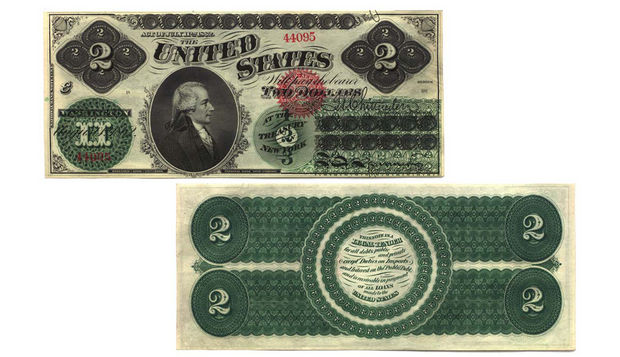
5 days ago saw the 150th year anniversary of an event so historic that a very select few even noticed: the birth of US fiat. Bloomberg was one of the few who commemorated the birth of modern US currency: “On April 2, 1862, the first greenback left the U.S. Treasury, marking the start of a new era in the American monetary system…. The greenbacks were originally intended to be a temporary emergency-financing measure. Almost bankrupt, the Treasury needed money to pay suppliers and troops. The plan was to print a limited supply of United States notes to meet the crisis and then have people convert the currency into Treasury bonds. But United States notes grew in popularity and continued to circulate.” The rest, as they say is history.
In the intervening 150 years, the greenback saw major transformations: from being issued by the Treasury and backed by gold, it is now printed, mostly in electronic form, by an entity that in its own words, is “set up similarly to private corporations, but operated in the public interest.” Of course, when said public interest is not the primary driver of operation, the entity, also known as the Federal Reserve is accountable to precisely nobody. Oh, and the fiat money, which is now just a balance sheet liability of a private corporation, and thus just a plug to the Fed’s deficit monetization efforts, is no longer backed by anything besides the “full faith and credit” of a country that is forced to fund more than half of its spending through debt issuance than tax revenues.
At the start of the Civil War, the U.S. didn’t have a national paper currency. Instead, the money supply consisted of U.S. coins and a collection of paper notes issued by private banks. Technically, the federal government began issuing its own paper currency in 1861. That year, the Lincoln administration issued $60 million in demand notes, a variant of a Treasury note that was redeemable “on demand” for gold coins at the Treasury or any sub-Treasury.
These notes were overshadowed in 1862 by the issue of $150 million in a new fiat currency officially known as United States notes and popularly known as greenbacks or legal tenders. By the end of the war, close to $450 million worth of greenbacks were in circulation.
The name greenbacks referred to the reverse of the notes, which were printed in green. The name legal-tender notes referred to the text that originally appeared on the back, which began, “This note is legal tender for all debts, public and private.” This provision made the currency a valid form of payment on par with gold and silver, which was a very controversial action at the time. It made the United States note a fiat currency — meaning its value was established by law alone and wasn’t based on some other unit of value, such as gold, silver or land.
Many Americans during and after the Civil War believed the creation of a fiat currency was unconstitutional. The Constitution explicitly stated that only gold and silver could be considered legal tender. In 1871, in the case of Knox v. Lee, the Supreme Court settled the matter by declaring that making United States notes legal tender was indeed constitutional.
By this time, the greenback was at the center of a countrywide debate on monetary policy. When the post-Civil War economic boom ended in the panic and depression of 1873, many people, especially farmers, blamed the Treasury’s policy of contracting the currency — that is, removing United States notes from circulation in an attempt to go back to the gold standard, which would require that a $1 note could be redeemed for $1 in gold.
As a consequence, there was a call for the expansion of United States note circulation or an inflation of the currency. This belief became joined with a political ideology that opposed big business and banking interests, resulting in the birth of the Greenback Party in 1874.
Opposing the Greenbackers were more conservative interests, sometimes known as “gold bugs,” who found support in the Republican Party and in elements of the Democratic Party. Gold interests proved the stronger contestant in the debate and in 1878, the total circulation of United States notes was fixed at a little over $346 million and the notes eventually became redeemable in gold (at least until 1933, when this provision was removed).
During the 20th century, United States notes became ever less important in the nation’s money supply, though Congress supported their continued circulation. They were increasingly replaced by currency issued by the Federal Reserve System, which came to look almost identical to the United States note. The Federal Reserve note thus became the new greenback.
In 1966, Congress allowed the Treasury to start removing United States notes from circulation. The last delivery of the notes by the Bureau of Engraving and Printing to the Treasury was made in 1971. In 1994, the Riegle Community Development and Regulatory Improvement Act eliminated the issuance of the notes altogether.
So instead of real money, America has an impostor “which came to look almost identical to the United States note” with the full complicity of everyone in charge, just so that when needed, any and all untenable debt burdens can be inflated away. And while the latter is a topic of a whole different discussion, we present another chart which, unlike the 150th anniversary of fiat, should be something discussed far more broadly… Because in a fiat world superpower status is always relative.
-
[Updated] The South Carolina Treasurer’s Office, acting upon a directive from the state legislature, has recently published a report on the advisability of investing in gold and silver. Basically, the state legislature wanted to know if it’s wise to invest public funds under it’s custody in gold & silver.
Here’s what the Treasurer’s Office has to say about itself:
Our mission is to serve the citizens of South Carolina by providing the most efficient banking, investment and financial management service for South Carolina State Government. Our commitment is to safeguard our State’s financial resources and to maximize return on our State’s investments.
This is a tall order, hence we can assume that the report must be well researched and credible. It concluded that it is not advisable to invest public funds in gold & silver because:-
There’s escalating market speculation
Current value (I think they mean price) is too high
Market possibly in a bubble
South Carolina Code of Laws states that the Treasurer has “ full power to invest” in debt instruments of the US government and corporations, but makes no mention of investments in derivatives of gold & silver. Hence investing in gold & silver derivatives may “create a legal conflict”
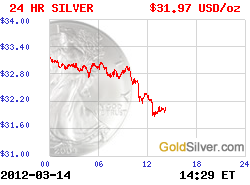
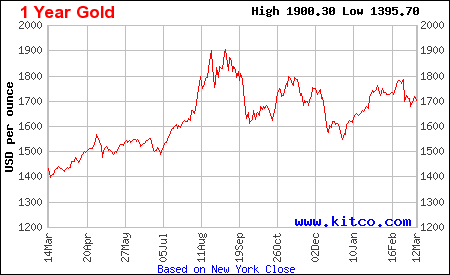
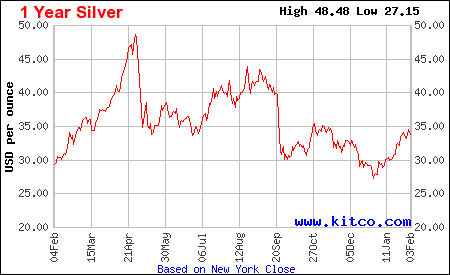
While the timestamp of the document was 27 Feb 2012, it can be assumed that the report was prepared soon after the end of September 23, 2011 due to this inclusion. From the perspective of a short term investment, that was a pretty good call, considering the fact that gold and silver have been taken down to $1624 and $31.40 respectively as I write.
However, this piece is not about how good the Treasurer’s Office was at making an investment call based on price. Neither is it about whether gold & silver is in a bubble. These conclusions (2) & (3) are opinions of the Treasurer’s Office, which are subjective. Of greater interest are the facts revealed in the body of the report.
Regular readers of this blog would have noticed that there are several key issues that are repeatedly discussed or highlighted here (through news feeds or third party contributions). They include:-
Gold & silver prices are being suppressed
Central Banks & major bullion banks are suppressing their prices
Naked short selling is one of the price suppression mechanism
Bullion Banks and exchanges practice fractional reserve bullion banking
Stay out of gold or silver bank accounts, ETFs, Certificates, and all forms of derivatives
The safest way to own gold & silver is to hold physical gold & silver
Items (1) to (4) are often disputed by the mainstream media and investors, sometimes referring to them as conspiracy theories. Hence, it is most interesting to see what this government published report has to say about these 6 issues.
Price Suppression is Real
In one short paragraph, this report confirms in no uncertain terms the truth behind the so called “conspiracy theories”. Not only does it confirm the existence of price suppression, it discloses the WHOs and the HOWs!
Risks of holding gold through ETFs, Certificates, Bank Accounts & other Derivatives
It has been repeatedly emphasized here that the only secure means of owning gold & silver is by holding physical coins and bars in your own possession or stored in a private vault outside the banking system. Anything else is a derivative - a paper or electronic representation of the real thing.
This report explains the nature of these derivatives and lists the risks associated with each, together with reasons why the Treasury’s Office advised against investing in them.
The full report in pdf is available for download at the South Carolina Treasurer’s website. Text from relevant sections is reproduced below with comments related to the 6 items above highlighted. Most of the remarks are self explanatory. There are, however, two groups of comments that warrant some discussion.
1. Allocated & Unallocated Accounts
Ways to Invest: Certificates
Unallocated gold certiñcates are a form of fractional reserve banking and do not guarantee an equal exchange for metal in the event of a run on the bank’s gold on deposit. Allocated gold certificates should be correlated with speciñc numbered bars, however it is difficult to prove whether a bank is improperly allocating a single bar to more than one investor.
Ways to Invest: Accounts
One of the most important differences between accounts is whether the gold is held on an allocated or unallocated basis. Another major difference is the strength of the account holder’s claim on the gold, in the event that the account administrator faces gold-denominated liabilities, asset forfeiture, or bankruptcy.
The above describes two products offered by banks to clients who want to invest in gold (or silver) without having to deal with the physical metals. For example, when a bank accepts $2,000 from a customer and issues a gold certificate or credits the customer’s gold account under the unallocated system, the bank is not obliged to buy and store 1.2 oz (at current price) of gold on behalf of the customer. It holds only a tiny portion of that amount in gold. Hence when many of its the customers decide to redeem their certificates at the same time, the bank will not have sufficient gold to deliver. This is what’s referred to as a “run on the bank’s gold on deposit”. The same applies when depositing cash in your bank. The practice of keeping only a tiny fraction of what’s rightfully belonging to the customers (gold or cash) is referred to as fractional reserve banking.
When selling allocated gold products, the bank is legally required to hold 100% of the customers deposit in physical metal. For example, if a customer deposits sufficient cash to own a 400 oz gold bar and is assigned a bar bearing serial No: AGR Matthey 156571, how can one be sure that the same bar or a portion thereof is not assigned to another customer at the same time? That’s the issue raised by the report - and the risk is real.
This brings us back to “the only secure means of owning gold & silver is by holding physical coins and bars in your own possession or stored in a private vault outside the banking system”. If you have to use a third party to store your metals, use specialized private vaults instead, because banks operate on a fractional reserve banking system.
There are many companies outside the banking system that offer secure vaulting services. Generally, they have very high transparency, including publishing audited client holdings on the web for public scrutiny (without any login required). Of course clients’ ID are anonymous, and known only to the operator and the client.
2. Reason for not investing in physical gold & silver
The report listed 5 ways to invest in gold & silver - ETPs, Certificates, Accounts, Derivatives and physical coins & bars. Notice how it highlights & explains all the risks associated with ETPs, Certificates, Accounts and Derivatives and the reasons why it is not advisable for the Treasury to invest in these.
Notice also that there are NO risk associated with physical metals. The only reason given for not investing in coins and bars is “South Carolina does not have the capacity to store or funding to secure gold and silver bullion”.
Proviso 89.145 GP:
Gold & Silver Investments
Office of State Treasurer
-
GOLD AND SILVER AS AN INVESTMENT:
Historically, investors have purchased gold as a hedge against an economic, a political, or a currency crisis. A decline in investment markets, a growing national debt, a weak currency, increasing inflation, military conflicts and social unrest are the most common reasons for investment in gold. Currently, gold and silver are at historic highs leading many expert investors to conclude that a bubble has been created in the precious metals market. Since the US recession began, the value of gold and silver has increased as investment markets perform poorly, troublesome economic news is announced, and when uncertainty in international markets intensifies.
Similar to other commodities, the value of gold and silver is determined by supply and demand, as well as speculation. The Federal Reserve, The London Bullion Market Association, JP Morgan Chase, and HSBC Holdings have practiced fractional-reserve banking and engaged in naked short selling causing artiñcial price suppression.
There are several ways to invest in gold and silver: bars, coins, ETP’s, certificates, accounts, and derivatives. If a state were to choose to invest in gold (and silver), it would likely choose to invest by:
1. ETP’s-Exchange Traded Products. This allows the stakeholder to invest in bullion without having to store bars and coins. The ñrst gold ETF (Exchange Traded Fund) was created in 2003 and has been viewed largely as a success, but has also been compared to investing in mortgagebacked securities. The annual expenses of the fund (storage, insurance, and management fees) are charged by selling a small amount of gold represented by each certificate, so the amount of gold in each certificate will gradually decline over time. ETF’s are investment companies that are legally classified as open-end companies or Unit Investment Trusts (UIT), but differ from traditional open-end companies and U]T’s. The main differences are that ETF’s do not sell directly to investors and they issue their shares in what are called Creation Units. Also, the Creation Units may not be purchased with cash but a basket of securities that mirrors the ETF‘s portfolio. The Usually, the Creation Units are split up and re-sold on a secondary market.
2. Certificates- allow investors to avoid the risks and costs associated with the transfer and storage of bullion by taking on a set of risks and costs associated with the certificate itself. Banks may issue gold certificates for gold which is allocated (non-fungible) or unallocated (fungible). Unallocated gold certiñcates are a form of fractional reserve banking and do not guarantee an equal exchange for metal in the event of a run on the bank’s gold on deposit. Allocated gold certificates should be correlated with speciñc numbered bars, however it is difficult to prove whether a bank is improperly allocating a single bar to more than one investor. The US ñrst authorized the use of gold certificates in 1863. By the early l930’s the US placed restrictions on private gold ownership and therefore, the gold certificates stopped circulating as money, but certificates are still issued by gold pool programs for investment purposes.
3. Accounts- Many banks offer gold accounts where gold can be instantly bought or sold just like any foreign currency on a fractional reserve (non-allocated, fungible) basis. Pool accounts, facilitate highly liquid, but unallocated claims on gold owned by the company. Digital gold currency systems operate like pool accounts and additionally allow the direct transfer of fungible gold between members of the service. Different accounts impose varying types of intermediation between the client and their gold. One of the most important differences between accounts is whether the gold is held on an allocated or unallocated basis. Another major difference is the strength of the account holder’s claim on the gold, in the event that the account administrator faces gold-denominated liabilities, asset forfeiture, or bankruptcy.
4. Derivatives- The product symbol for gold futures is GC, and it is traded in a standard contract
size of 100 troy ounces. In the US, gold futures are primarily traded on the New York Commodities Exchange (COMEX). As of 2009 holders of COMEX gold futures have experienced problems taking delivery of their metal. Along with chronic delivery delays, some investors have received delivery of bars not matching their contract in serial number and weight. Because of these problems, there are concerns that COMEX may not have the gold inventory to back its existing warehouse receipts.
ADVISABILITY: There is no statute preventing the State from investing in gold and silver. The various methods of investment in gold and silver each carry different and often significant risks, the foremost being speculation. As the US has experienced the recent bursts in the housing and tech bubbles, it is important to take caution when contemplating an unconventional investment. Taxpayer money (state funds and state pension) across the US has not typically been used to invest in gold or silver bullion.
Recently, with the uncertainty in global markets, the devaluation of the dollar, rising inflation, and a flat US economy, there has been a renewed interest in either moving back to a gold standard, investing in gold or both. The value of gold and silver has significantly increased in the last decade, meaning it would cost a great deal to invest at this time.
Risks: 1. Bars and coins-South Carolina does not have the capacity to store or funding to secure gold and silver bullion. For these reasons the State Treasurer’s Office does not advise investing in gold and silver bars and coins.
2. ETP’s- The armual expenses and costs associated with this type of investment are high. In recent years there have been issues surrounding gold ETP’s. The purchase price provides the investor with a fluctuating amount (in weight) of the metal. Over time, as value increases and more investors participate in the fund, the amount of metal owner by the investor decreases. ETP’s can also be split and sold on the secondary market. For these reasons the State Treasurer’s Ofñce does not advise investing in ETP’s for gold and silver.
3. Certificates- Certificates for allocated gold present an accountability problem. Allocated gold certificates are supposed to be correlated with speciñc numbered bars; however, it is difficult to verify whether a bank is improperly allocating a single bar to more than one investor. Also, unallocated gold certificates are a form of fractional reserve banking and do not guarantee an equal exchange for metal in the event of a run on the bank’s gold on deposit. This is in conflict with S.C. Code of Laws 1976 SECTION 11-9-660. For these reasons, the State Treasurer’s Office cannot advise investing in gold and silver certificates.
4. Accounts- Similar to the risks associated with gold and silver certificates, allocated and unallocated metals held in accounts produce similar accountability problems. The strength of the account holder’s claim on metals is subject to the account administrators liabilities, assets, and/or solvency. Per S.C. Code of Laws 1976 SECTION 11-9-660, the State Treasurer’s Office cannot advise investing in gold and silver accounts.
5. Derivatives- Over the last three years, gold futures traded on the New York Commodities Exchange (COMEX) have encountered significant accountability problems. Holders of COMEX gold ñltures have frequently experienced delivery delays of their metals. Once delivered, there have been many reports of inaccurate weights and serial numbers on bars that do not match the holder’s contract. For these reasons the State Treasurer’s Office does not advise investing in gold and silver derivatives.
-
Gold: April 2012
-
Having read the above, it may now be easier to make sense of the sharp price decline for both gold & silver over the past 2 days. Lets now ask some questions. Was the price action due to:
Market forces or Price Suppression in action?
Falling Demand or Naked Short Selling?
Human Traders or High Frequency Traders (HFTs)?
Historically, investors have purchased gold as a hedge against an economic, a political, or a currency crisis. A decline in investment markets, a growing national debt, a weak currency, increasing inflation, military conflicts and social unrest are the most common reasons for investment in gold
Have any of the issues above that formed the rationale for purchasing gold (and silver) been resolved?
Recently, with the uncertainty in global markets, the devaluation of the dollar, rising inflation, and a flat US economy, there has been a renewed interest in either moving back to a gold standard, investing in gold or both.
The mainstream media attributed this week’s sharp price decline to improving economy, low inflation and no imminent QE announcements following the release of the latest FOMC meeting minutes. Given that the above statement was published just 5 weeks before the FOMC minutes, who is lying?
Keiser Report on the same subject. His solution is the Silver Liberation Army (SLA)
-
7 Apr: Mike Maloney on RT discussing gold & silver manipulation, Blythe Masters denial of JPM’s role in price manipulation, “First government admission of price suppression” & High Frequency Sheering. Must Watch!
-
While I was travelling over the Andean mountains soaking in the majestic sceneries and virtually out of touch with the financial world for over 10 weeks, the PMs market seemed to be having its own mountain-valley experience. Unknown to me, gold and silver took a 15 and 24 percent plunge respectively against the USD towards the end of the year. While they were down against most fiat currencies, it did not affect me, nor others who’ve saved and done their accounting in ounces of gold and silver. Not one bit. Neither did they do us much good when their USD prices soared 11% and 19% respectively in January. Life goes on while the powers that be continue to play their paper shenanigans.
For the benefit of readers who continue to do their accounting in units of fiat currencies, I’ve summarised the performance of gold and silver in several currencies through the charts below. Hope they help to put things into perspective.
-
Gold & silver performance relative to various currencies in 2011
In 2011, gold appreciated by an average of 14.3% against all 75 fiat currencies tracked by goldsilver.com, while silver averaged a corresponding loss of 6.8%. Among the selected currencies of interest charted above, only the Indian Rupee recorded a loss against both gold and silver.
-
Gold & silver performance over 12 years
Going back to the beginning of this secular bull market in PMs, both gold and silver charted impressive gains against all tracked currencies. If you’ve been earning or saving in Indian Rupees over the past 12 years, you’d have lost over 500% against both gold and silver. If you think the Indian Rupee had it bad, spare a thought for those who’ve saved in Iranian Rial or Argentinian Peso, which depreciated by 3,368% and 2,240% respectively against gold.
Gold & silver performance before April’s price take downs
Silver’s 2011 performance was extremely volatile peaking in late April. Silver’s peak and subsequent drop in price mirrored what we witnessed in its 2008 price action when the silver spot price dropped 50% peak to trough intra-year. This chart shows how silver has been leading gold’s performance just before the April price take downs.
Be prepared!
If you’ve been following recent geo-political and macro-economics news, you’d be much better informed than me. Doing a quick review of what transpired during the period I left this blog idle, here’s what I consider noteworthy developments:
The Fed’s announcement of its zero-rate policy through 2014, requiring it to print more money to buy US Treasuries.
ECB engaging on its own campaign of printing money hoping to “solve” Euro zone’s deepening debt crisis.
Start of a countdown to the war with Iran.
MF Global’s $6.3 billion “repos” saga leading to its collapse and potentially bringing down the Futures/Options (and other derivatives) market along with it.
Bottom line is things are getting worse, not better (as the MSM would have you believe), especially for savers and retirees. 2012 and 2013 are setting themselves up to be potentially disruptive years. Be prepared!
Updates to static pages:
GoldMoney Review: Discontinued services, Gold & Silver “Client holdings by vaults” charts as at 30 Dec 2011
BullionVault Review: Gold & Silver ”Client holdings by vaults” charts as at 30 Dec 2011
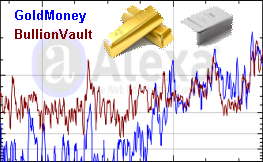
Compare AFE, BullionVault, GoldMoney: Comparative gold & silver holding charts as at 30 Dec 2011 and Alexa comparative traffic rank chart as at 01 Feb 2012.
Forecasts: All close ended PMs price action forecasts by industry leaders were off target! New ones are being tracked.
-
On the lighter side…
Endemic to the Galápagos Islands, these bright golden land iguanas (Conolophus subcristatus) are incredible friendly and approachable. If not for the 2-meter rule, you could easily reach out to touch them!
“When you own gold you’re fighting every central bank in the world”. Jim Rickards
To a great extend, that holds true for silver as well. This week, holders of Political Metals lost a battle, but certainly not the war. Measured against the USD, gold and silver are worth less compared to a week ago by 9.6% and 26.3% respectively.
It all started with Ben Bernanke’s statement, following the 2-day FOMC meeting, stating the obvious - that “there are significant downside risks to the economic outlook, including strains in global financial markets”. His antidote was a plan to purchase $400 billion of long-term Treasury bonds and to sell an equivalent amount of short-term debt. More commonly referred to as “Operation Twist 2″, this plan seeks to further reduce long term interest rates, after having pledged to hold short term rates practically at zero until 2013.
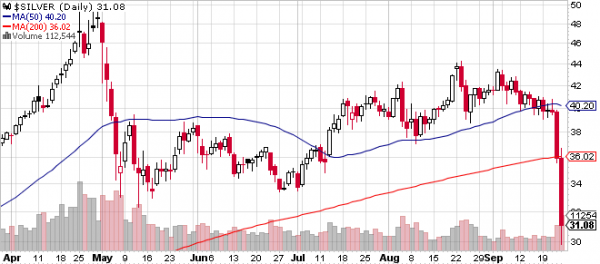
That announcement, made in the backdrop of the Eurozone debt crisis and news of slower growth in China, sent global stocks and commodity markets into a waterfall decline. This set up was ideal for the bullion banks who have massive gold and silver short positions. All they needed to do was to pull the trigger, and that’s exactly what they did on Thursday. Silver was pushed down sharply through its key 50 and 200 day moving averages, triggering an avalanche of tech funds selling the following day.
Going for the final kill of the week, news of yet another margin hike by CME (gold by 21%, silver by 16%) leaked into the market towards the end of Friday’s trading day. That further fuelled the selling, pushing silver briefly below $30 before closing at $31.08 - down 26.3% for the week.
In other markets this week, the Dow suffered its biggest loss since 2008. In four days U.S. stocks lost $1.1 trillion in value. The MSCI all-country world share index (tracking thousands of stocks from developed and emerging countries) recorded its second worst quarter in 23 years and the 30-year bond rates dropped 55bps - the biggest move since the 1987 Black Monday.
So there you have it, Dr. Ben Bernanke, bullion banks & CME working together in perfect harmony. I don’t believe for a moment that the resulting market turmoil was any surprise to Bernanke. Despite saying that gold is not money, he’s smarter than most people made him out to be. After all, he achieved an SAT score of 1590 out of 1600, graduated from Harvard and has a PhD in economics from MIT. Contrary to its statutory mandate of foster maximum employment and price stability, this market turmoil I believe is a piece of precision engineering to achieve some larger agenda. This round is yours, congratulations Ben!
This engineered global markets take down could be part of the deflationary phase that Mike Maloney talked about, which is a prelude to the hyper-inflation phase. They have to assist the bullion banks cover their shorts and bring the Political Metals price down to a lower base before starting the next round of QE or equivalent. Marc Faber told ThomsonReuters that “if the S&P drops to around 900-950, we’ll get QE3 for sure”.
Four ways to view the developments over the past week
If you’re reading this blog, you’re not a professional or a day trader, possibly someone already invested in gold or silver, someone holding some Political Metals (I distinguish between investing & holding here) or someone in the process of researching the matter. As non professional traders, we have to look through and not at the turmoil unfolding before us. All of the bloody carnage above are on “paper” or bits on silicon - illusionary financial derivatives of something tangible (like gold and silver) or derivatives of something totally virtual and non-physical (like interest rates, bonds, debts, CDS, etc). Real or imaginary, they are all derivatives backed by nothing more than a promise or lies of a third party.
Unfortunately, in so far as gold & silver is concerned, the outcome of the imaginary paper price wars above gets applied to the physical world. Price discovery currently comes from the paper derivatives market. Banks and multi billion dollar hedge funds throwing thousands of futures contracts or bets at each other (most of which are done through computerised High Frequency Trading algorithms) determine the price of the coin or bar you pick up at your local bullion dealers. Until such time when this absurd situation of the tail wagging the dog changes, I suggest 4 possible ways for you to view the developments over the past week, using silver as an example.
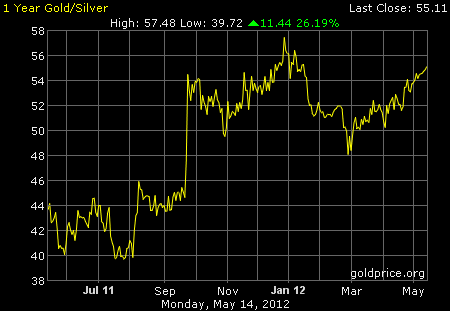
There’s a big difference between Investing(1) & Holding(2). If you adopt approach (1), and are smart enough to handle scenario (3), congratulations! Trading this dip or swapping silver for gold just before the GSR shot over 56 would have reaped a handsome return. After years of following newsletter writers, both paid and free, I came to the conclusion that attempting to achieve (3) is at best illusionary, and at worst risky. This is particularly true in a manipulated market. Take a look at some of the forecasts by well respected industry players here. Either they missed this week’s price action or are not telling us something. Richard Russell puts it this way:
I look at gold and silver, not as a play for profits, but as an accumulation of hard assets, in a world that it drowning in fiat money, and a world that will probably print trillions more of irredeemable paper.
Finally, if you’ve been waiting patiently (4) or have spare dry powder, congratulations! While the paper price of gold & silver gets whacked, physical demand is very strong. KWN reported that Sprott Money temporarily runs out of physical silver. So, get ready to pick up your discount. Not necessarily immediately, but then again, picking the absolute bottom can also be illusionary. Best industry advise is cost averaging.
Towards the end of Chris Powell’s speech at the 18th CLSA Investors’ Forum in Hong Kong, he addressed the all important question Why hasn’t gold kept up with inflation?
It’s because Western governments found ways of vastly increasing the supply of gold without having to go through the trouble of mining it — to dishoard and lease it from central bank reserves and to issue certificates of deposit against gold that never existed in the first place.
“Why” is supposed to be a basic question of journalism. But it has fallen out of financial journalism when it comes to gold, he lamented.
In recent years, and especially in recent months, I have spent much time explaining the gold price suppression scheme to leading financial journalists in the West. I have given them the documentation. Some of these journalists seemed interested. But none has ever reported anything about the issue. One writer who works for a major news agency in the United States was intrigued enough to call the Federal Reserve and ask about its gold swaps. She got a very telling “no comment.” But unfortunately she could not get her editor’s permission to write a gold story.
Frustrating as all this is, it is not too surprising. After all, who are the major advertisers in the Western financial news media and the major sources of financial news? The market manipulators and governments themselves. And journalists seem to take for granted that central banks operate in secret, particularly in regard to gold, so there’s no point in questioning them — even though central banking now determines the value of all capital, labor, goods, and services in the world, and does so in secret.
So here I am in Asia, which is a major victim of the gold price suppression scheme. Maybe there will be more curiosity and indignation about it here.
But Asia is not the only victim of this scheme. My own country may be the biggest victim. For this scheme has helped to corrupt the United States, destroying our once-free markets and the accountability of our government.
We in GATA do what we can, even though, from our beginning, we have wondered whether we could really presume to speak for gold. And not just for gold, of course — we are not idolaters — but for the economic and political liberty of individuals and the national sovereignty that gold serves and stands for. With gold always under attack precisely for what it represents, and with no others coming forward to defend it for what it represents, with even the gold mining industry’s main trade association refusing to acknowledge the attack, we have hoped that any presumption on our part might be forgiven.
We remain largely amateurs. At the outset we did not half understand what was going on and what we were setting about to do. Our name preserves that imperfect understanding. We thought we had discovered just another anti-trust violation. It was a while before we perceived that we were up against government policy and that most of what we were discovering had been discovered long ago, at least in principle, just not well taught, publicized, preserved, and made timely again.
Because it can work only through surreptitiousness and deceit, this government policy will be defeated when it is more widely understood — and every day it is being better understood, because it is getting so brazen. It was more brazen than ever the other day when Switzerland devalued its franc, the world’s leading “safe haven” currency, apparently leaving the “safe haven” field exclusively to gold. But just a few minutes before the Swiss franc’s devaluation was announced, unidentified sellers dumped thousands of gold futures contracts on markets around the world, causing the gold price to plunge along with the Swiss franc. These sellers plainly did not aim to make a profit from their gold holdings; if they had intended to make a profit, they would have sold gradually into the market. No, they meant to knock the price down hard, and they did.
These sellers almost surely were central banks. But as far as I could tell, no Western journalist has yet put a question to any central banker about that strange and counterintuitive action in the gold market.
I ask for your help in forcing an end to the gold price suppression scheme. I ask in the cause of giving individuals, nations, and all humanity a chance at democracy, liberty, and limited government with a neutral, fair, and impartial international currency that serves not just one government or another or one class or another but rather the whole brotherhood of man.
FRANKFURT — Europe appeared to be lurching toward a moment of decision in its sovereign debt crisis Sunday, as Greece struggled to meet conditions for additional aid amid rising German impatience with the cost.
Prime Minister George A. Papandreou of Greece canceled a planned trip to Washington to meet with his cabinet Sunday, in what looked like an increasingly desperate attempt to show foreign benefactors that the government can keep the promises it made in return for aid. Without the aid, the country would certainly default on its debt, an event that economists have warned could lead to bank failures in other countries and ignite another financial crisis.
“Greece’s imminent default is assured,” Carl B. Weinberg, chief economist at High Frequency Economics in Valhalla, New York, wrote in an e-mail Sunday. “Without an injection of cash within the next weeks, the nation will run out of resources to service its debt.”
Other analysts are less pessimistic, arguing that European leaders will do what is necessary to save Greece once they are confronted with the ugly ramifications of a default. These might include having to rescue banks, particularly in France and Germany, that have large holdings of Greek bonds, as well as putting even more acute pressure on other highly indebted euro zone countries like Italy and Spain. In the worst case, the euro could come apart, setting back the cause of European unity by decades.
When political leaders do the math, they may realize it is cheaper to save Greece than engineer a bank rescue only two years after the last round of bank bailouts, analysts said.
“You can stabilize the banking system and let the sovereign go through the roof, but that is not the most efficient way to do it,” said Guntram B. Wolff, deputy director of Bruegel, a research organization in Brussels.
Still, political leaders outside the euro zone have displayed concern that the European approach to the crisis lacks urgency. Timothy F. Geithner, the U.S. Treasury secretary, attended part of a meeting of European finance ministers on Friday and Saturday in Wroclaw, Poland. It is rare for a U.S. official to attend such a meeting, known as Ecofin, and it was Mr. Geithner’s first time.
“I can’t remember the last Ecofin meeting a U.S. Treasury secretary has attended,” said Nick Matthews, an economist at Royal Bank of Scotland. “It is a clear signal of how serious the sovereign debt crisis has become and an indication that it has gone beyond Europe and is threatening on a global dimension.”
The finance ministers failed to make substantial progress toward resolving the debt crisis or to make any pledge to recapitalize Europe’s banks.
… and here’s Andy Hoffman aka Ranting Andy’s take on this crisis
Ranting Andy Special: The Central Banks Can’t Win
RANTING ANDY – It’s another one of those days where I have too many thoughts in my head, making it hard to focus on just one. The pace of GLOBAL ECONOMIC COLLAPSE is accelerating too rapidly, to the point that at ANY GIVEN MINUTE of ANY GIVEN DAY the final death knell could sound, the commencement of the PANIC that CANNOT BE AVERTED by the stroke of a keyboard (i.e. printing electronic money).
Last Friday we entered the weekend with crashing stock markets (particularly BANKS, despite the best efforts of the PPT), surging gold prices (despite the typical, MASSIVE Cartel suppression tactics), and the prospect of an imminent Greek bond default. The Bank of Japan had just announced its most blatant (and in hindsight FAILED) attempt to devalue the yen, and the Swiss National Bank had just announced the UNTHINKABLE, an all-out currency devaluation in plain sight of the entire financial world.
That night, the G7 meeting (England, France, Germany, Italy, Japan, Canada, and the U.S.) concluded with a brief, ambiguous communiqué. I excerpted the key phrases below, which essentially said ‘WE WILL DO ANYTHING, LEGAL OR ILLEGAL, MORAL OR AMORAL, PRACTICAL OR IMPRACTICAL, SO SAVE THE STATUS QUO, IN WHICH WE, THE MOST WEALTHY, POWERFUL, CONNECTED A—HOLES ON EARTH RULE EVERYHING, STEAL EVERYTHING, AND DECIDE WHO LIVES AND DIES.’
Central Banks stand ready to provide liquidity to banks as required. We will take all necessary actions to ensure the resilience of banking systems and financial markets.
In other words:
‘CENTRAL BANKERS ARE ALL-POWERFUL GENIUSES WITH THE ABILITY TO MANIPULATE ANY AND ALL MARKETS INDEFINITELY SIMPLY BY PRINTING MONEY. IT DOESN’T MATTER THAT NOTHING WE HAVE SAID OR DONE HAS EVER WORKED, THAT SEVERAL OF US ARE VISIBLY BANKRUPT, OR THAT INFIGHTING THREATENS TO DESTROY OUR TREASONOUS UNION AT ANY SECOND. WE HAVE BEEN PRINTING DOLLARS, EUROS, YEN, POUNDS, AND FRANCS AT AN EXPONENTIAL RATE SINCE THE GLOBAL FINANCIAL CRISIS COMMENCED IN 2008, AND WILL CONTINUE TO DO SO, WITHOUT ANY PRETENSE IN THE SLIGHTEST, UNTIL THE MARKETS DO WHAT WE WANT.’
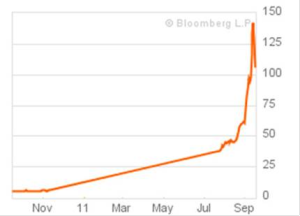
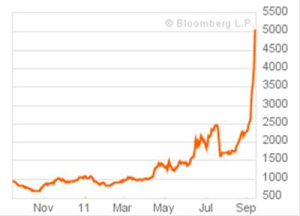
At that time, interest rates on Greek one-year debt had just passed 100%, while credit default swap spreads were, and still are, predicting a 98% chance of Greek default (tables below):
GREEK ONE-YEAR DEBT INTEREST RATE
GREEK CREDIT DEFAULT SWAPS (COST OF INSURING GREEK SOVEREIGN BONDS) – NOTICE IT CONTINUED TO RISE LAST WEEK!
But these banking geniuses, who cumulatively received $16 TRILLION OF OVERT AND COVERT BAILOUTS over the past three years from the Federal Reserve (ALL WITH FRESHLY-PRINTED DOLLARS), decided they could “save the day” once again if they just PRINT MORE MONEY, coupled of course with a MASSIVE, coordinated effort to SUPPORT BANK STOCKS and ATTACK GOLD AND SILVER PRICES.
Mike Maloney on RT discussing gold & silver manipulation, JP Morgan’s denial, “First government admission of price suppression” & High Frequency Sheering.
Ron Paul: Gold valuation & why there'll always be enough gold in a gold standard




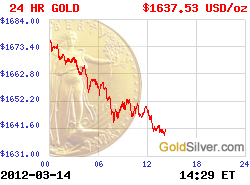
 More Charts: 1-Month, 1-Year, 5-Year, 10-Year
 More Charts: 1-Month, 1-Year, 5-Year, 10-Year