Archive

Posts Tagged ‘USD’

Gold Crash 2013 – Deliberately Engineered?

April 23, 2013 Leave a comment

By Bud Conrad | Casey Research Chief Economist

How can we explain gold dropping into the $1,300 level in less than a week?

Here are some of the factors:

  • George Soros cut his fund holdings in the biggest gold ETF by 55% in the fourth quarter of 2012.
  • He was not alone: the gold holdings of GLD have contracted all year, down about 12.2% at present.
  • On April 9, the FOMC minutes were leaked a day early and revealed that some members were discussing slowing the Fed $85 billion per month buying of Treasuries and MBS. If the money stimulus might not last as long as thought before, the “printing” may not cause as much dollar debasement.
  • On April 10, Goldman Sachs warned that gold could go lower and lowered its target price. It even recommended getting out of gold.
  • COT Reports showed a decrease in the bullishness of large speculators this year (much more on this technical point below).
  • The lackluster price movement since September 2011 fatigued some speculators and trend followers.
  • Cyprus was rumored to need to sell some 400 million euros’ worth of its gold to cover its bank bailouts. While small at only about 350,000 ounces, there was a fear that other weak European countries with too much debt and sizable gold holdings could be forced into the same action. Cyprus officials have denied the sale, so the question is still in debate, even though the market has already moved. Doug Casey believes that if weak European countries were forced to sell, the gold would mostly be absorbed by China and other sovereign Asian buyers, rather than flood the physical markets.

My opinion, looking at the list of items above, is that they are not big enough by themselves to have created such a large disruption in the gold market.

The Paper Gold Market

The paper gold market is best embodied in the futures exchanges. The prices we see quoted all day long moving up and down are taken from the latest trades of futures contracts. The CME (the old Chicago Mercantile Exchange) has a large flow of orders and provides the public with an indication of the price of gold.

The futures markets are special because very little physical commodity is exchanged; most of the trading is between buyers taking long positions against sellers taking short positions, with most contracts liquidated before final settlement and delivery. These contracts require very small amounts of margin – as little as 5% of the value of the commodity – to gain potentially large swings in the outcome of profit or loss. Thus, futures markets appear to be a speculator’s paradise. But the statistics show just the opposite: 90% of traders lose their shirts. The other 10% take all the profits from the losers. More on this below.

On April 13, there were big sell orders of 400 tonnes that moved the futures market lower. Once the futures market makes a big move like that, stops can be triggered, causing it to move even more on its own. It can become a panic, where markets react more to fear than fundamentals.

Having traded in futures for over two decades, I want to provide some detail on how these leveraged markets operate. It’s important to understand that the structure of the futures market allows brokers to sell positions if fluctuations cause customers to exceed their margin limits and they don’t immediately deposit more money to restore their margins. When a position goes against a trader, brokers can demand that funds be deposited within 24 hours (or even sooner at the broker’s discretion). If the funds don’t appear, the broker can sell the position and liquidate the speculator’s account. This structure can force prices to fall more than would be indicated by supply and demand fundamentals.

When I first signed up to trade futures, I was appalled at the powers the broker wrote into the contract, which included them having the power to immediately liquidate my positions at their discretion. I was also surprised at how little screening they did to ensure that I was good for whatever positions I put in place, considering the high levels of leverage they allowed me. Let me tell you that I had many cases where I was told to put up more margin or lose my positions. Those times resulted in me selling at the worst level because the market had gone against me.

The point of this is that once a market moves dramatically, there are usually stops taken out, positions liquidated, margin calls issued, and little guys like me get taken to the cleaners. Debates rage about the structure of the futures market, but my personal opinion is that a big hammer to the market by a well-heeled big player can force liquidations, increase losses, and push the momentum of the market much lower than the initial impetus would have. Thus, after a huge impact like we saw on April 13, the market will continue with enough momentum that a well-timed exit of a huge set of short positions can provide profits to the well-heeled market mover.

Moving from theory to practice, one of the most important things to keep your eye on is the Commitment of Traders (COT) report, which is issued every Friday. It details the long and the short positions of three categories of traders. The first category is called “commercials.” They are dealers in the physical precious metals – for example, gold miners. The second category is called “non-commercials.” They include hedge funds and large commercial banks like JP Morgan. Non-commercials are sometimes called “large speculators.” The rest are the small traders, called “non-reporting” since they are not required to identify themselves. The ones to watch are the large speculators (non-commercials), as they tend to move with the direction of the market. Individual entities could be long or short, but in combination the net position of the group is a key indicator.

The following chart shows the price of gold as a blue line at the top, and the next panel down shows the net position of these large speculators as a black line. You can see that over the long term, they move together. When the net speculative position is above zero, this group is betting on rising gold prices. Of course, the reverse is true when it’s below zero. In this 20-year view, the large speculators were holding net negative positions during the lowest point of the gold price, around the year 2000. As the price of gold rose, their positions went net long, and they profited.

An interesting thing about the chart above is that the increasing amount of net longs reversed itself before gold peaked in 2011, suggesting that these large speculators became slightly less bullish all the way back in 2010. The balance remains net long, but it remains to be seen how long that lasts.

What is not so obvious is that these large speculators are so big that they can affect the market as well as profit from it; when they initiate massive positions in a bull market, they drive the price of the futures contracts even higher. Similarly, when they remove their positions or actually go short, they can push the market lower.

So what happened a week ago was that a massive order to sell 400 tons of gold all at once hit the market. Within minutes the price plummeted, and over a two-day period resulted in the largest drop of the price for futures delivery of gold in 33 years: down $200 per ounce.

We don’t have the name of the entity that did this. However, the way the gold was sold all at once suggests that the goal was not to get the best price. An investor with a position of this size should have been smart enough to use sensible trading tactics, issuing much smaller sell orders over a period of time. This would avoid swamping the market; and some of the orders would be filled at higher prices and thus generate more profit. Placing a sell order big enough to affect the overall market price suggests that someone with powerful backing wanted to drive the price of gold down.

Such an entity could have been a large speculator who already had a sizable short position and could gain by unloading some of its short position once the market momentum had driven the price even yet lower. Or it could be a central bank – one that might be happy to have the gold price move lower, as it would provide cover for its printing of more new money. Of course, it could be some entity that owned long contracts and wanted to get out of the position all at once. We don’t know, but this kind of activity, resulting in the biggest drop in 30 years, raises more than just suspicion when we consider how important the price of gold is to many markets around the globe.

Can markets really be influenced by big players? Well, was the LIBOR rate accurately reported by huge banks? Have players ever tried to corner markets? The answer to all the above, unfortunately, is yes.

There’s an even bigger problem with the legal structure of the futures market: even the segregated funds on deposit can be pilfered by the broker for the brokerage’s other obligations. That is what happened to MF Global customers under Mr. Corzine. (I had an account with a predecessor company called Man Financial – the “MF” in the name. I also had an account with Refco, which is now defunct. Fortunately, the daggers did not hit my account, since I was not a holder when the catastrophes occurred.) My take: the futures market is dangerous, and not a place for beginners.

One last note: after the Bankruptcy Act of 2005, the regulations support the brokers, not the investors, when there are questions of legality about losses in individual investment accounts. Casey Research will be producing a report with much more detail on this subject in the near future.

So, what now? We aren’t going to see a secret memo – no smoking gun to confirm that what happened on April 13 was an attempt to affect the market. Still, the evidence is suspicious. When big entities can gain from putting on big positions, the incentives are big enough for them to try – LIBOR, Plunge Protection Team, Whale Trade, etc., all support this view.

The Physical Gold Market

Previously, there was little difference between the physical and paper markets for gold. Yes, there were premiums and delivery charges, but everybody regarded the futures market as the base quote. I believe this is changing; people don’t trust the paper market as they used to.

Instead of capitulating to fear of greater losses, the demand for physical gold has hit new records. The US Mint sold a record 63,500 ounces – a whopping 2 tonnes – of gold on April 17 alone, bringing the total sales for the month to 147,000 ounces; that’s more than the previous two months combined. Indian markets, which are more oriented to physical metal, now have a premium of US$150 over the futures price in Chicago. Demand at coin dealers has increased as the price has dropped. And premiums are much bigger than they were as recently as a week ago.

Here is a vendor page that quotes purchase prices and calculates the premiums on an ongoing basis. It shows premiums of 50% and more in many cases. On eBay, prices for one-ounce silver coins are $33 to $35, where the futures price is quoted as $23. A look on Friday April 19 showsone vendor out of stock on most items:

Buy – Sell On Silver Bullion
2013 Sealed Mint Boxes Of 1 Oz. Silver American Eagles - Brand New Coins
500 Coin Min.
(1 Sealed Box)
Buy @
Spot + $1.80
Sold Out
2013 Sealed Mint Boxes Of 1 Oz. Silver American Eagles “San Francisco Mint” Brand New Coins
500 Coin Min.
(1 Sealed Box)
Buy @
Spot + $2.00
Sold Out
90% Silver Coin Bags (Our Choice Dimes Or Quarters) $1,000 Face Value Figured at 715 Ozs Per $1,000 Face
$1,000 Face
Value Min.
We Buy @
Spot + $1.70
Per Oz (Spot
+ $1.70 X 715)
Spot + $4.99 Per Oz
(Spot + $4.99 X 715)
90% Silver Coin Bags 50¢ Half Dollars $1,000 Face Value We Ship in 2 $500 Face Bags
$1,000 Face
Value Min.
We Buy @
Spot + $1.90
Per Oz (Spot
+ $1.90 X 715)
Sold Out
90% Silver Coin Bags Walking Liberty Half Dollars $1,000 Face Value We Ship in 2 $500 Face Bags
$1,000 Face
Value Min.
We Buy @
Spot + $2.10 Per Oz (Spot
+ $2.10 X 715)
Sold Out
Amark 1 Oz. Silver Rounds ( Made By Sunshine ) Pure .999 BU
500 Coin Min.
Buy @
Spot -15c
Sold Out


Clearly, the physical gold market today is sending different signals than the paper market.

The Case for Gold Is Still with Us

The long-term fundamental reasons to hold gold are undeniably still with us. The central banks of the world are acting in concert in “currency wars” or “the race to debase.” As they print more money, the purchasing power of each unit declines. They are caught between the rock of having to keep interest rates low to support their governments’ huge deficits and the hard place of the long-term effect of diluting their currency. If rates rise, even First World governments will be forced to pay higher interest fees, leading to loss of confidence in their ability to pay back their debt, which will bring on a sovereign debt crisis like what we have seen in the PIIGS or Argentina recently.

The following chart shows the rapid growth in the balance sheets as a ratio to GDP for the three largest central banks. I’ve extrapolated the expected growth into the future based on the rate at which they propose to buy up assets. One could argue about how long these growth rates will continue, but the incentives are all there for all central banks to bail out their governments and their commercial banks. I fully expect the printing game to continue to provide the fuel for hard-asset investments like gold and silver to increase in price in the years to come.

(Click on image to enlarge)

Buying Opportunity or Time to Flee?

So what does it all mean? The paper price of gold crashed to $1,325 in the wake of this huge trade. It is now hovering around $1,400. My first reaction is to suggest that this is only an aberration, and that the fundamentals of the depreciating value of paper currencies will eventually take the price of gold much higher, making it a buying opportunity. But what I can’t predict is whether big players might again deliver short-term downturns to the market. The momentum in the futures market can make swings surprisingly larger than the fundamentals of currency valuation would suggest.

Traders will be looking for a significant turnaround to the upside in price before entering long positions. However, a long-term, fundamentals-based trader has to look at the low price as a buying opportunity. I can’t prove it, but I think the fundamentals will drive the long-term market more than these short-term events. The fight between pricing from the physical market for bullion and that from the “paper market” of futures is showing signs of discrimination and disagreement, as the physical market is booming, while prices set by futures are seemingly pressured to go nowhere.

In short, I think this is a strong buying opportunity.

We also advocate stashing a good chunk of your gold outside your home country. In fact, international diversification of all your wealth should be at the top of your to-do list this year. To help you get started, at 2 p.m. EDT on April 30, Casey Research is premiering a free web video event, Internationalizing Your Assets. It features some of the world’s top experts on internationalization, including Casey Research Chairman Doug Casey, Euro Pacific Capital CEO Peter Schiff, and World Money Analyst Editor Kevin Brekke. Together they will reveal how they personally protect their assets abroad – and how you can, too. Registration is free.

 More at Casey Research

The Money-ness of Bitcoins: A Rebuttal

April 5, 2013 1 comment

It’s refreshing to read a level-headed piece on BitCoins by Nikolay Gertchev, an economist with the European Commission, posted at the Ludwig von Mises Institute site. While I do not agree with the conclusion, at least it’s not one of those irrational and uninformed dismissal of BitCoin frequently coming from “gold & silver bugs”. The latest round of “BitCoin Bashing” was by Michael Pento on CNBC. His comments were so ridiculous that it drew this response from Trace Mayer - ”Why Michael Pento Should Just Keep His Mouth Shut“.

-

Mises Daily: Thursday, April 04, 2013 by 

The Money-ness of BitCoin

Bitcoins have been much in the news lately. Against the background of renewed concerns about the integrity of the euro zone and the imposition of capital controls in Cyprus, the price of a bitcoin has tripled over the last month and reached more than $141 for 1 BTC. Are we witnessing the spontaneous emergence of an alternative virtual medium of exchange, as some would put it? This article offers an answer to this question by considering three aspects of the economy of bitcoins: their production process, their demand factors, and their capacity to compete with physical media of exchange. > Read full article

-
While Nikolay stated that BitCoin satisfies the Misesian regression criterion for the free-market inception of a medium of exchange, he went on to state that BitCoin suffers from the disadvantages of limited demand and dependence on technology.

Here’s my 2 BTCs worth.

(1) Limited demand

Without the certainty that they can be transacted for any other good in the economy, a demand to hold them as money could not develop. It is with respect to their capacity to become and remain commonly used that bitcoins suffer from a relative disadvantage.

Buy a TV with BitCoinsCertainly true, but one has to bear in mind that the first BitCoin came into existence only in January 2009. It was not until February and April 2011 that it caught the attention of the social and mainstream media respectively. In a short span of 2 years, it’s market capitalization has grown from US$1 million to US$1 billion.

The first time BitCoin was used as a medium of exchange took place in May 2010 (A pizza was sold for 10,000 BTC). Today, you can buy this 32″ TV for 2.77 BTC. Visit the BitCoinStore and be amazed at what you can buy with your BitCoins.

BitPay, the leading BitCoin Payment Service Provider processed over $5.2 million in BitCoin transactions for its merchants during the month of March, signing up over 1,300 new merchants in that month alone. And it goes beyond electronics and consumer goods right into the heart of government services.

During March, BitPay’s bitcoin payment tools have also been integrated into E-GovLink, a billing system used by local governments, and FoxyCart, a popular SaaS cloud-hosted shopping cart service. Any company or organization using E-GovLink or FoxyCart can now add a bitcoin payment option to their business.

On the investment front, we see evidence of extremely high demand not just from the price action but also from the activity at the world’s largest BitCoin exchange, MtGox. Have a look at some numbers mentioned in their press release yesterday

Last year, Mt.Gox saw an average of 9,000 to 10,000 new accounts created every month. This number doubled in January, tripled in February, and sextupled in March. In this month alone (March), over 57,000 new accounts were created!

With this rapid rate of adoption, it won’t be long before “limited demand” for BitCoins becomes a non-issue.

(2) Dependence on technology

The key point, however, is that bitcoins could become a generalized medium of exchange only through the accessory use of other, specific and physical, goods in an economy that has reached a very high level of technological development.

In trying to understand whether the increased popularity of bitcoins is reflecting the emergence of a new money, we have actually come to a fundamental distinction between virtual and material media of exchange. The latter are technology-independent and matter-embodied; the former are technology-embodied and matter independent.

The author seems very concerned over the fact that this emerging BitCoin “virtual currency” is very dependent on technology, concluding his essay with this emphatic statement:

 Thus, on the free market, commodity monies, and presumably gold and silver, still have a great comparative advantage.

What’s referred to as “commodity monies”, is non existent today. Prior to WW2, nation states issued national currencies, some of which were pegged to a commodity (eg. gold) at varying ratios while others were not. Since the Bretton Woods Agreement in 1944, national currencies were no longer pegged to gold directly. Instead, they were pegged to gold through the USD, which was then directly pegged to gold. Nations holding US dollars could redeem them for gold at a fixed exchange rate. Since Nixon’s closing of the gold window in 1971,  the peg was broken. The dollar and hence all other national currencies in existence today are not backed by nor redeemable for gold or any commodity.

Let’s assume for the sake of argument that the gold window has not been closed, hence all currencies in existence globally are still commodity monies indirectly backed by gold. Let’s call our existing currencies “real currencies” as opposed to BitCoin, referred to as a “virtual currency”.

The argument that real currencies have an advantage over virtual currencies because “the latter are technology-embodied and matter-independent while the former are technology-independent and matter-embodied” makes no sense in our present day and age. The “mater-embodied” or physical nature of money matters only if it is mainly exchanged or transmitted physically, like in the days of old. Today’s real currencies are far from being “mater-embodied”. Consider the following two usage of real currencies, one on a micro level and the other on the macro.

On the last day of each month, you receive your salary via a series of numbers in your account at your employer’s computer. From there a substantial chunk is deducted and sent to the government as taxes; another portion deducted and sent to a pension fund, and the list goes on until a substantially smaller number appears in the computer of your bank. From there, more money automatically disappears from your account through auto debits to pay your mortgage, utility bills, credit cards, etc. As you rush home to use your Internet banking facilities to do a wire transfer your hard earned money to your son studying on the other side of the globe, more money is electronically taken out of a device in your vehicle whenever you drive past a toll both. Where and when does an average Joe sees or gets to use the money earned in its  ”mater-embodied” form??

Moving to the macro level, we find that reliance on the “technology-embodied” form of real currencies is several orders of magnitude greater than the reliance on it’s “mater-embodied” form.  The blue portion of the chart shows that M0, the money aggregate representing physical coins and notes, makes up only a tiny percentage of M3, which is the total currency in circulation comprising M0 and all other electronic representations of money. This chart goes up to 2007. The money printing after the 2008 crisis makes the current ratio even more extreme.

Virtually all of the trillions of dollars in global currency supply is being traded and moved around the globe “through the accessory use of other, specific and physical, goods”, that is, electronically via the modern banking system.

Gold-backed or otherwise, existing real currencies, or any new form of centrally issued currency (IMF’s SDR, etc) – none can ever be used widely in their “mater-embodied” form. Unless our civilization returns to the stone age, our currencies have, are and will increasingly be ”technology-embodied”.

BitCoin is the first and currently most widely adopted form of a new generation of currencies known as crypto-currencies. BitCoin may or may not succeed as a major currency of the future; but one of the many competing crypto-currencies (LiteCoin, NameCoin, PPCoin, etc) or some other yet to be developed crypto-currencies will certainly have a great competitive advantage over existing currencies.

All existing ”mater-embodied” forms of currencies have for all purposes and intent become ”technology-embodied” or electronic. Only difference being their technology is far inferior to that of crypto-currencies, of which BitCoin is currently the leader.

-

Related Articles:

Other Resources:

Will BitCoin Reach Parity With Gold?

March 28, 2013 Leave a comment
Chart_aAfter following its development for some time, I first wrote about BitCoins in June 2011 when it was trading around US$5 (New Digital Currency backed by nothing outperforming all other fiat currencies). I highlighted it again when it reached parity with silver in Feb this year.
-
As it approaches the US$100 level, and given its 500% rise over 3 months, one cannot help but ask if it’s another bubble about to burst.
-
Having recently breached parity with silver since its humble beginnings in January 2009, the next question would be if it’ll ever reach parity with gold; or will humanity’s first serious attempt at using a decentralized, peer-to-peer, non-political, censorship-resistant crypto-currency go the way of all fiat currencies – back to their intrinsic value of zero.
-
Before I attempt to answer these two questions, let us fly high above to take a bird’s eye view of the development of this emerging digital currency that has entered the cross hairs of the CIA, Fed, ECB and Wall Street. We’ll do that by breaking up its history into 3 cycles.
-
BitCoin's 3 cycles
-
Cycle 1 (1 Sep 2010 to 5 Apr 2011)
-
Back in May 2010 the first pizza sold in BitCoins (BTC) set the buyer back by 10,000 BTC (US$910,000 at current price). That was also the first real transaction made with the new currency. Subsequently, BitCoin climbed steadily from $0.06 to a high of $1.10 (that’s over 1,800% in six months).  Like all other markets, BitCoin underwent a correction (47%) from its all time high over a period of about 2 months. Since we can’t really see this spike in the chart above, we’ll zoom into that period in the chart below.
-
BitCoin_ Cycle 1
-
-
-
Milestones that may have caused the surge during this cycle
-
  • 6 Nov 2010
    Market capitalization reached US$1 million, indicating that real cash was flowing into this experimental digital currency
  • 9 Feb 2011
    BTC reached parity with US Dollar.  Social media (Slashdot, Twitter) picked up on the BTC/USD parity news, propelling it to an all time high.
  • 14 Feb 2011
    First vehicle was offered for sale in BitCoins
As we stare at Chart A in awe, amazed at it’s exponential rise, remember that it’s not the first time BTC is doing this. Looking at Chart B may lead us to think that it’s the second time, but Chart C just negated that idea. The current surge is so much larger than the second, which in turn is gigantic compared to the first; so much so that the first exponential surge described in cycle 1 above  is no longer visible in Chart B. If this trend continues, the current cycle will disappear like the first when looking at a long term chart several years down the road. Scary thought!?

English: Total Bitcoin supply over time. Start...

Let’s take a short detour to discuss how new BitCoins come into existence. It is one of the keys to understanding the price explosion in cycles 2 and 3. The BitCoin network runs an algorithm that generates new BitCoins over a period of about 130 years, up to a maximum of ~21 million BitCoins, with increasing difficulty (decreasing rate) over time as shown in the chart on the right.. The current rate is about 25 BitCoins every six minutes, with almost 11 million BitCoins already in circulation.

Unlike fiat currencies that are created out of thin air with a stroke on a keyboard by commercial and central banks, new BitCoins are created through a “proof of work” software process known as “mining“, not unlike the physical mining of gold and silver.  As the difficulty of mining new coins increases, so does the cost (view profitability calculator). This  is one of the factors that drive the price of existing BitCoins.
-
Cycle 2 (5 Apr 2011 to 17 Nov 2011)
-
April 2011 saw BitCoin rolling out of the laboratory into the real world. By this time, you could purchase a second hand car for 3,000 BTC, way less than the 10,000 needed to buy a pizza less than a year ago! Meanwhile, new exchanges popped up, and new currency pairs came into being (BTC/GBP, BTC/EUR, BTC/BRL, etc).
-
With all this attention and new found fame, BitCoin finally caught the attention of the mainstream media when it was featured in a TIME magazine article in April, the same month BTC reached parity with the Euro and British Pound. Market capitalization surged to US$10 million – a ten fold increase over 4 months.
-
Increasing demand due to greater publicity and demonstration of its utility as a currency in real life began to create new demand, pushing up the BTC price. Higher BTC prices translated into greater profitability for miners. Like the Gold Rush, miners began plugging their computing machines into the network. As that happened, the the mathematics behind the algorithm running the BitCoin network did what it was designed to do – it automatically increased the difficulty of mining, which surpassed 100,000 for the first time on 30 April 2011.  The overall increase in the network’s computing power, also known as Hashrate, resulted in increased stability and security of the BitCoin currency, driving up confidence which boosted demand.
-
This cycle fed on itself, pushing the price to its all time high of US$31.90 on 8 June 2011 – a stellar  5,500% increase from its low less than 2 months ago. Market capitalization was $206 million.
-
BitCoin: Cycle 2
-
Confidence was the name of the game. Confidence that the experimental currency was secure, safe and stable. The BitCoin community was euphoric. Finally, we have an electronic currency free from the reigns of central bankers and governments. It was accepted worldwide and could be transferred directly from one person to another instantly at virtually no cost.
-
Unfortunately or fortunately, depending on how you look at it, that euphoria bubble burst. Within days, BitCoins lost half its value. Thereafter, it continued its slide over the next 5 months to a low of US$1.99 in Nov-2011. A loss of 94% from its June peak.
-
Why?? While the game of confidence took time to build up, it was shattered in a heartbeat due to two consecutive events triggering within 10 days of its all time high.
-
  • 13 June 2011 – BitCoin theft
    A user claimed to have had 25,000 BTC stolen from his Bitcoin wallet (approx. USD equivalent $375,000)
  • 19 June 2011 – BitCoin Exchange hacked
    MtGox, the largest BTC exchange was hacked. Sixty thousand user accounts were stolen, and the hacker issued orders to sell hundreds of thousands of stolen BitCoins briefly driving the price from $17.51 per to $0.01. MtGox halted trading for a week to review their security and reversed the bogus trades.

-
That was BitCoins equivalent of the now famous Wall Street flash-crashes. One would think that a fiasco of this nature and magnitude would put the final nail in the coffin of BitCoin’s young, fragile and experimental economy.
-
Not so. Good sense prevailed. As the reality of the events sank in, BitCoin adherents and bystanders alike realized that the flash crash was a result of failures on the part of BitCoin users rather than BitCoin itself. Would a robbery resulting in the theft of your cash or precious metals damage the value or utility of the stolen goods? Would a break-in at your local bank put a dent on your confidence in the currency?

Certainly not. In five short months, BitCoin started its climb again from a low of  US$1.99 on 17-Nov 2011. That brings us to the third and current cycle.

-

Cycle 3 (17 Nov 2011 to present)
-
Another BitCoin theft involving 50,000 BTC (twice the amount in the previous theft) was reported, due to a  security breach at a web host. This time around, there was no knee jerk reaction. The price did not budge. The community has become wiser. BitCoin is like physical cash. You are careless storing it, you lose it. It’s no one’s fault, certainly not the currency itself.
-
For the first 14 months of this present cycle, nothing exciting happened, exchange rate wise. However, significant developments were taking place in the background that laid the foundations for the explosive surge as shown in Chart E below. During this period of consolidation, BTC firmed gradually against fiat currencies as its underlying infrastructure developed and the BitCoin economy continued to grow.
-
GoldMoney discusses the future of BitCoins with Jon Matonis of the Bitcoin Foundation. Can bitcoin compete with government currencies?More and more online merchants began accepting BitCoins. By now, BitPay, the premier BitCoin payment gateway services has signed up over 1,000 merchants, supporting up to 16 national currencies. You could buy virtually any consumer electronics & hardware at BitCoin Store. Besides pizzas and used cars, you could now trade in your BitCoins for gold & silver bullion! Yes, they’re good as gold! Not to be left behind, GoldMoney asked, through their annual customers survey, if we would like to buy PMs with BitCoins or to store our BitCoin wallets at GoldMoney much the same way we do with our PMs.
-
When it comes to escaping from the tyrannical reins of the powers that be (central planners and bankers), BitCoin truly shone. As a non government-issued and non banker-controlled currency, BitCoin saw rapid adoption by freedom fighter organizations. Banned from receiving donations through PayPal, Forbes reported that WikiLeaks asked for anonymous Bitcoin donations in June 2011. Soon after, Wikipedia, WordPress and GATA, among may other organizations began accepting BitCoins as donations or payments.
-
Another milestone for the BitCoin community was achieved in December 2011 when Paymium, a French-registered company announced that their exchange, Bitcoin-Central, became the first exchange licensed to operate with a bank. Not that we actually needed it, but having a foot in or a link with the regulatory world helps in giving BitCoin legitimacy in the eyes of some. Put another way, this link enables big boys with big (fiat) money to participate in the BitCoin economy as it gives them direct access to the banking networks which will “let us 100% automate all incoming and outgoing transfers”.  It should be noted that this is a bottom up rather than a top down approach to BitCoin’s participation in the world of regulated finance. Paymium voluntarily seek to create that link rather than being forced by regulators.
-
As publicity and confidence in BitCoin grew, it entered the radar screens of bankers and regulators. In the later part of the cycle 2, Gavin the lead BitCoin developer was invited to make a presentation at an emerging technologies conference for the US intelligence community at the CIA headquarters. Later that year, the European Central Bank commissioned a study on Virtual Currency Schemes and published a 54 page paper (pdf download) in October 2011.  BitCoin was clearly the focus of that study.
-
On the technical side, a major milestone kicked in on 28 November 2011 (Halving Day) when the BitCoin network halved the reward for miners. That was a pre-determined event, coded into the algorithm and was transparently executed. The implication was, the cost of mining a BitCoin doubled from that point in time. As how a truly free and open economy would operate, the BitCoin technopreneurs were already hard at work preparing for this event. Two months into the “high cost mining era” a new generation mining hardware known as the ASIC Rig hit the market and was soon plugged into the network.
-
As explained in cycle 1 above, the increase in mining difficulty over time created a feedback loop that resulted in increased price. The Halving Day compounded the impact of this feedback effect. If you’re still having difficulty appreciating the significance of the 28 November event, consider what would happen if the cost of copper or gold mining doubled overnight?
-
I had to walk you through the developments preceding the sharp surge in the price of BitCoin beginning February 2013 so that you’ll understand and appreciate the reasons behind that surge, which we’ll discuss below. It is not hype, as some would like to have you believe. There are even proponents of gold & silver who, due to business interests, have deliberately chosen to turn a blind eye on the merits of this emerging currency. There’s even a “silver bug” calling it a ponzi scheme.
-
BitCoin Chart: Cycle 3
-
Now to the exciting part. From its consolidated base of about $13 at the beginning of this year, it has surged to $92 (at time of writing), clocking in a 700% gain in the first quarter. Here’s a summary of events that triggered this price melt up. In and by themselves, they could not have possibly caused the surge. However, when viewed with the backdrop described in the preceding paragraphs, the sharp rise begins to make more sense.
-
  • Feb 13:
    CoinLab became the first BitCoin startup to receive Venture Capital investment amounting to $500,000.  CoinLab enables U.S. and Canadian investors to do large block trades of Bitcoins and keep them ultra-secure from loss. In short, bring in the big money to the BitCoin economy.
  • Feb 28:
    Previous all time high ($31.91) set 601 days ago was broken. This is a chartist’s dream. Resistance level cleared.
  • March 6:
    BitPay integrates Bitcoin with Fulfillment by Amazon.com’s (FBA) web service. BitCoin’s eCommerce has gone mainstream.
  • March 16:
    Following the Cyprus crisis and extended bank holidays, well informed Cypriots rushed to BitCoins. As an incentive to swap fiat for BTCs, Bitcoin-Central offered 0% trading fees for first 2 deposits of new account holders who are Cyprus citizens. Another first – the first BitCoin ATM was announced in Cyprus!
  • March 17:
    Forums encouraged/helped others to do the same
  • March 18:
    Cyprus fears spread to other Euro nations. Bitcoin apps soar in Spain!
  • March 26:
    BBC Newsnight featured BitCoins in the wake of the Cyprus crisis.


What next?

BitCoin's rise and fall. All time Highs and correctionsThe table on the right summarizes the gains for each cycle together with the duration from their lows to the peak. Cycle 3 is at its all time high at time of writing. To see how the current cycle compares with previous cycles, let’s visualize the table above by comparing Chart B, which was plotted on a linear scale, with its equivalent plotted on a logarithmic scale.

BitCoin Price Chart: Log Scale showing exponential surge

A logarithmic plot allows us to compare the exponential rise in each of the cycles. It also exposes other sub-cycles (1A, 1B) that are not visible in the linear plot.  This plot clearly reveals that BitCoin has survived 5 previous exponential rise events, and that the current surge (3C) is no where as steep as the major surge in Cycle 2.

Conclusions

BitCoin has experienced 3 major price melt-ups, followed by 2 major corrections, with an overall steep uptrend. Two positive feedback loops, commercial and technical, worked hand in hand to drive up the prices.

Commercial positive feedback loop
Increasing publicity and adoption created greater demand which drove up the price. The rise in price in turn attracted more miners into the network, which has the effect of strengthening the security and stability of the currency, resulting in greater confidence and demand. To add fuel to fire, the never ending financial crisis caused a loss of confidence in centrally controlled national or regional currencies and places the spot light on BitCoin’s unique advantages as a currency of choice, especially in the Internet era.

Technical positive feedback loop
BitCoin’s network senses increase in computing power and automatically adjusts to increase the mining difficulty. This drives innovation to develop machines with more computing power (we’re into the 4th generation of mining hardware – CPU>FPGA>GPU>ASIC), feeding into itself to create an ever more robust crypto-currency with the passage of time.

On the flip side, BitCoin has experienced one major correction (cycle 1) and one major crash (cycle 2).  Cycle 1′s correction of 47% after a rise of 688% does not seem to have any specific trigger, and can be attributed to market forces in a free economy. Cycle 2′s 94% crash after a 5,500% rise can be attributed to a panic leading to a temporary loss of confidence due to the first major reported theft and a security breach at the largest BTC exchange, both occurring within days of each other.

Within a relatively short period of time, BitCoin recovered from the temporary loss of confidence and more, leading to the current all time high.

Finally, I’ll have the basis to answer the two questions.

Is BitCoin a bubble that’s about to pop?
No. An imminent correction due to normal market forces – certainly. A crash similar to magnitude of Cycle 2 – not likely. It appears to have reached some form of critical mass (network computing power and mass adoption) to withstand serious challenges.

BitCoin: Forked Chain panicThe most likely trigger for a flash-crash kind of event would be the discovery of a major flaw or bug in the BitCoin protocol. In fact we came quite close to that on March 12, when BitCoin’s distributed database (the core of BitCoin) ran into some problems, technically known as a Forked Chain. Think of it as a serious genetic mutation, which could bring down an organism, in this case the entire BitCoin currency. BTC dropped 25% over a few hours.

The fact that BitCoin is an open-source project saved the day. The unique combination of Centralized Leadership without Centralized Authority resulted in a very speedy resolution. Within hours, everything was back to normal.

After this demonstration of the resilience of the project, confidence built up rapidly. I for one was extremely impressed with the way that event was resolved.

Will BitCoin reach parity with gold?
Yes. “When?” would be a better question. If BitCoin is not about to collapse under its own weight due to technical reasons, I think it will continue to gain traction to to achieve its next price target – a hundred dollar price handle, which is just a few dollars away at time of writing. Once you’re in the psychological hundred dollar region, it’s just a matter of time before it catches up with gold. Corrections and consolidations are to be expected as part of the journey to parity with gold.

In fact, Chart A above should be what the gold and silver chart should look like in the absence of central planners’ price manipulation. If you don’t like that conspiracy sounding word, replace it with price management/ price control, and you get the picture. After all, they are political metals.

-

Updates:

An imminent correction indeed kicked in starting April 12, and rather violently too! Here’s an excellent analysis of what happened and what to expect going forward. The journey towards gold parity continues…

Other Resources:

Graphics from Bloomberg BusinessWeek

World Gold Council Report: Median Optimal Allocation in Gold is 8% of Reserve Assets

March 15, 2013 Leave a comment

Reproduced below is the summary of a recent study published by the World Gold Council “Central bank diversification strategies – rebalancing from the dollar and the euro“.

As central banks look to reduce dollar and euro exposure, traditional reserve assets such as gold can play an important role alongside alternatives such as Chinese, Canadian, Australian, Swiss, and Danish denominated assets.

Chinese assets, gold, and Australian treasuries emerge as the most important assets for diversification when conducting a portfolio optimisation exercise focused on optimising Alternative assets outside the US dollar and euro. However, when market size and access constraints are considered, gold emerges as the dominant asset for diversification with a median optimal allocation of 8% in US dollar terms.

Overall, the study concludes that gold, with its lack of credit risk and highly liquid markets, is one of the most attractive alternatives in this diversification process. The study results suggest it would be prudent for reserve managers to build gold reserves alongside Alternative reserves, as Alternative markets need time to develop and allocations to gold remain largely below optimal levels.

Download full report here

Global assets allocation in gold

What would be the impact on gold price when global reserves managers  increase their reserve assets allocation in gold from current level of 1% to 8%? The chart below might offer some clues.

Perspective: The BIG Picture
Mouse over each bar for details. Click on bars for data source.

-

BitCoin at Parity with Silver!

February 21, 2013 Leave a comment

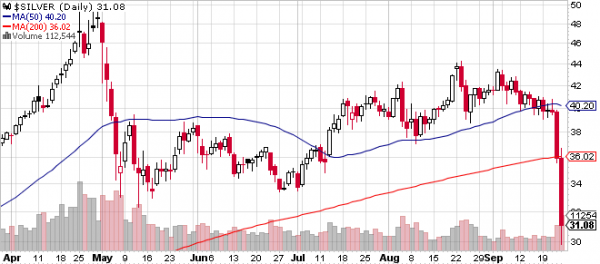
As gold & silver underwent another series of waterfall declines over the past 5 trading days, a historical event took place today. BitCoin, the world’s premiere crypto-currency reached parity with silver priced in the world’s reserved fiat currency. While BitCoin was trading around US$29.50, silver was smashed through that level a few hours ago to close the day at US$28.55.

Silver in US$ BitCoin in US$
     silver_btc1    btc_silver1

-

Many holders of physical gold & silver do so because of their distrust and disdain in the current monetary system, where national currencies are centrally issued, controlled, manipulated and debased at will.

Of late, a small but gradually increasing number gold & silver investors have begun to embrace BitCoin as an alternative currency because of its decentralized, peer-to-peer, politically-neutral, censorship-resistant and anonymous nature.

PoliticalMetals support BitCoin as an alternative currency, and has been tracking its performance against gold & silver for some time.
See chart of their relative performance over the past year.

View BitCoin live chart here or visit BitCoin.org for more info.

Caution:
While BitCoin is an exciting emerging digital currency, owning it entails a lot more risk compared to other assets, including PMs. Perform your due diligence, and don’t risk anything you cannot afford to lose. For the technically incline, the paper entitled Quantitative Analysis of the Full Bitcoin by Dorit Ron and Adi Shamir, The Weizmann Institute of Science, Israel, may be of interest.

Gold Vs BitCoin

Further Reading:
During 2012 Fiat Currencies And Gold Collapse Against Bitcoin

Since its inception in 2009, BitCoin has outperformed gold every year, while gold outperformed major currencies almost every year over the past 12 years.

-

Follow

Get every new post delivered to your Inbox.

Join 246 other followers

%d bloggers like this: