Archive

Posts Tagged ‘Volatility’

JP Morgan Chase for Dummies

May 11, 2012 Leave a comment

-

Breaking News:

JP Morgan sent out a notice at 4:30 p.m. that it would be holding a conference call at 5 p.m. which will include CEO James Dimon.

At the conference call, as reported by WSJ, Jamie announced that the the largest US bank has “taken $2 billion in trading losses in the past six weeks and could face an additional $1 billion in second-quarter losses due to market volatility”.

Here’s a Dummy trying to make sense of Wallstreet speak.

The losses stemmed from derivatives bets gone wrong in the bank’s Chief Investment Office, a part of the corporate branch of the bank that manages risk… Jamie announced.

So they lost $2 billion in 6 weeks and possibly another $1 billion over the next month. But what exactly are these derivative bets? Isn’t betting associated with gambling? Did the largest bank in the US take some of their bailout money, went gambling and now calling a press conference to announce their losses?

Mr. Dimon said the so-called synthetic hedge, using insurance-like contracts known as credit-default swaps, was “poorly executed” and “poorly monitored.” He said the bank has an extensive review underway of what went wrong, and that there were “many errors,” “sloppiness” and “bad judgment” on the bank’s part.

Ah… it’s not gambling, it’s actually a “synthetic hedge”. But I don’t even understand what’s a hedge, never mind the difference between synthetic and real! All I know up to this point is they lost big time through derivatives bets, which is a synthetic hedge, also known as credit-default-swaps. That’s quite a mouthful for a mere mortal.

What then are these credit-default swaps?

I know what’s a swap. You give me something, I give you another. But they’re  swapping “credit-default” for something else? That sounds like a weird thing to be swapping. Fortunately I have good ole Wikipedia to the rescue:

A credit default swap (CDS) is a financial swap agreement that the seller of the CDS will compensate the buyer in the event of a loan default or other credit event. The buyer of the CDS makes a series of payments (the CDS “fee” or “spread”) to the seller and, in exchange, receives a payoff if the loan defaults.

Oh, how could I have missed something so obvious! Didn’t Mr. Dimon say it’s an “insurance-like” contract? Now I get it, so I’ll just call it an insurance. JP Morgan sells insurance and receives an insurance premium. It works something like this: You lend me money, then buy an insurance policy from JPM saying that if I fail to repay your loan when it becomes due, they will pay you for the sum insured.

But insurance companies do payouts all the time. What’s the big deal? Then I recall that when there’s a major disaster - like the recent Christchurch earthquake, the payout was so big that AMI, the insurer, went under and had to be bailed out by the government to the tune of NZ$1 billion.

Now it begins to make sense why the conference call was made in such a haste. I recall that Greece defaulted in their debt triggering a payout around a figure of $3.5 billion, and I know JP Morgan is one of the major insurers and major holders of other types of “insurance contracts” collectively known as OTC Derivatives.

But how big exactly is JPM’s potential liability to these kinds of bets?

According to the Bank of International Settlements (BIS), which is the Central Bank of all national Central Banks, the total outstanding OTC Derivatives is $708 Trillion. Of this total notional amount,

  • 67% are interest rate contracts,
  • 8% are credit default swaps (CDS), 
  • 9% are foreign exchange contracts,
  • 2% are commodity contracts,
  • 1% are equity contracts, and
  • 12% are others.

Since CDS makes up only 8% of the total OTC Derivatives, and a relatively minor default by Greece caused such a significant loss for JPM, imagine what will happen to JPM and the likes of JPM when the other PIGS countries ( Portugal, Italy, Greece and Spain) actually go into default. Also imagine what will happen when the interest rate contracts, comprising the bulk of OTC Derivatives actually triggered?

There must be good reasons why derivatives are referred to as Financial Weapons of Mass Destruction (WMD).  Trying to time the explosion or implosion of this WMD is futile. Preparing for its consequences is vital. Take a look at the chart below, and see if you can spot where in this crazy world of finance is the safest place to be.

Mouse over each bar for details. Click to read data source

JP Morgan CDS OTC Derivatives

Updates:

-

Malaysian gold & silver buyers, look at what your US peers are doing.

March 30, 2012 Leave a comment

-

Shortly after BuySilverMalaysia.com launched its webstore on Feb 2, I learnt from its proprietor that he has received numerous emails asking if he would offer buyback as part of the service. “It seems like Malaysians’ concern is about selling back their silver”, he lamented. You’ll notice that it is one of only two dealers amongst those reviewed here without a buyback service.

This is one of the tell-tale signs that many Malaysians who have recently caught wind of the gold & silver story are erroneously looking at gold & silver as speculative investments. They are interested in making a quick buck by buying these metals with the hope of selling them back to their dealers when prices move up in short order.LowYat forum discussing gold & silver Some are even excited about gold or silver savings accounts offered by various banks and are happy to invest in paper gold or silver. To get an idea of the general sentiment, check out some lively threads at the Lowyat forum (start here, here or here).

Meanwhile, over in the US, it has been reported that bullion dealers who’ve been serving their customers for decades see very little buybacks. Their long term customers have been accumulating these metals, buying when prices are rising and buying even more when there’s a price dip. How is that so?

In a recent interview by SGTreport, Andy Hoffman of Miles Franklin said:

There are no buy-backs. Customers are not selling anything. They haven’t been selling any gold & silver back to Miles Franklin or any of our competitors for years, and they’re never going to. So don’t ever ever think that when you see a big smash in gold or silver that it’s people selling. It has nothing to do with it. It is the gold cartel naked shorting paper, and it’s only a matter of time before they completely and uterly are destroyed as they were in 1968 with the London Gold Pool, and as they have been every single time in history when they attempt to subvert the forces of real money with paper.

You’re not even investing, you’re just owning real money… and you’re doing it for defense. We’re here to protect ourselves.

People should not think of silver & gold as investments. They are savings.

There you have it. They buy gold & silver for different reasons. Not for speculation. Not even as an investment. They buy whenever they wanted to convert their savings from one form of money into another. It is like someone having more confidence in the SGD than RM looking for opportunities to buy more SGD whenever exchange rates are favorable. They buy and hold gold and silver as savings because they know that these monetary metals store value (retain purchasing power) much better than paper currencies. Most importantly, they own gold & silver fully aware that these are political metals, whose prices are actively managed or manipulated by central banks.

[Note: It may appear from the paragraph above that Americans are astute investors or savers. Far from it. Retail ownership of gold & silver on a per capita basis is much higher in India and many Asian countries than in the US. The "they" refers to a very tiny group of well informed Americans who understand gold & silver for what they are.]

For a better understanding of the issues discussed above, listen to SGTreport’s interview with Andy Hoffman discussing a range of topics including Price Manipulation using High Frequency Trading (HFT), Quantifiable Criminality, Exponentially off-the-chart Methods of Attacking, Silver Subsidies, Gold Silver Ratio (GSR), and more.

Part 1

High Frequency Trading (HFT) is now something like 75% of all NYSE trading as well as a big percentage of COMEX trading.

Goldman Sach is trading 1 out of every 6 trades on the NYSE everyday, which is basically the government controlling the market.

Avoid all paper investments. The only way you can beat them is with physical gold & silver that’s not margined.

Computers have taken over the market.

Part 2

Back in 2008, when silver was knocked down [to] $8 or $9 an ounce, the real price never got lower than $17 or $18 and most people don’t realise that.

You’re not even investing, you’re just owning real money… and you’re doing it for defense. We’re here to protect ourselves.

People should not think of silver & gold as investments. They are savings.

Silver sales in dollars is pretty darn close to gold sales in dollars.

-

Further Reading:

Silver Manipulation Explained

March 19, 2012 4 comments

-

Silver manipulation FSN, Eric, Sprott David Morgan, Ted Butler, Jim Puplava InterviewJim Puplava, president of FPS, discusses the hot topic of Silver Manipulation with four prominent players in the silver market.

-

Ted Butler explains the Silver Manipulation Scheme. iPad users, tap here.

-

Virtual roundtable discussion with Eric Sprott, David Morgan & CFTC Commissioner Bart Chilton. iPad users, tap here.

-

Source: Financial Sense Newshour

This Is What Volatility Looks Like

March 7, 2012 Leave a comment

-

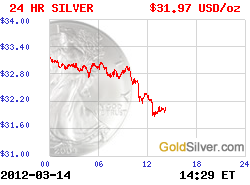
Today, gold & silver gave up another 2% & 3.4% respectively, bringing the plunge from their Wednesday’s intraday highs to 7% & 14% respectively. That’s over 4 trading days. The volatility in both directions is obvious as shown in this  2-year silver daily chart. The gold chart is no different.

Let’s take a closer look at what the price actions for both metals were like in the more distant past and what to expect over the coming months. Reproduced below is an analysis of daily price volatility by Jeff Clark, Senior Precious Metals Analyst, Casey Research.

-

This Is What Volatility Looks Like

Last Wednesday, February 29, gold dropped 4.8% and silver 6.2% (based on London fix prices). That’s quite the fall for one day. We’ve seen prices that have risen that much, too. But as I’m about to show, these ain’t nothin’, baby.

Based on our experience, we’ve been saying for some time that volatility will increase as the markets fight their way to the mania phase of this cycle – and that once there, the gyrations will jump even higher. This call doesn’t exactly require one to go out on a limb; it makes sense since more investors will be crowding in – and volatility was high in the 1979-’80 mania.

First, let’s put last Wednesday’s big plunge in perspective. Here’s a picture of the daily changes in the gold price since 2003, based on London fix prices. (This chart is very busy, but I want to show the bulk of the bull market in one visual.)

(Click on image to enlarge)

A 4.8% decline is one of gold’s bigger one-day movements over the past nine-plus years. But as you can see, there have been a number of days where gold rose or fell more than 5%. And it exceeded 6% on five occasions.

Here are the data for silver.

(Click on image to enlarge)

Last Wednesday’s decline of 6.2% was one of the metal’s bigger one-day movements. However, it’s exceeded 10% on 14 occasions, 15% three times, and rose an incredible 20.06% on September 18, 2008.

You might think this kind of volatility is high – and it’s true. Worse – or better, depending on how you see things – the volatility in the underlying commodity is magnified in the related company stocks. This is why Doug Casey calls mining stocks, especially the juniors, “the most volatile stocks on earth.” But the thing is, metals volatility has been higher in the past, particularly during a mania.

Here’s what I mean.

The following chart documents gold’s daily price changes from 1976 through the end of 1980. Take a look at the jump in volatility in 1979-’80.

(Click on image to enlarge)

Volatility became the norm in 1979 and especially 1980. Fluctuations of 4% or more were not uncommon.

Here’s the same chart for silver. The metal’s volatility during the 1979-’80 period became extreme.

(Click on image to enlarge)

Daily price movements of 6% or more didn’t occur once prior to 1979 – but then they became commonplace.

I wanted to take a closer look at the biggest price fluctuations during this period, so I ferreted out the largest days of volatility for each metal. For gold, I selected daily movements of greater than 5%.

(Click on image to enlarge)

During this five-year period, gold saw fluctuations greater than 5% on 38 days (19 up, 19 down). Not surprisingly, more “up” days occurred leading up to gold’s peak of January 21, 1980, and more down days came after it.

And yes, gold rose an incredible 13.3% on January 3, 1980. As it turned out, that biggest one-day rise was only 18 calendar days away from the very peak of the market. And the biggest decline of 13.2% on January 22, 1980 was the signal that the top was in.

For silver, I used one-day movements of 10% or more, all of which occurred in 1979 and 1980.

(Click on image to enlarge)

The silver price had fluctuations of 10% or more on 34 days (17 up, 17 down). They occurred over a period of only 15 months, an average of more than two per month.

And yes, silver really did rise a whopping 36.5% on September 18, 1979.

So while last Wednesday’s price movements for gold and silver were big, we simply haven’t seen this kind of volatility in our current bull market.

Now let’s have some fun. Let’s say we match the most volatile days from 1979-’80 at some point before the current bull market is over. If we use gold’s biggest up day (13.3%) and biggest down day (13.2%), here’s what would happen to prices from various levels. Remember, these areone-day gains and retreats:

Gold Price
+13.3%
-13.2%
1,700
1,926.10
1,475.60
1,750
1,982.75
1,519.00
1,800
2,039.40
1,562.40
1,900
2,152.70
1,649.20
2,000
2,266.00
1,736.00
2,250
2,549.25
1,953.00
2,500
2,832.50
2,170.00
2,750
3,115.75
2,387.00
3,000
3,399.00
2,604.00
4,000
4,532.00
3,472.00
5,000
5,665.00
4,340.00

Imagine gold jumping from $1,800 to $2,039.40 in one day!

However, unless you think $1,800 is the level from which the mania starts, it’s more likely we’d see a 13.3% advance (or something similar) from a higher starting point. We’d thus probably see gold jumping to $5,665 from $5,000, for example. And further, that would probably signal we’re near the top.

Keep in mind that volatility worked both ways during the mania, so dropping from $4,000 to $3,472 or something similar is likely to occur as well.

Here’s the same table for silver, with its biggest up day of 36.5% and down day of 18.5%.

Silver  Price
+36.5%
-18.5%
30
40.95
24.45
35
47.78
28.53
40
54.60
32.60
50
68.25
40.75
60
81.90
48.90
70
95.55
57.05
80
109.20
65.20
90
122.85
73.35
100
136.50
81.50
125
170.63
101.88

Can you imagine silver starting the day at $80 and hitting $109.20 before you go to bed that night? Something like that will probably happen at least once before this bull market is over. As with gold, though, that kind of movement is more likely to take place from a higher level, such as $100 or $125 (or higher?). And a fall like $100 to $81.50 will probably be part of the trend as well.

There are some definite conclusions we can draw from the historical picture:

  • First, if history repeats, or even rhymes, our biggest days of volatility are ahead. And they will be normal.
  • Second, big price fluctuations will be common as we enter the mania and approach the peak. In fact, when large daily movements become the norm, the historical record suggests we will be nearing the end of the cycle.
  • Third, since current volatility has thus far been lower than what was experienced during the final phase of the 1970s bull market, we are probably not in a bubble, nor yet in the mania phase, and nowhere near the top. Remember that the next time you hear some nincompoop spew bubble talk on CNBC.

What can an investor do with this information? Prepare yourself for bigger daily swings – in both directions. And buying on those outsized drops is probably a good strategy…

Because we now know what volatility looks like.

Today’s Silver Slam Down: Profit Taking or Intervention?

March 1, 2012 3 comments

-

If you’ve been following this blog for a while, you’d have noticed that I don’t usually post anything when there’s a sudden upward spike in PMs prices (there’s more than enough cheer leaders out there!), but will almost always have a comment when there’s a sudden smash down – and here’s the latest.

Silver Smash Down 29Feb12

It’s the classic picture of taking the staircase up (red line) and the elevator down (green line). The gradual climb over an entire trading session at the COMEX on Feb 28 has been attributed to short covering and/or new demand. That looks like how genuine buyers in a normal market would behave – buying at a rational pace to prevent sudden price spikes.

Now, take a look at what happened just a few hours ago. We see a series of waterfall declines in just over an hour bringing the price down by over 9%. Does that look like a normal market to you? The mainstream media attributed this to profit taking. The timing coincided with the U.S. Federal Reserve Chairman Ben Bernanke’s  testimony to the U.S. Congress.

Here’s a shorter version with Ron Paul’s comments on the Fed followed by questions to Bernanke after his testimony.

To many market watchers within the PMs community, there’s more than meets the eye.

Whichever way you look at it, this is another classic example of using a piece of news as trigger to execute trades in a manner that results in the sharpest price decline possible in order to paint the tape (scaring away speculators & momentum traders) or to generate negative publicity in the MSM (scaring away retail “investors”). I tend to agree that it’s yet another example of high handed PMs price manipulation and extreme volatility Jim Sinclair and others have been warning about.

Movements in gold will become so violent that gold will become untradable to individuals.

It applies to silver as well, if not more so. Ever wondered what is meant by that? To find out, try buying from some of the smaller web stores or walking into your favorite over-the-counter dealers during or shortly after a major price slam to take advantage of the unusually low prices. Chances are you’ll be greeted with an unusually high premium or an “Out of Stock” message. They could have genuinely ran out of stock, or may just want to temporarily hold back sales fully aware that this slam down is an abnormally and is short lived.

If indeed the PMs market is being manipulated and their prices are so volatile, does it actually make sense to invest in gold & silver?

Here are some articles to address the above question, some commentaries on previous price take-downs and PMs manipulations.

Why I don’t invest in Precious Metals

October 17, 2011 15 comments

Sharing some thoughts about gold & silver with KH of InvestSilverMalaysia.

-

KH (InvestSilverMalaysia): Hi CK Diong. Can you share with us how you started investing in Precious Metals?

CK (PoliticalMetals): I have been staring at this question for quite a while, not knowing how to respond. Fact is, I’ve not invested, and if I did, certainly not in Precious Metals.

I happen to be planning for early retirement around the time of the global financial crisis of 2008. It was so violent and swift that I quickly realized it was no ordinary crisis. That was when I decided to invest considerable time into understanding what actually was going on.

My research convinced me that what happened in 2007/08 was not another of those boom and bust economic cycles which will soon come to past, and that we will all be happily riding the next wave up again. I realized for the first time that what’s ahead of us in the next few years will be unlike anything we’ve seen in the past. The global debt-based monetary system is like a house of cards whose time has come.

Hence, I wanted to play safe and decided to take my retirement savings OUT of this precarious monetary system. I converted paper & electronic money into gold and silver, not as an investment, but as a store of value. I view them as Monetary Metals or Political Metals rather than Precious Metals.

KH: What do you think of investing in silver today?

CK: I don’t understand why anyone, save for the most die-hard speculators, would want to invest in something as volatile as silver. Why would anyone invest in something whose price can drop from $40 to $26 in less than 72 hours? And, if you know who’s behind the curtain making the silver prices so volatile, you’d want to stay away from this investment.

Having said that, I hold a substantial portion of my assets in the form of silver. I don’t invest in it, I just own it, and yes, that makes a lot of difference. I believe it’s a good asset to hold because like gold, it is a monetary metal that is a good store of value and it has no counter-party risk.

KH: What made you start PoliticalMetals.com?

CK: Going by what I’ve just said above, maybe I should just answer “to explain the difference between investing in and owning gold & silver”!

More seriously, PoliticalMetals was set up to educate and prepare readers for the trying times ahead. Being aware of the impending financial turmoil unlike anything we’ve experienced, I wanted to highlight that owning gold and silver is a flight to safety more than a fight for profits, especially for people under similar circumstances as myself.

I also wanted to help expose the political nature of these 2 monetary metals. Understanding that gold and silver are Political Metals (whose prices have been and still are being manipulated and suppressed by governments through their central banks) rather than Precious Metals makes all the difference. If I had viewed buying gold and silver as investments in Precious Metals, I don’t think I would have taken the step to invest my hard earned savings back then when gold was in its 3 digits and silver in its low teens. Why? Because they looked very expensive at that time! As an investment, they looked so risky to me, especially at the nadir of the 2008 crisis.

After I understood them for what they really are – Political Metals and Monetary Metals, there was no turning back, and I just wanted to share this with the wider audience.

KH: What is your view on having physical metals vs paper metals?

CK: Again, if it’s for investment or short term speculation, paper metals are great, provided you are prepared to do battle with professionals. But if you’re buying gold and silver for the reasons I mentioned above, paper metals are the last things you’d want to touch.

KH: What methods would you recommend on buying silver?

CK: That’s a tough one in Malaysia! Bullion (not numismatic) coins or small bars are must-haves despite their high premiums. I think you’ll just have to bite the bullet and pick up some well recognized brands from your trusted dealers. Alternatively, get a few friends to pool together your funds and make a larger order directly from online US dealers who offer much more competitive prices.

For larger amounts, you could consider buying professional-grade bullion bars directly from the London Bullion Market and storing them in private vaults outside the banking system, ie not vaults belonging to banks. You get them at spot price plus a small commission by the dealers and you don’t have to worry about theft. For example, if you’re looking at RM100K, that’s about 30kg of silver. Would you risk storing that at home considering the high break-in rates in Malaysia? Ramp that up and you get the picture.

KH: From your blog, you have done comparison on Precious Metals investment with a few countries. What are the differences you find among these countries?

CK: Generally, premiums are much higher in Malaysia, especially for silver. Since the market is relatively young, many of the dealers are new and small. They may not be able to handle large orders (especially silver) and even if they do, would you trust them with large upfront payments?

In contrast, you get some very established dealers offering much lower premiums in countries where the market is more mature. That’s why I mentioned you should look beyond your borders if you are dealing in larger quantities.

KH: What improvement would you like to see in Malaysia?

CK: Development of a more established network of independent dealers outside the banking system.

-
Related Articles:
Follow

Get every new post delivered to your Inbox.

Join 175 other followers