Archive

Posts Tagged ‘Shortage’

Silver Manipulation Explained

March 19, 2012 4 comments

-

Silver manipulation FSN, Eric, Sprott David Morgan, Ted Butler, Jim Puplava InterviewJim Puplava, president of FPS, discusses the hot topic of Silver Manipulation with four prominent players in the silver market.

-

Ted Butler explains the Silver Manipulation Scheme. iPad users, tap here.

-

Virtual roundtable discussion with Eric Sprott, David Morgan & CFTC Commissioner Bart Chilton. iPad users, tap here.

-

Source: Financial Sense Newshour

Permanent Gold Backwardation – When and how it will happen

February 11, 2012 1 comment

Permanent Gold Backwardation
By Keith Weiner

-
The Root of the Problem Is Debt

Worldwide, an incredible tower of debt has been under construction since President Nixon’s 1971 default on the gold obligations of the US government. His decree severed the redeemability of the dollar for gold and thus eliminated the extinguisher of debt. Debt has been growing exponentially everywhere since then. Debt is backed with debt, based on debt, dependent on debt and leveraged with yet more debt. For example, today it is possible to buy a bond (i.e., lend money) on margin (i.e., with borrowed money).

The time is now fast approaching when all debt will be defaulted on. In our perverse monetary system, one party’s debt is another’s “money.” A debtor’s default will impact the creditor (who is usually also a debtor to yet other creditors), causing him to default, and so on. When this begins in earnest, it will wipe out the banking system and thus everyone’s “money.” The paper currencies will not survive this. We are seeing the early edges of it now in the euro, and it’s anyone’s guess when it will happen in Japan, though it seems long overdue already. Last of all, it will come to the USA.

The purpose of this article is to present the early-warning signal and explain the actual mechanism to these events. Contrary to popular belief, it will not happen because the central banks increase the quantity of money to infinity. The money supply may even be contracting (which is what I expect).

To understand the terminal stages of the monetary system’s fatal disease, we must understand gold.

Defining Backwardation

First, let me introduce a key concept. Most traders define “backwardation” for a commodity as when the price of a futures contract is lower than the price of the same good in the spot market.

In every market, there are always two prices for a good: the bid and the ask. To sell a good, one must take the bid. And likewise, to buy the good, one must pay the ask. In backwardation, one can sell a physical good for cash and simultaneously buy a futures contract, and make a profit on the arbitrage. Note that in doing this trade, one’s position does not change in the end. One begins with a certain amount of the good and ends (upon maturity of the contract) with that same amount of the good.

Backwardation is when the bid in the spot market is greater than the ask in the futures market.

Many commodities, like wheat, are produced seasonally. But consumption is much more evenly spread around the year. Immediately prior to the harvest, the spot price of wheat is normally at its highest in relation to wheat futures. This is because wheat inventories in the warehouses are very low. People will have to pay a higher price for immediate delivery. At the same time, everyone in the market knows that the harvest is coming in one month. So the price, if a buyer can wait one month for delivery, is lower. This is a case of backwardation.

Backwardation is typically a signal of a shortage in a commodity. Anyone holding the commodity could make a risk-free profit by delivering it and getting it back later. If others put on this trade, and others, and so on, this would push down the bid in the spot market and lift up the ask in the futures market until the backwardation disappeared. The process of profiting from arbitrage compresses the spread one is arbitraging.

Actionable backwardations typically do not last long enough for the small trader to even see on the screen, much less trade. This is another way of saying that markets do not normally offer risk-free profits. In the case of wheat backwardation, for example, the backwardation may persist for weeks or longer. But there is no opportunity to profit for anyone, because no one has any wheat to spare. There is a genuine shortage of wheat before the harvest.

Why Gold Backwardation Is Important

Could backwardation happen with gold? Gold is not in shortage. One just has to measure abundance using the right metric. If you look at the inventories divided by annual mine production, the World Gold Council estimates this number to be around 80 years.

In all other commodities (except silver), inventories represent a few months of production. Other commodities can even have “gluts,” which usually lead to a price collapse. As an aside, this fact makes gold good for money. The price of gold does not decline, no matter how much of the stuff is produced. Production will certainly not lead to a “glut” in the gold market pulling prices downward.

So, what would a lower price on gold for future delivery mean compared to a higher price of gold in the spot market? By definition, it means that gold delivered to the market is in short supply.

The meaning of gold backwardation is that trust in future delivery is scarce.

In an ordinary commodity, scarcity of the physical good available for delivery today is resolved by higher prices. At a high enough price, demand for wheat falls until existing stocks are sufficient to meet the reduced demand.

But how is scarcity of trust resolved?

Thus far, the answer has been: via higher prices. Higher prices do coax some gold out of various hoards, jewelry, etc. Gold went into backwardation for the first time in December 2008. One could have earned a 2.5% (annualized) profit by selling physical gold and simultaneously buying a February 2009 future. Gold was $750 on December 5, but it rocketed to $920 – a gain of 23% – by the end of January.

But when backwardation becomes permanent, then trust in the gold futures market will have collapsed. Unlike with wheat, millions of people and many institutions have plenty of gold they can sell in the physical market and buy back via futures contracts. When they choose not to, that is the beginning of the end of the current financial system.

Why?

Think about the similarities between the following three statements:

  • “My paper gold future contract will be honored by delivery of gold.”
  • “If I trade my gold for paper now, I will be able to get gold back in the future.”
  • “I will be able to exchange paper money for gold in the future.”

The reason why there was a significant backwardation (smaller backwardations have occurred intermittently since then) is that people did not believe the first statement. They did not trust that the gold future would be honored in gold.

And if they don’t believe that paper futures will be honored in gold, then they have no reason to believe that they can get gold in the future at all.

If some gold owners still trust the system at that point, then they can sell their gold (at much higher prices, probably). But sooner or later, there will not be any sellers of gold in the physical market.

Higher Prices Can’t Cure Permanent Gold Backwardation

With an ordinary commodity, there is a limit to what buyers are willing to pay based on the need satisfied by that commodity, the availability of substitutes and the buyers’ other needs that also must be satisfied within the same budget. The higher the price, the more holders and producers are motivated to sell, and the less consumers are motivated (or able) to buy. The cure for high prices is high prices.

But gold is different. Unlike wheat, gold is not bought for consumption. While some people hold it to speculate on increases in its paper price, these speculators will be replaced by others who hold it because it is money.

Once the gold owners have lost confidence, no amount of price change will bring back trust in paper currencies. Gold will not have a “high enough” price that will discourage buying or encourage selling. Thus gold backwardation will not only recur, but at some point, it will stay in its backwardated state.

In looking at the bid and ask, one other observation is germane to this discussion. In times of crisis, it is always the bid that is withdrawn – there is never a lack of asks. Permanent gold backwardation can be seen as the withdrawal of bids denominated in gold for irredeemable government debt paper (e.g., dollar bills).

Backwardation should not be able to happen at all as gold is so abundant. However, the fact that it has happened and keeps happening means that it is inevitable and that, at some point, backwardation will become permanent. The erosion of faith in paper money is a one-way process (with some zigs and zags). But eventually, backwardation will become deeper and deeper (while the dollar price of gold is rising, probably exponentially).

The final step is when gold completely withdraws its bid on paper. At that point, paper’s bid on gold will be unlimited, and this is why paper will inevitably collapse without gold.

Conclusion

Permanent gold backwardation leading to the withdrawal of the gold bid on the dollar is the inevitable result of the debt collapse. Governments and other borrowers have long since passed the point where they can amortize their debts. Now they merely “roll” the debt and the interest as they come due. This leaves them vulnerable to the market demand for their bonds. When they have an auction that fails to attract bids, the game will be over. Whether they formally default or whether they just print the currency to pay, it won’t matter.

Gold owners, like everyone else, will watch this happen. If government bond holders sell their securities in response to this crisis, they will only receive paper backed by that same government and its bonds. But the gold owner has the power to withdraw his bid on paper altogether. When that happens, there will be an irreconcilable schism between gold and paper, with real goods and services taking the side of gold. And in a process that should play out within a few months once it gets started, paper money will no longer have any value.

Gold is not officially recognized as the foundation of the financial system. Yet it is still a necessary component. When it is withdrawn, the worldwide regime of irredeemable paper money will collapse.

Disconnect Between Paper & Physical Prices And What We Can Do About It.

October 7, 2011 12 comments

Since the recent price take down, we’re inundated by stories of retail buyers not being able to buy physical coins and bars at the ridiculously low spot prices painted by the paper futures markets. For those fortunate enough to get their hands on any physical bullion, it will be at relatively large premiums over spot with long delivery lead times. The disconnect is growing with each dramatic take-down..

“Sold Out”

KH of InvestSilverMalaysia reported that,

Back in Malaysia, it has been a wild ride. With the recent collapse of gold & silver prices, PM suddenly becomes very hot. Lowyat is having comments like 5 pages/per day ever since that crash. Physical silver bullion dealers are not selling. They are either: holding up the stock or, stock have been completely drained. Replenishing takes 2-3 wks. Even so, many bigger supplier from the states are having the same problem too! Too many orders! I am guessing even those at the top of the food chain are having problem processing massive orders. Many smaller local websites just shut down – refusing to take orders. 1cheapsilver has yet to recover from that 26-dollar-fall. It is really a war zone here.

Here’s what greeted him at UOB when he personally went there to buy his gold bullion. Read his story here.

Here’s another story along the same line from the UAE, courtesy of ArabianMoney.

Several readers of ArabianMoney have written to us over the past two weeks to express their astonishment at the current price of silver because demand where they live is so high that stocks have run out.

Consider this comment: ‘I used to buy silver from a shop in Kobar in Saudi. From the last four weeks they said they ran out of silver. I cannot find anyone who sells silver in Saudi now. I asked them from where do they get their silver. They said the UAE. The problem is they only have 1kg bars…and I still cannot find any supplier.’

No stock

Well don’t bother coming to the UAE. Our information is that the 1kg bars mentioned here and featured in a video on the website last month (click here) are all sold out too. We’ve also had feedback about low or no stock in Texas and Australia from big private bullion dealers there.

Now what would normally happen when a commodity is in short supply is that the price would go up to encourage sellers to put some more into the market. That is presently not happening because the silver price is being artificially suppressed in the Comex futures market by the bullion banks acting on instructions from the Fed presumably, so why would you sell that silver cheaply if you happened to own some?

But something has to give and it is the price of physical silver rather than the Comex price of the shiniest of metals. If you can find any silver these days you will pay quite a substantial premium over the spot price. But pay it because that is probably still a bargain compared to where silver prices are going.

The truth is that silver is a rare metal, more rare than gold. Silver reserves have been estimatated at one-hundredth of gold reserves. Silver is after all consumed by industrial processes and reserves have dwindled over the years because the price has been kept so low for so long by market manipulation. Why is that?

Silver price fixing

This market manipulation dates back to the last silver boom of the late 70s and the spectacular $50 spike in the price in 1980. The central banks then saw suppression of the silver and gold price as a part of their war on inflation. They clearly lost that war but kept gold and silver prices down until this decade.

Thirty-one years later and we are still not back to those silver prices despite a seven-fold increase in the global money supply. On that reckoning silver ought to be $350 an ounce, not $30 today.

However, the snap back for silver prices now has the capacity to be sensational, and far beyond the mini-spike in the first few months of this year from $30 to almost $50 again. So those who go seeking out physical silver to buy at current prices are going to be very well rewarded and soon, not in 31 years!

ArabianMoney continues to stick with silver as our top tip for 2011 (click here) and that means a big rebound in the price before the end of the year.

-End-

.. and watch what the Chinese are doing

-

It is evident from the stories above that trying to catch the absolute intermediate bottoms during corrections and expecting to buy physical bullion at those prices may be illusionary. So, if there are no gold vending machines nearby, what can the ordinary man on the street do to take advantage of the recent violent take-downs (expect more to come) and the increasingly volatile paper gold & silver prices? Consider these 2 options.

(1) Cost averaging

While there’s a possibility that that PMs prices may be forced to step into the elevator shaft yet again, the probability of that happening is anyone’s guess. For serious savers who understand that physical bullion is the only financial asset with no counter-party risks and that the fundamentals for owning PMs have not deteriorated one bit, the recent market intervention by the Powers That Be (PTB) should be viewed as a generous gift and an opportunity to start (or continue) accumulating on a cost averaging basis.  Here’s an excellent article on Ounce Cost Averaging buying strategy.

(2) Buy bullion like a professional

Retail buyers of physical bullion are so very far down the food chain that it’s very difficult to take full advantage of the sharp (deep and fast) drop in paper prices. This has driven some to consider PM derivatives like ETFs and pooled accounts. While these vehicles offer the advantage of capturing the narrow window of opportunity presented during price smashing operations by the PTB, the danger lies in the fact that these players end up buying and owning paper claims to PMs instead of owning the real thing. Living in the current financial system teetering on the verge of collapse, the more prudent among us would like to stay away from these investments carrying counter-party risks.

That leads us to the option of buying and owning physical bullion like professionals do – at the London Bullion Market. Of course we can’t do that directly. The way around is to use the services of established bullion dealers that act as the only middleman between us and the London Bullion Market. BullionVault, GoldMoney and AFE are 3 of the more reputable companies in this industry I’m familiar with, and they are reviewed here.

Learn more about buying and storage options, including discussions about Allocated Bullion Accounts in the comments section.

Updated: Oct 9

Silver is Oversold “It’s a License to Steal”

October 2, 2011 1 comment

-

Here are two great interviews discussing the reasons & implications of the recent price action of gold & silver.
-

Sean (SGT Report) discusses the recent silver price take-down with David Schectman.

  • Place of technical analysis in a manipulated market
  • Silver is so oversold “It’s a License to Steal”
  • Difference between physical silver and paper silver prices
  • Why hedge funds sold their winning positions in gold & silver
  • While hedge funds, Soros & Paulson sold paper silver in the Comex, the Indians, Russians, Chinese, Arabs and retail buyers bought up all the physical silver they could get their hands on. (Make sure you watch part 2)

-

Al Korelin (Korelin Economics Report) discusses the recent silver price take-down with David Morgan. Some key points:

  • Have the fundamentals for silver changed?
  • CME margin hikes favour the shorts
  • Political events and how they affect the price of silver
  • If you don’t want to lose any money, stay out of the futures market. They are for professionals
  • Stay out of this sector if you don’t have a high degree of accumen in the industry or can’t take wild swings

Credit where credit is due

September 24, 2011 9 comments

-

“When you own gold you’re fighting every central bank in the world”. Jim Rickards

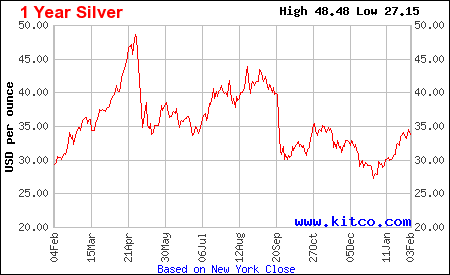
To a great extend, that holds true for silver as well. This week, holders of Political Metals lost a battle, but certainly not the war. Measured against the USD, gold and silver are worth less compared to a week ago by 9.6% and 26.3% respectively.

It all started with Ben Bernanke’s statement, following the 2-day FOMC meeting, stating the obvious – that “there are significant downside risks to the economic outlook, including strains in global financial markets”. His antidote was a plan to purchase $400 billion of long-term Treasury bonds and to sell an equivalent amount of short-term debt. More commonly referred to as “Operation Twist 2″, this plan seeks to further reduce long term interest rates, after having pledged to hold short term rates practically at zero until 2013.

That announcement, made in the backdrop of the Eurozone debt crisis and news of slower growth in China, sent global stocks and commodity markets into a waterfall decline. This set up was ideal for the bullion banks who have massive gold and silver short positions. All they needed to do was to pull the trigger, and that’s exactly what they did on Thursday. Silver was pushed down sharply through its key 50 and 200 day moving averages, triggering an avalanche of tech funds selling the following day.

Going for the final kill of the week, news of yet another margin hike by CME (gold by 21%, silver by 16%) leaked into the market towards the end of Friday’s trading day. That further fuelled the selling, pushing silver briefly below $30 before closing at $31.08 – down 26.3% for the week.

In other markets this week, the Dow suffered its biggest loss since 2008. In four days U.S. stocks lost $1.1 trillion in value.  The MSCI all-country world share index (tracking thousands of stocks from developed and emerging countries) recorded its second worst quarter in 23 years and the 30-year bond rates dropped 55bps – the biggest move since the 1987 Black Monday.

So there you have it, Dr. Ben Bernanke, bullion banks & CME working together in perfect harmony. I don’t believe for a moment that the resulting market turmoil was any surprise to Bernanke. Despite saying that gold is not money, he’s smarter than most people made him out to be. After all, he achieved an SAT score of 1590 out of 1600, graduated from Harvard and has a PhD in economics from MIT. Contrary to its statutory mandate of foster maximum employment and price stability, this market turmoil I believe is a piece of precision engineering to achieve some larger agenda. This round is yours, congratulations Ben!

This engineered global markets take down could be part of the deflationary phase that Mike Maloney talked about, which is a prelude to the hyper-inflation phase. They have to assist the bullion banks cover their shorts and bring the Political Metals price down to a lower base before starting the next round of QE or equivalent. Marc Faber told ThomsonReuters that “if the S&P drops to around 900-950, we’ll get QE3 for sure”.

Four ways to view the developments over the past week

If you’re reading this blog, you’re not a professional or a day trader, possibly someone already invested in gold or silver, someone holding some Political Metals (I distinguish between investing & holding here) or someone in the process of researching the matter. As non professional traders, we have to look through and not at the turmoil unfolding before us. All of the bloody carnage above are on “paper” or bits on silicon – illusionary financial derivatives of something tangible (like gold and silver) or derivatives of something totally virtual and non-physical (like interest rates, bonds, debts, CDS, etc). Real or imaginary, they are all derivatives backed by nothing more than a promise or lies of a third party.

Unfortunately, in so far as gold & silver is concerned, the outcome of the imaginary paper price wars above gets applied to the physical world. Price discovery currently comes from the paper derivatives market. Banks and multi billion dollar hedge funds throwing thousands of futures contracts or bets at each other (most of which are done through computerised High Frequency Trading algorithms) determine the price of the coin or bar you pick up at your local bullion dealers. Until such time when this absurd situation of the tail wagging the dog changes, I suggest 4 possible ways for you to view the developments over the past week, using silver as an example.

4 ways to view the Sep 11 price action of silver
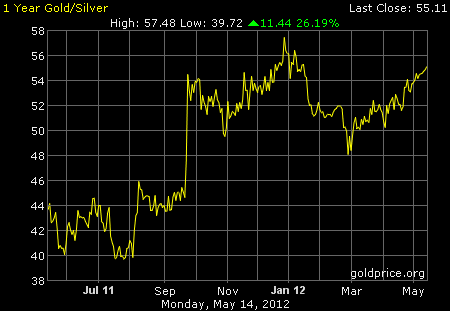
There’s a big difference between Investing(1) & Holding(2). If you adopt approach (1), and are smart enough to handle scenario (3), congratulations! Trading this dip or swapping silver for gold just before the GSR shot over 56 would have reaped a handsome return. After years of following newsletter writers, both paid and free, I came to the conclusion that attempting to achieve (3) is at best illusionary, and at worst risky. This is particularly true in a manipulated market. Take a look at some of the forecasts by well respected industry players here. Either they missed this week’s price action or are not telling us something. Richard Russell puts it this way:

I look at gold and silver, not as a play for profits, but as an accumulation of hard assets, in a world that it drowning in fiat money, and a world that will probably print trillions more of irredeemable paper.

Finally, if you’ve been waiting patiently (4) or have spare dry powder, congratulations! While the paper price of gold & silver gets whacked, physical demand is very strong. KWN reported that Sprott Money temporarily runs out of physical silver. So, get ready to pick up your discount. Not necessarily immediately, but then again, picking the absolute bottom can also be illusionary. Best industry advise is cost averaging.

Updated:

-

Why hasn’t gold kept up with inflation?

September 22, 2011 Leave a comment

-

Towards the end of Chris Powell’s speech at the 18th CLSA Investors’ Forum in Hong Kong, he addressed the all important question Why hasn’t gold kept up with inflation?

It’s because Western governments found ways of vastly increasing the supply of gold without having to go through the trouble of mining it — to dishoard and lease it from central bank reserves and to issue certificates of deposit against gold that never existed in the first place.

“Why” is supposed to be a basic question of journalism. But it has fallen out of financial journalism when it comes to gold, he lamented.

In recent years, and especially in recent months, I have spent much time explaining the gold price suppression scheme to leading financial journalists in the West. I have given them the documentation. Some of these journalists seemed interested. But none has ever reported anything about the issue. One writer who works for a major news agency in the United States was intrigued enough to call the Federal Reserve and ask about its gold swaps. She got a very telling “no comment.” But unfortunately she could not get her editor’s permission to write a gold story.

Frustrating as all this is, it is not too surprising. After all, who are the major advertisers in the Western financial news media and the major sources of financial news? The market manipulators and governments themselves. And journalists seem to take for granted that central banks operate in secret, particularly in regard to gold, so there’s no point in questioning them — even though central banking now determines the value of all capital, labor, goods, and services in the world, and does so in secret.

So here I am in Asia, which is a major victim of the gold price suppression scheme. Maybe there will be more curiosity and indignation about it here.

But Asia is not the only victim of this scheme. My own country may be the biggest victim. For this scheme has helped to corrupt the United States, destroying our once-free markets and the accountability of our government.

We in GATA do what we can, even though, from our beginning, we have wondered whether we could really presume to speak for gold. And not just for gold, of course — we are not idolaters — but for the economic and political liberty of individuals and the national sovereignty that gold serves and stands for. With gold always under attack precisely for what it represents, and with no others coming forward to defend it for what it represents, with even the gold mining industry’s main trade association refusing to acknowledge the attack, we have hoped that any presumption on our part might be forgiven.

We remain largely amateurs. At the outset we did not half understand what was going on and what we were setting about to do. Our name preserves that imperfect understanding. We thought we had discovered just another anti-trust violation. It was a while before we perceived that we were up against government policy and that most of what we were discovering had been discovered long ago, at least in principle, just not well taught, publicized, preserved, and made timely again.

Because it can work only through surreptitiousness and deceit, this government policy will be defeated when it is more widely understood — and every day it is being better understood, because it is getting so brazen. It was more brazen than ever the other day when Switzerland devalued its franc, the world’s leading “safe haven” currency, apparently leaving the “safe haven” field exclusively to gold. But just a few minutes before the Swiss franc’s devaluation was announced, unidentified sellers dumped thousands of gold futures contracts on markets around the world, causing the gold price to plunge along with the Swiss franc. These sellers plainly did not aim to make a profit from their gold holdings; if they had intended to make a profit, they would have sold gradually into the market. No, they meant to knock the price down hard, and they did.

These sellers almost surely were central banks. But as far as I could tell, no Western journalist has yet put a question to any central banker about that strange and counterintuitive action in the gold market.

I ask for your help in forcing an end to the gold price suppression scheme. I ask in the cause of giving individuals, nations, and all humanity a chance at democracy, liberty, and limited government with a neutral, fair, and impartial international currency that serves not just one government or another or one class or another but rather the whole brotherhood of man.

-
> Read the full speech here

-


Chris Powell, is the treasurer/secretary of Gold Anti Trust Committee and a newspaper editor in Connecticut.

Follow

Get every new post delivered to your Inbox.

Join 175 other followers