Archive

Posts Tagged ‘Money’

The only viable solution is to get government out of the money business permanently

May 15, 2012 Leave a comment

Ron Paul

The Fed: Mend It or End It?

-
Last week I held a hearing to examine the various proposals that have been put forth both to mend and to end the Fed. The purpose was to spur a vigorous and long-lasting discussion about the Fed’s problems, hopefully leading to concrete actions to rein in the Fed.

First, it is important to understand the Federal Reserve System. Some people claim it is a secret cabal of elite bankers, while others claim it is part of the federal government. In reality it is a bit of both. The Federal Reserve System is the collusion of big government and big business to profit at the expense of taxpayers. The Fed’s bailout of large banks during the financial crisis propped up poorly-run corporations that should have gone under, giving them a market-distorting advantage that no business in the United States should receive. The recent news about JP Morgan is a case in point. JP Morgan, a recipient of $25 billion in bailout money, recently announced it lost another $2 billion. If a corporation shows itself to be a bottomless money pit of “errors, sloppiness and bad judgment,” the Fed shouldn’t have expected $25 billion in free money to change that or teach anyone a lesson in fiscal discipline. But it determined that this form of deliberate capital destruction was preferable to one business suffering bankruptcy. Clearly, some changes need to be made.

Several reforms for the Fed were discussed at the hearing. One was a call for the full employment mandate to be repealed, in order to allow the Fed to focus solely on stable prices.

Another reform calls for changes to the composition of the Federal Open Market Committee. Still another proposal was for outright nationalization of the Fed or of its functions. But if what the Fed does now is bad and inflationary, allowing the Treasury to print and issue money at-will would be even worse, and could possibly lead to a Weimar-like hyperinflation.

The problems and advantages of the gold standard were discussed at the hearing. The era of the classical gold standard was undoubtedly one of the greatest eras in human history. For a period of several decades in the late 19th century, the West made enormous advances. However, the gold standard was still run by government. The temptation to suspend gold redemption reared its head again with the outbreak of World War I. Once the tie to gold was severed and fiscal restraint thrown to the wind, undoing the damage would have required great fiscal austerity. Instead, the Western world proceeded to set up a gold-exchange standard which lasted not even a decade before easy money led to the Great Depression.

While returning to the gold standard would certainly be far better than maintaining the current fiat paper system, as long as the government retains the power to go off gold we may end up repeating the same mistakes.

The only viable solution is to get government out of the money business permanently. The way to bring this about is through currency competition: allow parallel currencies to circulate without receiving any special recognition or favor from the government. Fiat paper monetary standards throughout history have always collapsed due to their inflationary nature, and our current fiat paper standard will be no different.

It is imperative that the American people be educated on the dangers of the Fed and the importance of restoring sound money. The laying of the groundwork must begin today, so that the American people will be prepared for the day when the mirage the Fed has created evaporates completely. The full hearing footage is available on my website and I would encourage every American to take a look.

-

Australia’s Constitution – The reason why I haven’t paid any income tax for 15 years.

May 10, 2012 Leave a comment

By Marissa Calligeros | Brisbane Times, Brisbane, Australia

-

It’s the Constitution — No BullionAustralian Nugget

A Queensland driver has tried in vain to argue it is “impossible” for him to pay a speeding fine because the Australian constitution states the government can accept only coins made of gold or silver as payment for debts.

Indeed, section 115 of the Commonwealth of Australia Constitution Act states: “The state shall not coin money nor make anything but gold and silver coin a legal tender in payment of debts.”

Leonard William Clampett tested the weight of constitutional law in Brisbane Magistrates Court in September last year, after he was snapped by a speed camera driving at 73km/h in a 60km/h zone on Wardell Street, Enoggera.

He argued he could not pay a $200 speeding fine, because “there is no gold and silver coins in common circulation”.

“It’s logical when you look at the paramount legislation in this country, that no matter what money they [the police] request or you award them, I can’t pay,” he told Magistrate Sheryl Cornack.

“I haven’t been able to pay a lot of things over the years. Fifteen years, I haven’t paid any income tax because it’s not possible to pay it.

“I haven’t paid for instance a couple of companies. I haven’t paid Crown Law Queensland $12,500 they claimed from me, because of section 115 of the Commonwealth Constitution.

“It is paramount law in this country, but somehow or other, certain people don’t seem to catch onto that …

“A state, as opposed to the Commonwealth, cannot compel you to pay in other than gold and silver coin. Fairly simple.”

Police prosecutors called on an expert from Melbourne, who was required to travel to Brisbane and review the evidence, to confirm the roadside camera was working accurately when it photographed Mr Clampett speeding.

Despite his argument, Ms Cornack found Mr Clampett guilty and ordered he pay the $200 fine, as well as $76.90 in court costs.

She also ordered Mr Clampett pay police prosecution’s out of pocket expenses, totalling $3500, in obtaining the expert witness.

But, three weeks later, Mr Clampett fought to have Ms Cornack’s ruling overturned by the Supreme Court.

He applied for a judicial review on the grounds no court had previously defined the terms of the constitution.

“My claims, and the action sought based thereon, are as well for the Queen as for myself,” Mr Clampett wrote in his application.

However, Supreme Court Justice Martin Daubney said the basis of Mr Clampett’s argument “has long been discredited”.

“None of the reasons advanced by the applicant amount to any good reason for having instituted the present application,” he stated in a written judgment, published this week.

He did not comment further on Mr Clampett’s argument regarding constitutional law.

Justice Daubney dismissed Mr Clampett’s application.

Categories: News Tags: , , , ,

If you stop printing, another massive economic crash will occur

May 6, 2012 Leave a comment

Robert Wenzel: Economic Policy Journal

My Speech Delivered at the New York Federal Reserve Bank

At the invitation of the New York Federal Reserve Bank, I spoke and had lunch in the bank’s Liberty Room. Below are my prepared remarks.

Thank you very much for inviting me to speak here at the New York Federal Reserve Bank.

Intellectual discourse is, of course, extraordinarily valuable in reaching truth. In this sense, I welcome the opportunity to discuss my views on the economy and monetary policy and how they may differ with those of you here at the Fed.

That said, I suspect my views are so different from those of you here today that my comments will be a complete failure in convincing you to do what I believe should be done, which is to close down the entire Federal Reserve System

My views, I suspect, differ from beginning to end. From the proper methodology to be used in the science of economics, to the manner in which the macro-economy functions, to the role of the Federal Reserve, and to the accomplishments of the Federal Reserve, I stand here confused as to how you see the world so differently than I do.

I simply do not understand most of the thinking that goes on here at the Fed and I do not understand how this thinking can go on when in my view it smacks up against reality.

Please allow me to begin with methodology, I hold the view developed by such great economic thinkers as Ludwig von Mises, Friedrich Hayek and Murray Rothbard that there are no constants in the science of economics similar to those in the  physical sciences.

In the science of physics, we know that water freezes at 32 degrees. We can predict with immense accuracy exactly how far a rocket ship will travel filled with 500 gallons of fuel. There is preciseness because there are constants, which do not change and upon which equations can be constructed..

There are no such constants in the field of economics since the science of economics deals with human action, which can change at any time. If potato prices remain the same for 10 weeks, it does not mean they will be the same the following day. I defy anyone in this room to provide me with a constant in the field of economics that has the same unchanging constancy that exists in the fields of physics or chemistry.

And yet, in paper after paper here at the Federal Reserve, I see equations built as though constants do exist. It is as if one were to assume a constant relationship existed between interest rates here and in Russia and throughout the world, and create equations based on this belief and then attempt to trade based on these equations. That was tried and the result was the blow up of the fund Long Term Capital Management, a blow up that resulted in high level meetings in this very building.

It is as if traders assumed a given default rate was constant for subprime mortgage paper and traded on that belief. Only to see it blow up in their faces, as it did,  again, with intense meetings being held in this very building.

Yet, the equations, assuming constants, continue to be published in papers throughout the Fed system. I scratch my head.

I also find curious the general belief in the Keynesian model of the economy that somehow results in the belief that demand drives the economy, rather than production. I look out at the world and see iPhones, iPads, microwave ovens, flat screen televisions, which suggest to me that it is production that boosts an economy. Without production of these things and millions of other items, where would we be? Yet, the Keynesians in this room will reply, “But you need demand to buy these products.” And I will reply, “Do you not believe in supply and demand? Do you not believe that products once made will adjust to a market clearing price?”

Further , I will argue that the price of the factors of production will adjust to prices at the consumer level and that thus the markets at all levels will clear. Again do you believe in supply and demand or not?

I scratch my head that somehow most of you on some academic level believe in the theory of supply and demand and how market setting prices result, but yet you deny them in your macro thinking about the economy.

You will argue with me that prices are sticky on the downside, especially labor prices and therefore that you must pump money to get the economy going. And,  I will look on in amazement as your fellow Keynesian brethren in the government create an environment  of sticky non-downward bending wages.

The economist  Robert Murphy reports that President  Herbert Hoover continually pressured businessmen to not lower wages.[1]

He quoted Hoover in a speech delivered to a group of businessmen:

In this country there has been a concerted and determined effort  on the part of government and business… to prevent any reduction in wages.

He then reports that FDR actually outdid Hoover by seeking to “raise wages rates rather than merely put a floor under them.”

I ask you, with presidents actively conducting policies that attempt to defy supply and demand and prop up wages, are you really surprised that wages were sticky downward during the Great Depression?

In present day America, the government focus has changed a bit. In the new focus, the government  attempts much more to prop up the unemployed by extended payments for not working. Is it really a surprise that unemployment is so high when you pay people not to work.? The 2010 Nobel Prize was awarded to economists for their studies which showed that, and I quote from the Nobel press release announcing the award:

One conclusion is that more generous unemployment benefits give rise to higher unemployment and longer search times.[2]

Don’t you think it would make more sense to stop these policies which are a direct factor in causing unemployment, than to add to the mess and devalue the currency by printing more money?

I scratch my head that somehow your conclusions about unemployment are so different than mine  and that you call for the printing of money to boost “demand”. A call, I add, that since the founding of the Federal Reserve has resulted in an increase of the money supply by 12,230%.

I also must scratch my head at the view that the Federal Reserve should maintain a stable price level. What is wrong with having falling prices across the economy, like we now have in the computer sector, the flat screen television sector and the cell phone sector? Why, I ask, do you want stable prices? And, oh by the way, how’s that stable price thing going for you here at the Fed?

Since the start of the Fed, prices have increased at the consumer level by 2,241% [3]. that’s not me misspeaking, I will repeat, since the start of the Fed, prices have increased at the consumer level by 2,241%.

So you then might tell me that stable prices are only a secondary goal of the Federal Reserve and that your real goal is to prevent serious declines in the economy but, since the start of the Fed, there have been 18 recessions including the Great Depression and the most recent Great Recession. These downturns  have resulted in stock market crashes, tens of  millions of unemployed and untold business bankruptcies.

I scratch my head and wonder how you think the Fed is any type of success when all this has occurred.

I am especially confused, since Austrian business cycle theory (ABCT), developed by Mises, Hayek and Rothbard, has warned about all these things. According to ABCT, it is central bank money printing that causes the business cycle and, again you here at the Fed have certainly done that by increasing the money supply. Can you imagine the distortions in the economy caused by the Fed by this massive money printing?

According to ABCT, if you print money those sectors where the money goes  will boom, stop printing and those sectors will crash. Fed printing tends to find its way to Wall Street and other capital goods sectors first, thus it is no surprise to Austrian school economists that the crashes are most dramatic in these sectors, such as the stock market and real estate sectors. The economist Murray Rothbard in his book America’s Great Depression [4] went into painstaking detail outlining how the changes in money supply growth resulted in the Great Depression.

On a more personal level, as the recent crisis was developing here, I warned throughout the summer of 2008 of the impending crisis. On July 11, 2008 at EconomicPolicyJournal.com, I wrote[5]:

SUPER ALERT: Dramatic Slowdown In Money Supply Growth

After growing at near double digit rates for months, money growth has slowed dramatically. Annualized money growth over the last 3 months is only 5.2%. Over the last two months, there has been zero growth in the M2NSA money measure.This is something that must be watched carefully. If such a dramatic slowdown continues, a severe recession is inevitable.

We have never seen such a dramatic change in money supply growth from a double digit climb to 5% growth. Does Bernanke have any clue as to what the hell he is doing?

On July 20, 2008, I wrote [6]:

I have previously noted that over the last two months money supply has been collapsing. M2NSA has gone from double digit growth to nearly zero growth .

A review of the credit situation appears worse. According to recent Fed data, for the 13 weeks ended June 25, bank credit (securities and loans) contracted at an annual rate of 7.9%.

There has been a minor blip up since June 25 in both credit growth and M2NSA, but the growth rates remain extremely slow.

If a dramatic turnaround in these numbers doesn’t happen within the next few weeks, we are going to have to warn of a possible Great Depression style downturn.

Yet, just weeks before these warnings from me, Chairman Bernanke, while the money supply growth was crashing, had a decidedly much more optimistic outlook, In a speech on June 9, 2008, At the Federal Reserve Bank of Boston’s 53rd Annual Economic Conference [7], he said:
I would like to provide a brief update on the outlook for the economy and policy, beginning with the prospects for growth.  Despite the unwelcome rise in the unemployment rate that was reported last week, the recent incoming data, taken as a whole, have affected the outlook for economic activity and employment only modestly.  Indeed, although activity during the current quarter is likely to be weak, the risk that the economy has entered a substantial downturn appears to have diminished over the past month or so.  Over the remainder of 2008, the effects of monetary and fiscal stimulus, a gradual ebbing of the drag from residential construction, further progress in the repair of financial and credit markets, and still-solid demand from abroad should provide some offset to the headwinds that still face the economy.

I believe the Great Recession that followed is still fresh enough in our minds so it is not necessary to recount in detail as to whose forecast, mine or the chairman’s, was more accurate.

I am also confused by many other policy making steps here at the Federal Reserve. There have been more changes in monetary policy direction during the Bernanke era then at any other time in the modern era of the Fed. Not under Arthur Burns, not under G. William Miller, not under Paul Volcker, not under Alan Greenspan  have there been so many dramatically shifting Fed monetary policy moves. Under Chairman Bernanke there have been significant changes in direction of the money supply growth FIVE different times. Thus, for me, I am not at all surprised at the current stop and go economy. The current erratic monetary policy makes it exceedingly difficult for businessmen to make any long term plans.  Indeed, in my own Daily Alert on the economy [8] I find it extremely difficult to give long term advice, when in short periods I have seen three month annualized M2 money growth go from near 20% to near zero, and then in another period see it go from 25% to 6% . [9]

I am also confused by many of the monetary programs instituted by Chairman Bernanke. For example, Operation Twist.

This is not the first time an Operation Twist was tried. an Operation Twist was tried in 1961, at the start of the Kennedy Administration [10] A paper [11] was written by three Federal Reserve economists in 2004 that, in part, examined the 1960′s Operation Twist

Their conclusion (My bold):

A second well-known historical episode involving the attempted manipulation of the term structure was so-called Operation Twist.  Launched in early 1961 by the incoming Kennedy Administration, Operation Twist was intended to raise short-term rates (thereby promoting capital inflows and supporting the dollar) while lowering, or at least not raising, long-term rates. (Modigliani and Sutch 1966)…. The two main actions of Operation Twist were the use of Federal Reserve open market operations and Treasury debt management operations.. Operation Twist is widely viewed today as having been a failure, largely due to classic work by  Modigliani and Sutch….

However, Modigliani and Sutch also noted that Operation Twist was a relatively small operation, and, indeed, that over a slightly longer period the maturity of outstanding government debt rose significantly, rather than falling…Thus, Operation Twist does not seem to provide strong evidence in either direction as to the possible effects of changes in the composition of the central bank’s balance sheet….

We believe that our findings go some way to refuting the strong hypothesis that nonstandard policy actions, including quantitative easing and targeted asset purchases, cannot be successful in a modern industrial economy.  However, the effects of such policies remain quantitatively quite uncertain. 

One of the authors of this 2004 paper was Federal Reserve Chairman Bernanke. Thus, I have to ask, what the hell is Chairman Bernanke doing implementing such a program, since it is his paper that states it was a failure according to Modigliani, and his paper implies that a larger test would be required to determine true performance.

I ask, is the Chairman using the United States economy as a lab with Americans as the lab rats to test his intellectual curiosity about such things as Operation Twist?

Further, I am very confused by the response of Chairman Bernanke to questioning by Congressman Ron Paul. To a seemingly near off the cuff question by Congressman Paul on Federal Reserve money provided to the Watergate burglars, Chairman Bernanke contacted the Inspector General’s Office of the Federal Reserve and requested an investigation [12]. Yet, the congressman has regularly asked about the gold certificates held by the Federal Reserve [13] and whether the gold at Fort Knox backing up the certificates will be audited. Yet there have been no requests by the Chairman  to the Treasury for an audit of the gold.This I find very odd. The Chairman calls for a major investigation of what can only be an historical point of interest but fails to seek out any confirmation on a point that would be of vital interest to many present day Americans.

In this very building, deep in the underground vaults, sits billions of dollars of gold, held by the Federal Reserve  for foreign governments. The Federal Reserve gives regular tours of these vaults, even to school children. [14] Yet, America’s gold is off limits to seemingly everyone and has never been properly audited. Doesn’t that seem odd to you? If nothing else, does anyone at the Fed know the quality and fineness of the gold at Fort Knox?

In conclusion, it is my belief  that from start to finish  the Fed is a failure. I believe faulty methodology is used, I believe that  the justification for the Fed, to bring price and economic stability, has never been a success. I repeat, prices since the start of the Fed have climbed by 2,241% and there have been over the same period 18 recessions. No one seems to care at the Fed about the gold supposedly backing up the gold certificates on the Fed balance sheet. The emperor has no clothes.  Austrian Business cycle theorists are regularly ignored by the Fed, yet they have the best records with regard to spotting overall downturns, and further they specifically recognized the developing housing bubble. Let it not be forgotten that in 2004, two economists here at the New York Fed wrote a paper [15] denying there was a housing bubble. I responded to the paper [16] and wrote:

The faulty analysis by [these] Federal Reserve economists… may go down in financial history as the greatest forecasting error since Irving Fisher declared in 1929, just prior to the stock market crash, that stocks prices looked to be at a permanently high plateau.

Data released just yesterday, now show housing prices have crashed to  2002 levels. [17]

I will now give you more warnings about the economy.

The noose is tightening on your organization, vast amounts of money printing are now required to keep your manipulated economy afloat. It will ultimately result in huge price inflation, or,  if you stop printing, another massive economic crash will occur. There is no other way out.

Again, thank you for inviting me. You have prepared food, so I will not be rude, I will stay and eat.

Let’s have one good meal here. Let’s make it a feast. Then I ask you, I plead with you, I beg you all, walk out of here with me, never to come back. It’s the moral and ethical thing to do. Nothing good goes on in this place. Let’s lock the doors and leave the building to the spiders, moths and four-legged rats.

-

Footnotes

[1] http://www.amazon.com/Politically-Incorrect-Guide-Depression-Guides/dp/1596980966/ref=sr_1_1?ie=UTF8&qid=1335313972&sr=8-1

[2] http://www.nobelprize.org/nobel_prizes/economics/laureates/2010/press.html

[3] ftp://ftp.bls.gov/pub/special.requests/cpi/cpiai.txt

[4] http://www.amazon.com/Americas-Great-Depression-Murray-Rothbard/dp/146793481X/ref=sr_1_1?ie=UTF8&qid=1335314537&sr=8-1

[5] http://www.economicpolicyjournal.com/2008/07/super-alert-dramatic-slowdown-in-money.html

[6] http://www.economicpolicyjournal.com/2008/07/alert-collapsing-credit.html

[7] http://www.federalreserve.gov/newsevents/speech/bernanke20080609a.htm

[8] http://www.economicpolicyjournal.com/2009/04/announcing-epj-quarterly-economic.html

[9]http://www.economicpolicyjournal.com/2008/07/super-alert-dramatic-slowdown-in-money.html

[10] http://www.frbsf.org/publications/economics/letter/2011/el2011-13.html

[11] http://www.federalreserve.gov/pubs/feds/2004/200448/200448pap.pdf

[12] http://www.huffingtonpost.com/2012/04/03/federal-reserve-watergate-iraqi-weapons_n_1400645.html

[13] http://www.federalreserve.gov/releases/h41/Current/

[14] http://www.newyorkfed.org/aboutthefed/visiting.html

[15] http://fednewyork.org/research/epr/04v10n3/0412mcca.pdf

[16] http://www.economicpolicyjournal.com/2012/02/checkmate-new-york-fed-as-totally.html

[17] http://www.nytimes.com/2012/04/25/business/economy/survey-shows-us-home-prices-still-weak.html

Special thanks to the following, who helped me research and collect data for this paper: Stephen Davis, Bob English, Jon Lyons, Ash Navabi, Joseph Nelson, Nick Nero,  Antony Zegers

Compulsive Hoarding is an affliction, an illness

April 19, 2012 Leave a comment

Submitted by Adrian Ash | BullionVault

Just because you hoard money or Gold Bullion, doesn’t mean you’re sick or wrong…

-
It disables the sufferer and those around them, presenting a health hazard as stuff piles up and the home turns into a trash can.

“Hoarding and anxiety go hand-in-hand,” says one struggling survivor. “For many people, including hoarders and non-hoarders, fear keeps us from letting go of objects we don’t need.” Beating fear is a tough ask, however, and “clean-up usually provokes intense anxiety,” says another report.

Anyone helping the hoarder – even a professional cleanup crew – should be gentle, always caring and encourage the person to deep breathe and relax.

Now, given these sensitivities – and seeing how the causes of hoarding include dementia, depression, and obsessive compulsive personality – you might expect people to be a bit nicer when trying to get hoarders to stop. But no.

“Companies’ growing cash piles are irking shareholders and stunting growth,” barked the Financial Times in late January. “Politicians and policymakers are going to have to ask the question,” declared David Bowers of Absolute Strategy Research in London – “How much longer are we going to allow companies to run themselves for cash?

Two weeks later, Martin Wolf was at it in the same pages. “Britain needs to whittle down corporate cash piles,” he announced, also quoting approvingly a London finance type, this time Andrew Smithers of Smithers & Co. “If the fiscal deficit is to disappear…there needs to be a mixture of lower profits, higher investment, and significantly smaller current account deficits.

“Increases in government investment and private housebuilding would also help,” said Wolf, parroting UK and US economic policy since the Second World War. But the slaughter of corporate hoarders is new. Because the phenomenon is new, and “highly indebted UK households should not run large deficits again.” Or to quote The Times this Monday, “Consumers cannot lead recovery. Britain needs business to stop ‘stashing the cash’.”

Now “Companies must stop hoarding cash and start investing instead,” says – choke! – Will Hutton in The Guardian, quoting this week’s same press release from the same think-tank, Ernst & Young’s ITEM Club. “David Cameron and George Osborne have still not developed a full-throated industrial policy that would encourage companies to spend money on investment and innovation.”

“Business investment has picked up nicely in the US,” says ITEM’s chief economic advisor, Peter Spencer, apparently missing the $1.24 trillion in US corporate cash piles stacked up by end-2011 – well over half of it outside Uncle Sam’s borders according to Moody’s, as emerging-market growth plus onerous US tax treatment drives businesses to avoid remitting profits back home.

“But UK companies remain extremely risk-averse, which is sapping strength from the economy. Until these companies…start increasing levels of investment and dividends, the economy will remain on the critical list.”

Perhaps if everyone shouts loudly enough, the hoarders will snap out of it? But then, they are trying already, albeit at gun point. US equities have been paying a higher yield than Treasury bonds for the first time in six decades. “Total dividends paid by UK companies hit a record £67.8 billion in 2011 [$110bn] a rise of almost 20% on 2010,” says Hargreaves Lansdowne, the retail-investor brokerage. “Encouragingly, dividend growth was seen across all industry sectors.”

And it’s not like corporate US and Britain didn’t do their bit in fighting the war of debt vs. recession starting in the mid-1990s either. Over the 12 years ending spring 2009, for instance, private-sector UK companies outside the financial sector spent 124 months growing their bank debt net-net. Yes, UK households  fought harder (141 out of 144 months), but they began to rein in their borrowing sooner and actually saved money right when the canon fodder were called on for a last “big push” in late 2007.

But so what? “British companies are running a cash surplus of some 6% of GDP, the largest in the world,” says Hutton, gasping at people making a profit and daring to keep it.

[They] are refusing to spend that cash on investment or innovation, preferring to hoard it, preserve profit margins or buy back their own shares.

Oh the monsters! Refusing to spend…stashing the cash…hoarding what should be shared for the good of us all! It must not be allowed. And luckily the financial press began softening up public opinion at the start of the year, when the FT first ran that story about what it called “the $1,700bn problem. Companies in the US are flush with cash and are paying out a smaller proportion of their earnings as dividends than ever before. Much the same can be said for western Europe. Governments and households on both sides of the Atlantic are meanwhile strapped for cash. This cannot persist much longer.”

“Businesses run ‘for cash’, rather than spending in an attempt to boost revenues, do not promote growth,” said the Pink ‘Un.  The government should do something to stop it!

The battle front today is against the hoarding of currency. No one will deny that if the vast sums of money hoarded in the country today could be brought into active circulation there would be a great lift to the whole of our economic progress.

So said Herbert Hoover, then US president, in early 1932, and quoted in Murray Rothbard’s America’s Great Depression (Princeton, 1963). “We are making war on depression. War against a lack of confidence. Our people must have something tangible to do in the fight. There is no use to go out and say ‘Have confidence, courage and faith.’ They must have something positive to bite on.

They can bite on the question of hoarding.

Hoover’s war on the hoarders presaged Roosevelt’s war on fear, with a task force of opinion and business leaders enlisted to make hoarding cash – then outside the banks, under the mattress, for fear of default – socially unacceptable. “It [hoarding] began in April last year in consequential amounts,” Hoover told a private White House gathering of newspaper editors and other luminaries that February. “The disturbances in Austria, which finally culminated in the German panic, showed paralleled increases of hoarding in the United States, which rose at one time to about seventy or one hundred million a week…[Then came] the disturbance in Great Britain which finally resulted in the British abandonment of the gold standard.

“Instantly, within 24 hours after the Bank of England ceased paying gold, hoarding jumped in the United States to $250,000 a week.”

This was unsurprising. Because then, as now, people kept hold of their money – hoarded it, if you must – for fear of losing it to one of the catastrophes striking so many others around them. And then, as now, US citizens also had the option of what would soon prove a rare privilege, of hoarding Gold Bullion too. In the early 1930s, however, people kept their cash at home, out of deposit accounts, for fear of banking collapse. Gold meantime really was money.

Keeping gold at home – out of circulation and safely away from bank credit – was therefore bad for the nation. It could not be allowed to persist, and Hoover’s successor, F.D.R., wasted no time in making Gold Bullion illegal for everyone but the State, nationalizing private gold holdings at $26 per ounce, raising the official price to $35 per ounce, and thereby enforcing on the United States the very Dollar devaluation which gold hoarders had feared.

Bite on that. Or to put it another way, just because you hoard gold or fear bank credit today, doesn’t mean you are in need of treatment or tough love.

Buying Gold today? Make it simple, secure and low cost…starting with a free gram of Zurich bullion right now…at BullionVault

BullionVault & GoldMoney: So different, yet so similar

April 17, 2012 Leave a comment

-
If you’ve checked out the Compare AFE, BullionVault & GoldMoney page, you’d have noticed that BullionVault & GoldMoney packaged their bullion dealership and custodian services very differently. It’s interesting to note how the same service can be approached in such a contrasting manner.

There is however, one other significant difference not highlighted in the comparison. It’s not so much about differences in the companies’ services. Rather, it’s over differing opinions of the founders in the much debated the matter of Gold Cartel and Gold Price Manipulation.

In a recent interview by Chris Martenson, Paul Tustain of BullionVault said:

I am not really strongly in the manipulation camp but I do agree that market manipulation tends to happen in futures contracts. This is not anything to do with gold or silver specifically, it is to do with the way futures contracts work.

-
London AM & PM Fix

There are many gold and silver market abnormalities that have been cited as supporting evidence of gold price suppression by the “manipulation camp”. One of the more interesting ones is the phenomenon where the London AM fix has almost always been higher than the PM fix for over a decade. When asked concerning the above, Paul responded:

But I think there is a rational market explanation and I do not think that market manipulation by governments is in fact it. I think it is much simpler than that.

-
It appears that he is using the Occam’s Razor, which is a principle urging one to select among competing hypotheses that which makes the fewest assumptions and thereby offers the simplest explanation of the effect. Put another way, it admonishes us to choose from a set of otherwise equivalent models of a given phenomenon the simplest one. It should be noted however, that simplest available theory need not be most accurate. Listen to Paul’s take on this issue and make your own conclusion after reading a detailed analysis of this phenomenon by Adrian Douglas. Paul also goes into great detail showing how other perceived market abnormalities or statistical aberrations can be explained away without invoking the manipulation theory, including the much discussed bullion banks’ short position in the futures market. A transcript of the interview can be found here.

Gold trading is influenced by government intervention

On the other corner of the gold price manipulation ring, we have James Turk, founder of GoldMoney, director of GoldMoney Foundation and consultant at Gold Anti-Trust Action Committee (GATA). James’ work exposing the gold price suppression scheme is all over the web.

In his April 13 article Some Answers to Doug Casey’s Questions James wrote:

The investigation into the inner workings of the gold market that are out of public view and decided behind closed doors in central banks is an ongoing effort. It has been that way for years, and fortunately, the Gold Anti-Trust Action Committee has been there relentlessly compiling the mounting evidence that something is amiss, that gold trading is influenced by government intervention aimed at keeping the price from rising to its fair value. Or to put it another way, by allowing the gold price to climb higher year after year in what I have dubbed a “managed retreat”, governments hope that people will not notice what is happening to the ongoing debasement of the US dollar…

That was his conclusion at the end of his argument for the case that gold (& silver) price manipulation by central planners  has been and still remains a strategic policy to keep the dollar and the banks that support it alive. Read the full article here.

In his presentation at the GATA 2008 conference, James explained why central banks interfere in the gold market. Interesting to note how he foresaw the Lehman Brothers bankruptcy by predicting another Bear Stearns collapse was only several months away.

So there you have it – two innovative entrepreneurs, two great companies, very contrasting views on PMs market manipulation but they share one very important thing in common – Their relationships with their clients are on a Bailee/Bailor basis and not on a Debtor/Creditor basis. Both companies vouch in no uncertain terms that their clients have complete ownership of physical bullion in their custody. Their At the end of the day, I think that’s what matters most.

-

Further Reading:

GoldMoney & BullionVault clients of all people most to be pitied?

April 13, 2012 3 comments

-

Gold priced in US$ has been declining from its high in August 2011. Wall street has it that it’s because the euro zone debt crisis is now under control, the US economy is recovering, inflation is low and the US unemployment situation is improving. Oh, not to forget there has been no more money printing and the Dow has gained some 20% since gold’s peak. In short, improving outlook has caused investors to move out of gold’s safe haven into riskier assets.

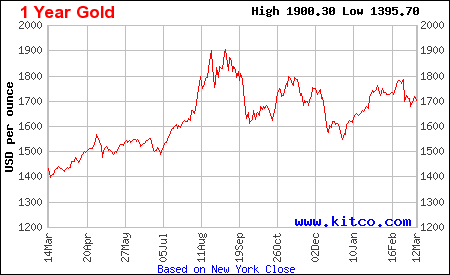
Less demand leads to lower gold prices as reflected in the chart below. Some analysts say the 11-year bull market in gold is over, gold is in a bubble that has or is about to bust.

Gold 1 year chart

If that be the case, clients of GoldMoney & BullionVault (two of the more established and popular physical gold dealer and custodians) have got it all wrong and hence are “of all men most to be pitied”. Look at how their collective gold holdings have been increasing relentlessly, even during periods of sharp price declines.

Gold Holdings Comparison: GoldMoney VS BullionVault

This short term chart covering the period since gold’s intermediate top in August 2011 shows steady increase of total holdings from quarter to quarter. The growth at BullionVault is particularly impressive.

GoldMoney & BullionVault: Quarterly Change in Gold Holdings

-
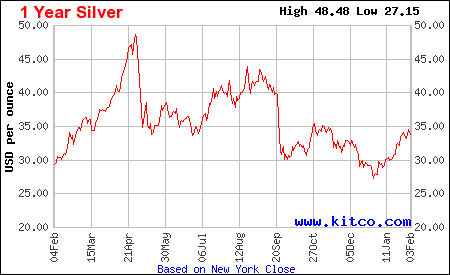
The same goes for silver.

Silver 1-year chart

Silver Holdings Comparison: GoldMoney VS BullionVault

GoldMoney & BullionVault: Quarterly Change in Silver Holdings

What then can be said of the apparent dichotomy between the declining trend in gold & silver prices and the increasing demand seen in the metal purchases? Just two words:

Paper & Physical

Prices reflected in the charts come about mainly by “traders” trading paper gold & silver. Traders is put between quotes because they are not the normal traders you’d expect to find in a free market. Most of the trades that determine the price trends are placed by very few large bullion banks and High Frequency Trading (HFT) machines. Yes, the prices are greatly influenced by trades initiated by machines preprogrammed with sophisticated algorithms to set the price which ever way the owners wanted them to go. In case you’re wondering, who may be the people on the other side of these trades? It’s people like this, who sets up trades hoping to beat the supercomputers on the other side only to get sucked in and forced to dump when their stops are hit.

On the other hand, real humans are behind the accumulation of physical metals at BullionVault, GoldMoney and many other private vaults. These are the same humans that do not believe the spin of the MSM, but hold on to the view that the financial crisis is not yet behind us. They believe that the worse is yet to come. I’m one of them. We understand that holding our savings and retirement funds in paper assets and paper money is most likely to result in a massive loss of purchasing power through hyperinflation when the real crisis hits.

We’re not 100% sure it will happen, neither can we be 100% sure it won’t happen.

What about you? Paper or physical?

-

Data source

-

Related Articles:

-

Follow

Get every new post delivered to your Inbox.

Join 175 other followers