Archive

Posts Tagged ‘CinC’

Endgame: When Debt is Fraud, Debt Forgiveness is the Last and Only Remedy

September 2, 2011 Leave a comment

Republished with permission of Charles Hugh Smith | oftwominds

-

We hold this to be self-evident: When Debt is Fraud, Debt Forgiveness is the Last and Only Remedy.

Today I present an important guest essay by long-time contributor Zeus Yiamouyiannis, who suggests that when debt is essentially fraudulent, then debt forgiveness is both the logical and the only remedy. In case you missed his previous analyses on oftwominds.com, I list some of Zeus’s previous essays at the end of the entry.

Endgame: When Debt is Fraud, Debt Forgiveness is the Last and Only Remedy
by Zeus Yiamouyiannis, Ph.D., copyright 2011.

-
Introduction

Finally serious economists are considering a position I have been maintaining and writing about since the 2008 financial meltdown. Whatever its name— erasure, repudiation, abolishment, cancellation, jubilee—debt forgiveness, will have to eventually emerge forefront in global efforts to solve an ongoing systemic financial crisis.

On a grand scale the only way to erase counterfeit money and (counterfeit) assets of hundreds of trillions of dollars is to erase the debts associated with those fake assets. (Let me underscore again, these are not “toxic” assets, they are fake assets.)… Forgiveness in general, and forgiveness of debt in particular, stand as virtues if they free us up to acknowledge, address, and learn from our culpability, start anew, and create forward.” (The Big Squeeze, Part 3: The Quiet Rebellion: Civil Disobedience, Local Markets, and Debt Erasure - January 29, 2011)

Debt forgiveness, therefore, accomplishes two important things. It eliminates the increasing and outsized portion of productive enterprise to pay off unproductive obligations, and it clears the ground for new opportunities, new thinking, invention, and entrepreneurialism. This is why the ability to declare bankruptcy is so essential in the pursuit of both happiness and innovation.

Currently we are mired in a “new normal” and calls for “austerity” which are nothing more than the delusional efforts of a status quo to avoid the consequences of its own error and fraud and to profit evermore. So bedazzled by the false wealth created by debt multiplication and its concomitant fantasy of ever-higher returns, this status quo continues to be stupidly amazed that people are not spending and that the economy is not picking up. But how could it be otherwise?

Productive wealth has been trapped in a web of parasitic theft, counterfeiting, liability evasion, non-regulation, and prosecutorial non-accountability. All the fundamental attributes of a functioning exchange economy have been warped to reward creative criminals. I spoke extensively about this in my posts from 2008. (Imaginary Worth, Empire of Debt: How Modern Finance Created Its Own Downfall - October 15, 2008)

The unsustainable nature of debt

Two observations: 1) Fabricated/parasitic so-called “wealth” destroys value by diluting the value of productive wealth. 2) Debt/credit that cannot be paid back is never an asset and is always a hot-potato liability (needing to be foisted to a greater fool to garner “profit” and transaction fees):

The models [modern debt are] based upon had no contact with reality. They assumed unlimited growth and ability to pay. When matched against the reality of people paying ten times their salary for mortgages that actually added more money owed to their principal (i.e. with negative amortization), required no money down, and set up “balloon payments,” large step-ups in payments after a few years) there is no possible way they could NOT default in a predictable span of time. (Part II: How the Credit Default Swap Scam Works - October 13, 2008)

Systemically, all debt that charges a percentage (“usury”) originates in delusion. Debt grows exponentially indefinitely, growth (income and otherwise) cannot. This leads to a widening condition where the fruits of productive “growth” devoted to interest payments increase until those fruits are entirely consumed. (The Elephant In The Room: Debt Grows Exponentially, While Economies Only Grow In An S-Curve - Washington’s Blog)

Once this happens, stores of wealth (hard assets) begin to be cannibalized to make up for the difference. You see this in Greece with its sale of public assets to private companies, and in middle-class America where people are liquidating retirement accounts to pay for their cost of living.

This problem is compounded by a private Federal Reserve that lends money into circulation at interest, and then allows the multiplication of this consumer debt-money liability through fractional reserve banking. The money in circulation today could pay only a small fraction of the total private and public debt. That fact alone is evidence of a kind of systemic fraud. “If you just work hard enough, save, and make sensible decisions, you can get out of debt” could only physically work for a bare fraction of the population, given the money-to-debt ratio. The rest would have to simply default to clear the boards.

This is why debt forgiveness makes not only moral but rational, mathematical sense. Finances require balancing to be coherent. There must be some way to redress systemic imbalance. One has to be able to “zero the scales” to get an accurate weight of value and to re-establish healthy value creation.

Voices in the debate

Some analysts are beginning to see the forest through the trees in terms of debt forgiveness. Steve Keen, Australian economist and current deflationist, and Michael Hudson, American economic contrarian and prescient essayist, are both using clear-sighted reality-based financial analysis to debunk accounting games that obscure the untenable debt situation and to call for debt forgiveness.

How can selling sovereign assets and imposing austerity on Greek citizens (taking money out of their hands through higher taxes and lower benefits) do anything other than hollow out value and contract the Greek economy in the face of a deep global recession? Michael Hudson: It can’t. Greece’s debt needs to be written off.

It seems unreasonable and unrealistic to expect that large sectors of the New European population can be made subject to salary garnishment throughout their lives, reducing them to a lifetime of debt peonage… (T)he only way to resolve it is to negotiate a debt write-off…” (The Coming European Debt Wars: EU Countries sinking into Depression - Michael Hudson, Global Research, April 9, 2010)

-
([We’ll Have] a Never-Ending Depression Unless We Repudiate the Debt, Which Never Should Have Been Extended In The First Place - Washington’s Blog)

Why isn’t “quantitative easing” and flooding the U.S. economy with debt-money working to prime borrowing and lending? Steve Keen: Because the money is going into deleveraging in a time of overextension:

“Bernanke is throwing (a) trillion dollars into the system. Rather than that leading to ten trillion dollars of additional credit money, creating the inflation people are expecting, that trillion dollars is all that goes in, and people deleveraging actually reduce their level of spending by more than a trillion dollars by trying to pay their debt down, and it cancels out what the government is trying to do… We need a 21st century jubilee.” (On the Edge with . . . Steve Keen (Max Keiser, video)

Other well-known commentators are not seeing the debt forest at all. In their contentious debates over deflation and inflation, neither Rick Ackerman nor Gonzalo Lira seem to be aware of the overwhelmingly fraudulent nature of present global debt– including the 600 to 1,000 trillion dollars of fabricated notional wealth represented by the derivatives markets, fraudclosure, and a host of other sources.

Rick Ackerman: “’Ultimately, every penny of every debt must be paid — if not by the borrower, then by the lender.’ Inflationists and deflationists implicitly agree on this point… and we differ only on the question of who, borrower or lender, will take the hit.” (Let’s Think This Through Together….)

I posted a pithy response in the comment section:

Both Rick and Gonzalo left out the obvious third way–debt forgiveness. No… debt does not have to be paid by someone; it can be absolved, especially debt created upon fraudulent and/or counterfeit-ridden practice… (D)erivatives are not real wealth, and neither was the ostensible climb in the values of housing resting in large part on those phony-wealth derivatives.
The only “real wealth” here revolves around ability to produce real and needed goods (to allow us to survive), and the ability to create something that increases one’s quality of life (to promote our thriving). Precious little of the present global economy involves either one of these. Yeah, if we use FASB standards and Goldman Sachs accounting, we can pretend our worthless junk is all really simply very rare, “unique condition” collectibles worth trillions of dollars.

I’ve got a better idea. Take our financial junk out of the global attic in boxes, put them out on the front lawn, and see if anyone wants to pay a few bucks for the various items, give away the leftovers to anyone interested passing on the sidewalk, and recycle, donate, or dispose of the rest. It’s a moving sale, and if our economy is going to get moving, maybe we ought to have one.” (Zeus Yiamouyiannis - April 6, 2011 at 4:11 pm)

How it might play out

This subtle debt extortion creates a system of never-ending debt-slavery for a vast majority of the population. When this “manageable” slavery is aggravated by a desire to use hardship to extort ever greater assets from the overburdened at ever cheaper prices (what Naomi Klein calls “disaster capitalism”), by open and unapologetic widespread fraud, and by the unjust offloading of risk and liability to taxpayers who had nothing to do with poor decisions of private banks, then the systemic abuse is revealed in the daily lives of citizens.

Debt creates scarcity, which stimulates fear, which drives manic competition, which favors opportunism, collusion, and concentrations of power, which translates to abuse, which results in a collapse of legitimacy for the economic system. Overreach causes a breaking point, and we are getting close to it. Will the response be warfare, taxpayer revolt, political upheaval, mass default, debt forgiveness, something other, some combination? I have predicted pockets of violence would be mixed with some softer combination of taxpayer revolt, mass default, political upheaval, and debt forgiveness, along with a return to community exchange to meet basic needs. (The Big Squeeze, Part 3: The Quiet Rebellion: Civil Disobedience, Local Markets, and Debt Erasure - January 29, 2011)

This possibility of epic reprisal may very well compel banks to come to the table around debt forgiveness to avoid violent backlash and criminal prosecution, even over preserving their gravy train companies. The bitter irony of these companies and their galloping greed is that they ended up victimizing each other by selling junk to each other and extracting all the real value in salary and bonuses. Their assets rest on notional values, that when unmasked would drive each into immediate insolvency. They have simply been scam artists, producing little value and extracting mountains of money.

What might this look like? Looking at present trends and using the very useful framework of Kubler-Ross’s stages of grief, it might go something like this…

Average debtor:

  1. Denial: Liquidate savings to pay for over-priced house and cost of living.
  2. Anger and fear: Exhaust resources, experience want, compounded by austerity measures.
  3. Bargaining: Attempt to negotiate with bank through HAMP and other mechanisms to lower payments. Banks don ‘t bite and even have incentives to foreclose.
  4. Depression: Lose/default on the house and move in with family or cheap rental.
  5. Find out life is better without being a debt slave and spend more time with community and the ones you love.

Bankers:

  1. Denial: Collect 144 billion in bonuses after financial collapse and laugh as not a single trading day loss arises for zombie TBTF banks completely subsidized by governments.
  2. Anger: Express false righteousness, indignation, and hubris over even modest/toothless demands/regulations attempted to be placed on them by governments. Exhibit sadistic zeal at being able to simply claim you own and liquidate properties they have no clear title to.
  3. Bargaining: Experience dawning awareness that may have just cooked your own gooses as strategic defaults skyrocket, populist demands to prosecute fraudclosure gain traction, and quantitative easing ad infinitum dwindles and fails to keep stock prices artificially aloft. Improvise panicked attempts to “be reasonable” and actually negotiate, once the asset and money flow well runs dry.
  4. Depression: Contemplate and realize possible bankruptcy by big banks. Retreat to the Hamptons to hire criminal defense lawyers, contemplate empty life, and shoulder the abuse of media and contempt of a global citizenry.
  5. Acceptance: Trying to regain “good guy” status and avoid criminal prosecution by agreeing to be part of debt forgiveness.

Once defaults happen in increasing numbers and certain asset prices plunge (i.e. real estate), what will initially look like a bonanza for capitalist parasites could easily get out of hand, with people either unable or unwilling to buy inventory even at greatly reduced prices. Profits would tank at banks, liabilities would skyrocket even with most of it transferred to government guarantee. Because no one plays the game anymore, banks could go under as well, as people rise to vote out bank-friendly politicians and simply refuse to pay. This unraveling could easily force exposure of the notional value of derivatives in banks as worthless, meaning they are as bankrupt as the people they exploited. At this point, there will be a common desire and need to simply “forgive” the debts and try to find some way to distribute these empty homes.

Conclusion

Debt forgiveness simply calls out either the inherent systemic inability to make good on debts or the recognition that debt was produced through fraudulent means. In the present situation, both conditions obtain. There has likely been no point in world history where debt forgiveness has been so comprehensively merited. The only speculation from my point (barring world-wide global feudalism and eternal debt slavery) is whether we will initiate such forgiveness or be forced into it.

-


Thank you, Zeus, for this prescient and insightful analysis of debt and debt renunciation. The Kondratieff Cycle can only turn to Spring after debt renunciation completes the Winter cycle. Let’s stop pretending we’re still in Summer, and that the Fed’s puny “quantitative easing” and monetary cargo-cult machinations can reverse the seasons.

(all essays by Zeus Yiamouyiannis, Ph.D.)

Part I: A 70 Trillion Dollar Counterfeiting Ring
(September 23, 2008)

According to several sources the market for so-called “credit default swaps” last year alone was nearly equal to the total global GDP, around 70 trillion dollars by some estimates. Yet these derivatives have no discernible “origin” or value.

Part II: How the Credit Default Swap Scam Works
(October 13, 2008)

Instead of asking the obvious, complex, and obscuring question, “What value DO they have?”, one should ask the elegant and simple question, “What value COULD they have?” Even a cursory examination would seem to indicate that the answer is either zero or less-than-zero.

Part III: Credit Default Swaps Create Less-Than-Zero Value
(October 13, 2008)

Now, how can a supposed “asset” like credit default swaps have a “less-than-zero” (negative) value. First, credit default swaps were insuring debt. Debt is not an asset as I explained in previous essays, but a liability. Mistake number one was to confuse asset and liability.

Part IV: There Is Ultimately No Gaming the System: When the Micro Crash Reflects the Macro Crash
(September 29, 2008)

The proposed 700 billion dollar bailout cannot really “work” from a system level. I know it’s real intention is to cover the butts of Wall Street investors, but you have the same problem in macro that homeowners have in micro. Nobody knows what homes are worth right now, so buyers are sitting it out. It isn’t about restricted credit (even though that is a factor). It isn’t about being too cash strapped to make a down payment (though that too is a factor). It’s about not wanting to be suckered into buying something that may still be overpriced.

-
Related Articles:

Why $20,000 Gold doesn’t excite me

August 24, 2011 3 comments

-

It scares me!

Gold punched through $1,900 today. If the current financial system can withstand the stress and remained intact till the day gold trades at $20,000 an ounce, what will life be like then?

If we’re holding gold at that time, we may be doing fine but we are not likely to be 10 times richer. That’s because nothing much has happened to our gold. Rather, paper currencies would have lost so much purchasing power that it would take 10 times more of the same to buy what we could buy today. A Big Mac will most likely cost around $43 in the US. In Malaysia, NZ and Britain, it’ll like be  around RM76NZ$54 and £25 respectively (estimates based on Big Mac Index). When a basic meal costs that much, life can be very tough for savers who continued holding on to their paper currencies or other paper assets.

Many of my friends and relatives, from retired professionals to missionaries have been ill advised to rely on supposedly safe or high yielding investments like mutual funds, government managed pension schemes, term deposits or hot stocks to generate passive income or preserve the value of their retirement funds. Despite being presented with information from this website and elsewhere, there’s little affinity shown towards gold or silver. This scares me and for their sake, I hope gold does not get anywhere close to $20,000 before they get on board.

What’s even scarier is the fact that an enormously huge segment of society do not have the means to get on board, even if they wanted to. We’re looking at the 1.4 billion people living on less than NZ$2.25 a day. That’s less than 0.05 ounces of silver! They worry not about the Fed nor the Cartel but about how to provide food, clothing, housing and healthcare with that amount each day. It’s about survival, not savings. Pause for a moment to imagine their plight when gold hits $20,000.  Spare them a thought today, and check out their appeal for assistance.

Why $20,000 gold?

In this recently released documentary, Mike Maloney presents the case for $20,000 gold by stepping back and looking at the big picture. He takes us back, very far back, and paints us a very big picture. This excellent educational video is a must watch, especially if you’re new to the Political Metals space. It’ll be your 90 minutes well spent.

But if you can’t spare the time, I’ve highlighted some of his key points with some new charts below for a quick read.

-

Dow/Gold Ratio Chart: Where are we in the Wealth Cycle? 

Using the Dow Jones Industrial Average (Dow) as a measure of performance of the equities market in general, the ratio of the Dow to the price of gold indicates the performance of equities market relative to gold. Currently each point of the Dow is worth about 6oz of gold. During the process of correction after the biggest stock market bubble in history, the ratio is expected to head towards the historical mean (4oz) and overshoot it before finding its fair value again.

Historical Dow Gold Ratio since 1900

The bigger the bubble (deviation from mean), the larger the overshoot. During the present cycle, Mike expects the overshoot to touch 0.5:1 (1 oz of gold worth 2 points of Dow). In its extreme, the Dow would have to collapse from 11,000 to 950 if the price of gold remains at current level of $1,900. Conversely, gold will increase to $22,000 if the Dow remains at current levels.

Relative performance of Dow Vs Gold & Silver since Jan 2000
(Worst reference point, at peak of stock market bubble)

Dow Vs Gold & Silver Since 2000 (at peak of Stock Market Bubble)

Relative performance of Dow Vs Gold & Silver since March 2009
(Best reference point, at the start of QE1)

Dow Vs Gold & Silver Since 2009 (at start of QE1)-

Currency Supply Chart: Where are we in the Inflation/Deflation Cycle?

For simplicity, “money” & “currency” are used interchangeably here. Watch the video to see the difference.

Monetary inflation is the increase in money supply resulting in price inflation (rising prices of goods & services), with a time lag between the former and the latter. The reverse applies to monetary deflation and price deflation. Studying the trend in money supply or the total amount of currency in circulation (CinC) over a period of time gives us an idea of where we are and where we’re heading in terms of inflation and deflation.

Money is created in two stages. The initial Base Money is created by the Fed (or other central banks). More new money is then created (up to 9 times the initial Base Money) within the private banking system through credit. It is loaned into existence. Watch the video to learn more about the money creation process.

CinC minus M1

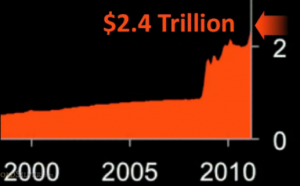
The chart above  represents the amount of CinC that’s exclusively created by the private banking system. The highlighted area indicates that this component of the overall money supply has dropped by $1.7T since the 2008 crisis. This is the Debt Collapse or Credit Contraction. Less lending by banks results in less money chasing goods and services, leading to price & asset deflation. It is evident from the chart that a contraction of this magnitude has never happened since 1960. The last time it happened was just before the Great Depression of the 1930s.

M1: Increase in Base MoneyIn response to this credit contraction, and in an attempt to prevent another Great Depression, the Fed has been rapidly increasing the Base Money supply by creating new money. The recent rate of increase is unprecedented. The first trillion dollars was created over a period of about 90 years. The next $1.4T came into existence over the last 2 years!

This rapid increase in Base Money (red chart) was an attempt to offset the decrease in the credit money (blue chart). When we add these two components of money supply together, we obtain the total CinC (Base Money plus Credit Money) as shown in the chart below.

Total CinC

Notice the contraction at the top of the chart, albeit a smaller one. It is evident that despite the frantic pace of money printing by the Fed, it has not succeeded in offsetting the reduction in money supply due to credit contraction.

The Fed has little choice but to continue creating money.  With such a large perturbation in total currency supply and due to the complexity and size of the monetary system, it is not possible for the Fed or anyone else to create just sufficient money at just the right rate such that the total CinC won’t overshoot its long term trend. The principle that the larger the deviation from the mean, the larger will be the overshoot during the correction applies here as in the stock market above. The fact that there’s an undetermined time lag, between monetary inflation and price inflation further adds to the likelihood that the next round of money printing will result in a massive overshoot. Coupled with other factors, hyperinflation could be just round the corner.

Deflation or Inflation?

In his book, Rich Dad’s Advisors: Guide to Investing In Gold and Silver: Protect Your Financial Future, and again in his presentation, Mike predicted the following sequence of events:-

  1. Threat of deflation – At the onset of the 2008 crisis (Past)
  2. Money printing – TARP, QE1, QE2 (Past & more to come)
  3. Big inflation – Here and now (anyone disagree?)
  4. Real deflation – Asset deflation in real estate & stock market (The severe but short deflation  is ahead)
  5. Hyperinflation – Just round the corner?

How does gold perform under inflation and deflation environment? Check out the study by Oxford Economics: “Impact of inflation and deflation on the case for gold”.

Related Resources:

-

New Digital Currency backed by nothing outperforming all other fiat currencies

June 13, 2011 Leave a comment

BitCoinJust around the time silver suffered a waterfall decline, one little known “asset class” experienced an explosive gain of around 800% in a matter of weeks. It’s not gold, certainly not silver.
It’s BitCoin, a revolutionary 2-year old  Digital Currency that’s not issued by anybody nor owned by anybody, and hence not controlled by anybody. Utilising an ingenious decentralized structure, Bitcoin relies on cryptography and mathematics to ensure security and reliability. If you understand P2P technology, you get the idea.

At first glance, it appears to be a just another high-tech virtual currency backed by nothing, certainly not by gold or silver. But how does it compare with other fiat currencies?

The USD (or any local equivalent) in your pocket is backed by nothing save by the “full faith and credit of the US government” and can be created at will out of thin air. Unlike the USD & all other fiat currencies, new BitCoins cannot be created out of nothing by a select few. Work, in the form of computing resources, has to be expended before each new BitCoin can come into existence.

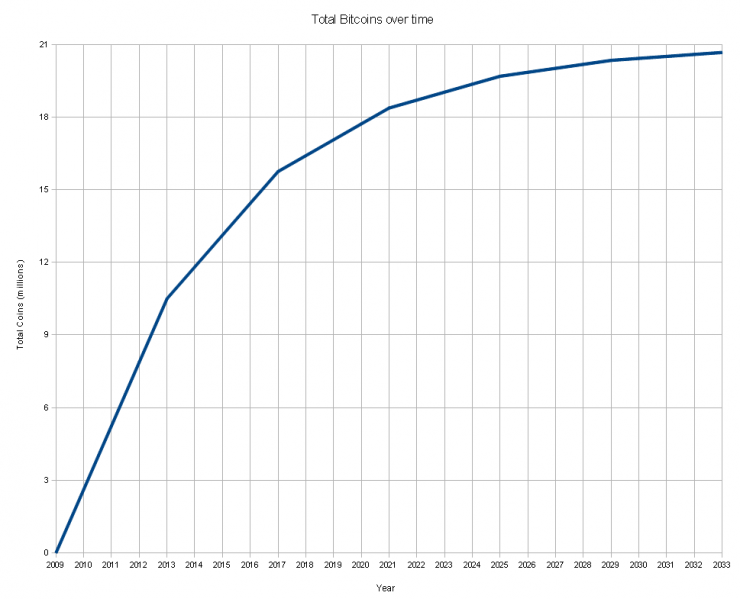
BitCoin in Circulation

BitCoin creation over time, with a maximum of 21 million. Current BTC in circulation is around 6,519,900

While Ben Bernanke or any other Central Banker is able to create an infinite amount of new fiat money, BitCoin has a built-in mathematical limit of 21 million BTC (unit of BitCoin), expected to be reached in the year 2140.

Perhaps the most significant is the difference in the rate of new money creation. Fiat money is being created at an exponentially increasing rate, while creation of new BitCoins is mathematically restrained to be increasingly more difficult to create over time.

Don’t have any BitCoins but want some? You may want to start Mining for BitCoins before it runs out!… Or considering how difficult it already is, you’ll probably be better off just waiting to invest in a junior BitCoin mining company :)

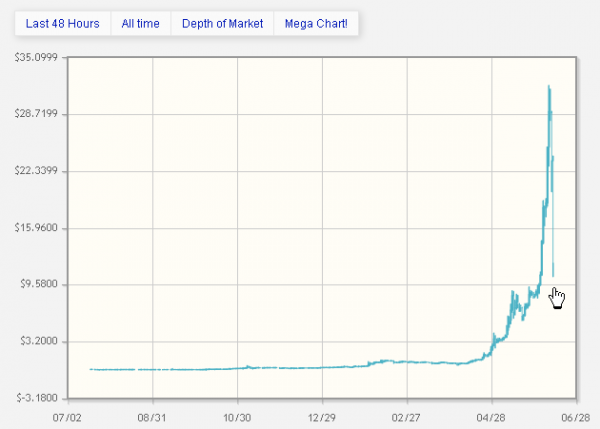
Could this potential scarcity be what’s driving up the BitCoin exchange rate over the past few weeks? Or was it just due to a burst of publicity. Whatever it is, anything that rises in a hyperbolic manner falls just as fast. See the chart below, captured at time of writing (11.30am NZT).

BitCoin Exchange Rate

BitCoin Exchange Rate as at June 13 NZT

-

Watch the Startups interview with Gavin Andresen and Amir Taaki, 2 of the developers currently behind BitCoin (recorded when BitCoin was at about $5).

-


You may want to fast-forward to about 7mins into the video

-

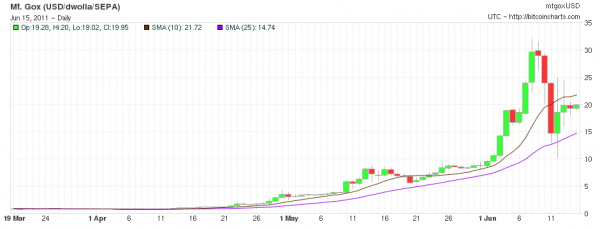
Updated: 15 Jun 2011 – BitCoin exchange rate has bounced off its recent low as quickly as it fell. Currently between it’s 10 day and 25 day simple moving average.

BitCoin Chart - Mt. Gox Exchange (USD per BTC) as at 21:45hrs 15Jun NZT

BitCoin Chart - Mt. Gox Exchange (USD per BTC) as at 21:45hrs 15Jun NZT

Click on the image for live chart

-

The Economist’s Perfectly Useless Gold

June 1, 2011 5 comments

On the Letters’ page of The Economist last week, Nils Sandberg from Cambridge University’s Judge Business School presented a common argument against gold’s current value.

SIR – Buttonwood discussed the possibility of gold as a bubble (April 30th). Of course it is—it has almost no real value and, as you say, no revenue or cashflow. It is an iconic commodity both emotionally as jewellery and intellectually as a stable investment, and has long been a guiding point for commodity inflation. But what gives it that place?

Gold has few uses beyond jewellery, and yet the trading of gold internationally is many times larger than that industry. Today it, like a share with no dividends, is a purely speculative investment and its value is entirely a function of such speculation. A high gold price does not cripple an industry or a nation; the current owners just get richer. A currency with a constant influx, the rise in value of gold is like a great Ponzi scheme where the future must always pay today’s bills.

Commodities with stable consumption and high volume production (like wheat and iron) are better indicators of real prices and as they continue to rise inflation is a risk. Gold is different. One day the money will dry up, and the house of cards will fold.

Nils Sandberg
Judge Business School
Cambridge

-

Here’s founder & CEO of BullionVault, Paul Tustain’s response.

Tuesday, 31 May 2011

Would you – or China – rather own gold 8 years from now, or US Treasury bonds…?

According to him, gold is in bubble territory because it has few industrial uses. Disproving Mr Sandberg’s thesis is childishly simple.

  • Take one $20 bill out of your wallet;
  • Consider the industrial applications of the paper it is printed on;
  • Now burn it.

Well, why didn’t you? After all, its value – according to Mr Sandberg’s thesis – rests on the paper’s usefulness in industrial processes.

Nevertheless it’s still interesting to understand why gold (like $20 bills) is valued above its manufacturing relevance. Unsurprisingly the answer lies in marginal utility.

Gold offers humanity one exceptionally useful property; it has an extraordinarily stable stock. There are 166,000 tonnes of the stuff above ground (worth about $8 trillion) of which about 88% is held as a value store of sorts, in jewelry (52%) and bullion (36%). The stock is growing by about 1.5% a year, from the combined efforts of all the world’s miners.

It is because gold is each of (i) geologically rare, (ii) elemental (i.e. incapable of being manufactured) and (iii) industrially useless, that it has this reliable stock quantity. Nothing else can do it; not silver, which is 80 times more common in the ground, nor platinum, which is far too useful as a catalyst to offer stock stability.

Reliable scarcity is the key property savers require of money, which otherwise fails to store value. But of course we don’t need gold to deliver reliable scarcity, we can usually create that reliable scarcity artificially, as we do with our modern currencies.

Now the marginal utility explanation. When new currency is too freely issued reliable scarcity becomes under-supplied, and savers go in search of it. Having seen artificial reliable scarcity fail in one currency, the promise of it in another is unconvincing, so they turn to natural reliable scarcity, and demand for it increases dramatically as governments print money. This is what drives gold up.

Mr Sandberg is right though, that gold will eventually go down again, when currencies’ artificial scarcity once more becomes reliable, and when those currencies start to generate a yield. But in the meantime it looks irrationally optimistic to hope that the US government – faced with a $21 trillion debt – will not print more and more money.

The question, therefore, is whether the savers who own $100 trillion of dated debt instruments in the bond markets will take fright at continuing money printing policies of the US and other governments. That $100 trillion of dated debt has already started running down the clock. It is shifting to the short end, where it behaves more and more like cash. Maybe its holders will demand cash (as is their right) at its redemption. The sums involved would swamp the $15 trillion of cash and near-term deposit instruments currently in issue.

People who choose to buy gold are increasingly aware of this possibility. We don’t know whether the Dollar, the Euro, the Yen and the Pound (all of which have started a debt market drift to the short end) will ultimately go into the currency death spiral. We are just mindful that it is the usual destiny of currencies driven by political expedience toward the printing press. It looks like a possibility at least.

To finish with here’s the brainteaser which the Chinese are currently wrestling with. Now that you know the US debt profile is slowly shifting to the short end, and represents about six times the currency in issue, you are required to choose today something to own in 2020. What would you (or China) rather have – a tenth of the US Treasury’s paper bond debts, or five times its very large gold reserve?

At current market prices these two are worth about the same. But in the intervening 8 years, the US government has budgeted to issue $8 trillion net of its own bonds, representing an increase in the stock of 57%. A further $1 trillion of gold will be mined worldwide, an increase in the global stock of 12%.

Paul Tustain
BullionVault


-

… But 

who has been, and will be buying up all these debt?

FED Monetary Base as at May 18 2011

FED Monetary Base as at May 18, 2011

-

and while they’re printing all these money, they might as well print more food stamps. 

Food Stamps

Maybe that’s why they say gold is useless. Who needs gold when you’re living out
The American Dream – Free Money, Free Food, Cheap Housing!

“Double dip” declared as U.S. housing prices tumble

-


The Printing Continues… QE3 within sight?

February 25, 2011 3 comments

This is the most recent US Money Supply (M2) data and Adjusted Monetary Base as at February 24, 2011. To obtain a big picture view of the rate of monetary base expansion expansion since 1961, see Money Supply chart appearing in my previous post Investing in PMs or Holding PMs.

U.S. Money Supply as at Feb 24, 2011. Source: Federal Reserve Bank of St. Louis

U.S. Money Supply as at Feb 24, 2011. Source: Federal Reserve Bank of St. Louis


Adjusted Monetary Base

Adjusted Monetary Base. See how it's going VERTICAL again

If this trend does not look bad enough,  the recent statement by Kansas City Fed President Thomas Hoenig may give an idea of where this chart will go beyond the “end” of QE2 in June 2011. With the recent sharp rise in oil prices downward pressure on the stock market and economy in general, QE3 may be just round the corner!

Feb 1 (Reuters) – The Federal Reserve could debate extending its bond-buying program beyond June if U.S. economic data prove weaker than policymakers expect, Kansas City Fed President Thomas Hoenig said.

Another round of bond buying “may get discussed” if the numbers look “disappointing,” Hoenig told Market News International in an interview published on Tuesday.

And the reason for the sharp rise in the adjusted monetary base can be seen in the 2 charts below. The first shows top holders of US federal debt as at October 31, 2010. The second as at December 31, 2010. When foreign nations slow down or stop buying US treasury holdings, the Federal Reserve becomes the lender of last resort. That’s when the QE programs run at full steam creating money out of thin air and lending it to the US government.


Top holders of US debt as at October 31, 2010

Top holders of US debt as at October 31, 2010

- Click on chart to see larger image -

Top holders of US debt as at December 31, 2010

Top holders of US debt as at December 31, 2010

It gets worse. China sold $34.2bn of US treasury bonds in December 2010, raising fears that ­Beijing is using its financial ­muscle to signal that it has lost confidence in American economic policy.

Higher inflation coming to a country near you.


Investing in PMs or Holding PMs?

January 20, 2011 8 comments

-

This is a continuation of my previous post – Gold & Silver: Precious Metals or Political Metals?

-

Silver Flash Crash

Updated: May 1-6, 2011 Silver volatility. Click for details

Volatility & counter-intuitive price actions are the order of the day for any holders of gold & silver. When you see an apparently “unexplainable” price movement in gold and silver (as is the case since the first trading day of 2011 till the time of this writing), it’s when you have to start viewing them as Political Metals to be held and owned rather than Precious Metals to be invested in. Otherwise, you’ll either never get on-board the PMs bandwagon, end up loosing lots of sleep if already on-board, or worse still, doing the unthinkable – sell in a panic during a bull market hoping to buy back lower. It’s worth noting what a gold veteran, Franklin Sanders, said:

You never make the big money in trading, but in getting it right and WAITING. Ultimate peak of this bull market lies three to ten (3 to 10) years away. Hold on. Wait….

This strategy began to make even more sense to me when, in addition to viewing gold & silver as Political Metals, I stopped thinking of my purchase of PMs as an “investment”. According to Wikipedia,

Investment is putting money into something with the hope of profit. More specifically, investment is the commitment of money or capital to the purchase of financial instruments or other assets so as to gain profitable returns in the form of interest, income (dividends), or appreciation (capital gains) of the value of the instrument.

If I had viewed buying PMs as an investment, I would have started out with a certain percentage of my savings, say “X” dollars. I would have bought “Z” ounces of gold and hoped to sell it for “Y” dollars in the future. If Y was greater than X, it was a good investment and I would have made some money. I would have increased the amount of dollars I hold and hence increased my asset base. Since money has 3 basic functions (a medium of exchange, a unit of account and a store of value), I would have used paper currencies as a store of value (means of savings). Gold was just a financial instrument which I owned temporarily, hoping to exchange it for more money in the future.

I did not, and here’s why.

Today’s paper money is a poor store of value

The above mainstream view of money and investment in gold & silver holds true as long as paper currencies continued to perform its third function (store of value) faithfully. Sadly, this is not the case as shown in the chart below. The world’s reserve currency has lost as much as 98% of it’s purchasing power since the creation of the Federal Reserve System in 1913. The massive loss of purchasing power holds true for all other currencies, many of them much more severe than the US$.

-

How and when your US Dollar lost 98% of its purchasing power.

How and when your US Dollar lost 98% of its purchasing power.

-

Since the financial disaster in 2008, the US Federal Reserve has increased it’s monetary supply like never before in it’s history. The chart below extracted from a WSJ article Get Ready for Inflation and Higher Interest Rates indicates how much money they have created out of thin air (money that never existed before) and pumped into the financial system. When even a small portion of this newly created money begins to flow into the economy as Currency in Circulation (CinC), it’s not hard to imagine what that 2 cents that’s left over from the original dollar will be further reduced to!

-

Exploding Money Supply

Exploding Money Supply


The US is not alone. See who else is cranking up their printing press.

Feb 25 Update: The Printing Continues 

-

However, when I consider PMs to be a store of value and a means of account while utilising paper currencies only as a medium of exchange, things become a lot simpler. I will be keeping track how many ounces of gold and silver I have as my savings rather than counting how many dollars I have in my bank account or how many dollars my Precious Metals “investment” portfolio is worth at any time. In my example above, “Z” will be more important to me than “Y” because I hold PMs. I don’t invest in PMs. Short term price volatility becomes a non-issue because fundamentally, the limited supply of physical PMs makes them a superior store of value compared to the unlimited quantity of paper or electronic money that can be created at will out of thin air by bankers.

That sharp rise of monetary supply seen in the chart above happened after the first round of Quantitative Easing (QE1) amounted to slightly less than a trillion dollars. Since then, another round of monetary base expansion referred to as QE2 was announced in November 2010. It is currently ongoing and will run till the third quarter of 2011. QE2 is estimated at $900 billion. Try to figure how the chart above will look like by the end of this year! I’ll be highlighting this as it develops.

Take a 2-minute break to watch this video on paper currencies versus gold & silver as money. It pretty much summarises what you’ve read so far.

-

Update on Aug 24, 2011
[Watch a full feature documentary that explains these issues in depth: Why $20,000 Gold doesn't excite me.]

-

Finite quantity of gold Vs infinite quantity of Fiat (paper or electronic) money

Finite quantity of gold Vs infinite quantity of Fiat money

So much about paper money. Consider some gold facts & figures:

Total above-ground gold ever mined is estimated at around 130,000 tonnes (a cube with sides of 19 m, smaller than the length of a tennis court). Divided amongst the population of the world there are about 20 grams (0.64 oz) per person.

Annual production rate is estimated at 2,600 tonnes (2% per year). Comparing these facts with the two charts above gives an idea of paper money supply increase versus gold supply increase. The figures for gold’s monetary cousin, silver, is even more staggering.

Another great reason to hold PMs

When compared to paper money, it has been shown that PMs act as a more superior store of value (means of saving). It has also been shown to outperform currencies in 2010 by as much as triple digit percentages. But how do PMs perform in the longer term and relative to the other asset classes? The chart below plots the relative performance of gold, silver and the S&P 500 over the last decade referenced to dollar prices on 2nd January 2001 until the time of writing. Gold and silver have increased in value by over400% and 500% respectively while the general stock market remained flat over that period. When adjusted for inflation, a typical investor in equities would have booked a loss in real terms over this period.

Political Metals, gold & silver, outperforms stocks in general over the last 10 years

Political Metals, gold & silver, outperforms stocks in general over the last 10 years

Update on Aug 24, 2011
[It may seem "unfair" to compare PMs with stocks at the peak of the dotcom boom. The same stellar performance of PMs (especially silver) Vs stocks using the March 6, 2009 low following the 2008 financial crisis as the reference point can be seen in this chart and the follow up article Why $20,000 Gold doesn't excite me.]

-


-

Three Phases of a Bull Market, Four Phases of a Bubble. Where are we now?

Gold and silver priced in USD (and many other currencies) are at or near their all time nominal highs. They are however far from their approximate 1980 inflation-adjusted highs of $7,600 and $450 respectively.

Have I missed the boat? Isn’t it already too late to buy? What if the “gold bubble” bursts soon after I buy? These would be the obvious questions in the minds of anyone who is not yet holding any PMs.

It is timely to look at the big picture and see where we are in the current PMs secular bull market.

-

Stealth, Awareness, Mania, Blow-off phases of a bubble

Stealth, Awareness, Mania, Blow-off phases of a bubble. Reproduced with permission of Dr. J.P. Rodrigue

-
The Stealth Phase (Stage 1)

This is the early stage of the bull market. A time when gold and silver has been so beaten up by the previous bear market that no body wants to talk about them, much less buy and hold on to them. However, those who understand the fundamentals realize an emerging opportunity for substantial future appreciation. So the “smart money” and contrarian investors move in, often quietly and cautiously. This category of investors tends to have better access to information and a higher capacity to understand it. Prices gradually increase, but often completely unnoticed by the general population. In this current PMs bull run, the Stealth Phase ran from 2001-2006.

The Awareness Phase (Stage 2)

Also called the “Wall of Worry” phase, the Awareness Phase is when institutional and the savvy investors come into the arena. These investors start to realize the momentum, bringing additional money in and pushing prices higher. There can be a short-lived sell off phase (bear trap) taking place as a few investors cash in their first profits (there could also be several sell-off phases, each beginning at an higher level than the previous one). The smart money takes this opportunity to reinforce its existing positions. In the later stages of this phase the mass media starts to take notice and those getting in are increasingly “unsophisticated”.

….when gold climbed above $1,000, it only entered its second stage. – James Turk of GoldMoney. Nov 23, 2009

Silver is still in stage one. It won’t advance into stage two until $50 is exceeded, just like gold did not enter stage two until its previous high of $850 was hurdled. – James Turk of GoldMoney. Feb 14, 2011


The Mania Phase (Stage 3)

It begins when commentators who have been consistently wrong about PMs will be telling everyone willing to listen to buy gold. The excitement created by the mainstream media convinces everyone that this is where fortunes are made. The crowd starts rushing into PMs. These “trend followers” don’t walk — they run to get on board due to their herd mentality. You will know that the mania phase phase is here when lines begin to form in coin shops, everyone at the party talks about PMs, your taxi driver and favourite shoe-shine man tells you they are buying PMs. Prices goes parabolic, and towards the later part of this phase, the smart money and contrarian investors begin to move out as quietly as they moved in during the Stealth phase.

The Blow Off Phase (Stage 4)

The tipping point is hit. Confidence and expectations encounter a paradigm shift. Prices drop, followed by a rebound during the denial phase when many try to reassure the public that this is just a temporary setback. Fear sets in and capitulation follows in earnest. After hitting the bottom in despair, it re-bounces and approaches the mean trend line, ready for the next cycle.

This brings me back to where I started.

I heard one group of analyst exclaiming “buy now before the price explodes!”, and another saying “sell – gold is in a bubble”. Yet another said “wait for a correction – the price has gone up too much recently”.

It’s your turn to make your call.

I trust that by going through the thought process behind my journey in recognizing gold and silver as Political Metals having a great potential to act as a reliable store of value, you would have received some food for thought. Invest some time to continue your own research and do your own due diligence.

A good place to start is navigating through some of the menu links at the top of the page. You find some selected research materials from reputable sources I’ve personally relied upon when I was accumulating PMs.

For absolute beginners, it will be beneficial to move your focus away from the price performance of PMs. Rather, take a step back and invest some time to understand some very important fundamentals before you consider buying your first ounce of gold or silver. Visit the Knowledgebase section, where some essential reference materials are laid out for you in order of importance.

Should you decide to convert part of your savings in paper currencies into PMs as a hedge against inflation and potential currency debasement, make sure you land up holding physical gold & silver and not “paper gold” like Gold Certificates, Gold Savings accounts, Pooled gold accounts, Gld or Slv ETFs or anything besides real physical metals with atomic numbers 79 and 47!

Owning physical gold and silver has NO Counterparty Risk. All other PMs financial instruments are merely paper or electronic representations of gold or silver.

Remember, in a crisis, any paper (or electronic) representation of anything maybe worth only the paper it’s printed on.

For more information, see How to buy & store PMs.

-

Be prepared for a financial catastrophe – Not because we’re 100% sure it will happen, but because we can’t be a 100% sure it won’t happen. – Chris Martenson

-

Follow

Get every new post delivered to your Inbox.

Join 175 other followers