Archive

Posts Tagged ‘Stocks’

Can you spot the Bubble(s)?

May 9, 2012 2 comments

-

With gold and silver gradually heading south since leap day, many PMs investors are beginning to get cold feet.  Then we have, over the weekend Charlie Munger, Berkshire Hathaway’s No.2 commenting that “civilized people don’t buy gold”. Not surprising – why would anyone bother since “gold is a barbaric relic” anyway.  And with Bill Gates saying he’s in the same camp with Buffett & Munger, are we missing something?

Today, GATA posted an “encouragement from Embry and Sinclair”, while Jim Sinclair wrote in his “Answering The Cries For Help” email despatch:

Today has been interesting in a perverse way. I have heard from every gold short who knows my name. I have heard from every weak gold holder that knows my name yelling for help. This time I cannot answer all the incoming communications. Nobody could.

A month ago I got over 3500 incoming emails in less than three hours. The shorts exulting by email really cannot expect an answer. Even the weak gold and frustrated gold share holders cannot expect me to assuage their pain one at a time. ..

It sure does look or sound scary out there. If I were a PMs investor, I’d probably be among the first to heed Sinclair’s advise “If you cannot stand the heat you must get out of the kitchen”.

But if you’re not investing in gold or silver, merely holding them as a form of currency, there’s really no need to panic. Take a minute to study the chart below. It puts things into perspective. And while you’re at it, try to see if you can spot a bubble or two!

-

Perspective: The BIG Picture
Mouse over each bar for details. Click on bars for data source.

Why did Buffet, Munger & Gates say what they said? The answer is in this video.

-

Sources:

?modestbranding=1

GoldMoney & BullionVault clients of all people most to be pitied?

April 13, 2012 3 comments

-

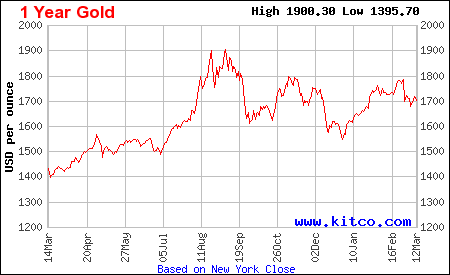
Gold priced in US$ has been declining from its high in August 2011. Wall street has it that it’s because the euro zone debt crisis is now under control, the US economy is recovering, inflation is low and the US unemployment situation is improving. Oh, not to forget there has been no more money printing and the Dow has gained some 20% since gold’s peak. In short, improving outlook has caused investors to move out of gold’s safe haven into riskier assets.

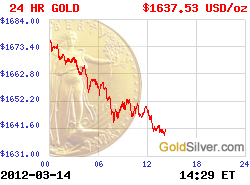
Less demand leads to lower gold prices as reflected in the chart below. Some analysts say the 11-year bull market in gold is over, gold is in a bubble that has or is about to bust.

Gold 1 year chart

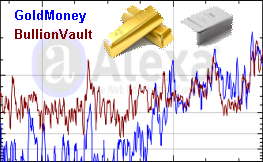
If that be the case, clients of GoldMoney & BullionVault (two of the more established and popular physical gold dealer and custodians) have got it all wrong and hence are “of all men most to be pitied”. Look at how their collective gold holdings have been increasing relentlessly, even during periods of sharp price declines.

Gold Holdings Comparison: GoldMoney VS BullionVault

This short term chart covering the period since gold’s intermediate top in August 2011 shows steady increase of total holdings from quarter to quarter. The growth at BullionVault is particularly impressive.

GoldMoney & BullionVault: Quarterly Change in Gold Holdings

-
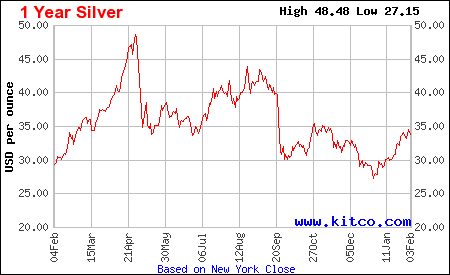
The same goes for silver.

Silver 1-year chart

Silver Holdings Comparison: GoldMoney VS BullionVault

GoldMoney & BullionVault: Quarterly Change in Silver Holdings

What then can be said of the apparent dichotomy between the declining trend in gold & silver prices and the increasing demand seen in the metal purchases? Just two words:

Paper & Physical

Prices reflected in the charts come about mainly by “traders” trading paper gold & silver. Traders is put between quotes because they are not the normal traders you’d expect to find in a free market. Most of the trades that determine the price trends are placed by very few large bullion banks and High Frequency Trading (HFT) machines. Yes, the prices are greatly influenced by trades initiated by machines preprogrammed with sophisticated algorithms to set the price which ever way the owners wanted them to go. In case you’re wondering, who may be the people on the other side of these trades? It’s people like this, who sets up trades hoping to beat the supercomputers on the other side only to get sucked in and forced to dump when their stops are hit.

On the other hand, real humans are behind the accumulation of physical metals at BullionVault, GoldMoney and many other private vaults. These are the same humans that do not believe the spin of the MSM, but hold on to the view that the financial crisis is not yet behind us. They believe that the worse is yet to come. I’m one of them. We understand that holding our savings and retirement funds in paper assets and paper money is most likely to result in a massive loss of purchasing power through hyperinflation when the real crisis hits.

We’re not 100% sure it will happen, neither can we be 100% sure it won’t happen.

What about you? Paper or physical?

-

Data source

-

Related Articles:

-

Gold Vs. Miners: The Wrong Question, Part I

October 15, 2011 3 comments

Submitted by Adrian Ash | BullionVault

-

Over the last 5 years, gold has turned every 1% gain in Gold Mining stocks into a 2% rise…

WHY are Gold Mining stocks underperforming the metal? asks Adrian Ash at BullionVault.

“Gold stocks should be a levered bet on the price of gold…There has been a terrible underperfomance,” as one forum posting said back in June.

“Thought this could be a good hedge against market meltdown but doesn’t follow gold price,” said another Gold Mining fund holder in August.

“Switched my portfolio to Blackrock Gold Acc in Feb. ’11 with the naive thinking it would give me a good exposure to Gold Prices,” said a third. “Gold has jumped 30% since then, but the fund is pretty much at the same price.

“I know there must be a lot of people in the same situation.”

Too true. February 2011 saw retail investors using UK brokerage TD Waterhouse choose Blackrock Gold & General as the top holding in their tax-protected ISA accounts for the third year running. And why not? Over the 12 years to this spring, as Blackrock’s own website says, its Gold & General Fund was the best-performing ISA product bar none. “Our investors,” said TD Waterhouse, “appear to be seeking some solidity in light of the continued Eurozone sovereign debt crisis and concerns over possible future inflation.”

Solidity paid off, but Gold Mining stocks didn’t. Over the next 6 months – and as the Eurozone debt crisis hit fresh peaks, and UK inflation held at 20-year highs above 5% year-on-year – gold put on 29% for Dollar investors and rose 27% for UK buyers. Gold equities, in contrast, lost 16% on the XAU index of US-listed producer stocks. Fighting the headwind of a falling Dollar, Blackrock’s Gold & General fund could only cut that loss in half for its UK investors.
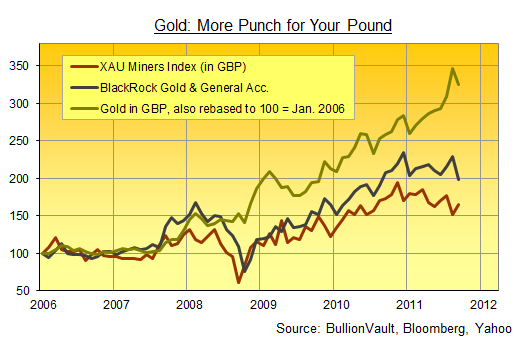
“We’re confident the gap will close,” said Evy Hambro, manager of the £3.3 billion mining-share fund ($5.2bn), to the Financial Times in September. “It has always closed in the past. This is an abnormally long one and an abnormally large one.”

But how long? And how abnormal exactly? No one’s expecting the answer which the data throw out.

“Gold shares historically outperform Gold Bullion in a rising market due to the operational gearing,” says another UK-run gold fund in its sales literature. That’s because, in a bull market for bullion, you’d expect Gold Mining firms to have “fixed or semi-fixed costs [but] rising revenue stream.” So you might even expect that famed 2-to-1 or 3-to-1 leverage over the gold price cited so often in mining-stock stories online.

But no. Here’s the percentage-point gap between Gold Bullion and nine different gold-equity plays, as of Sept. 30th this year…

Year-to-Date 1 year 3 year 5 year 10 year 15 year
XAU Mining Index -18 -29 +56 -129 -198 -260
HUI Index -7 -19 +100 -98 +257 -100
Barrick (ABX) -14 -23 +35 -108 -212 -207
Newmont (NEM) +3 -17 +69 -121 -251 -267
US Global fund -10 -24 +154 -51 +545 +327
Tocqueville fund -18 -27 +195 -62 +403 n/a
Van Eck fund -15 -26 +163 -55 +474 0
Blackrock fund* -30 -30 -31 -111 +275 +184

*Relative to gold in GBP               Source: BullionVault via Bloomberg, Yahoo

Three things jump out, as you can see:

  • First, not all Gold Mining stocks, indices or managed funds are the same, not by a country mile;
  • The right miners (and the right funds) performed as expected if you bought them far enough back, outperforming gold bullion by a good margin since 1996 or 2001;
  • Three years ago – October 2008 – was a one-time chance to pick up Gold Mining equity at such a wide discount, even shares in the biggest, lumbering producers have since beaten the investment return on plain gold bullion.

That opportunity to beat gold with stocks was very rare. Take the Philadelphia Stock Exchange’s XAU index of gold and silver miners, for instance. Its plunge amid the Lehman Brothers’ meltdown of 2008 made October that year the only month-end to offer the opportunity of out-performing gold bullion’s gains today since the XAU index was launched in 1983. Yes, really.

On the Amex Gold Bugs Index (the HUI), only 12 separate months in the last 120 have now seen new buyers out-pace gold bullion at today’s levels. For the UK’s actively-managed BlackRock Gold & General, it’s four months in the last nine years. For US Global Investors, 11 months in the last six years, and for the Tocqueville Gold Fund, it’s 20 months in the last eight years.

Underperformance in gold-mining equity is thus starting to look the norm, not the exception. Not only the producers as a group, but also the two biggest gold stocks (Barrick and Newmont) and even the top-performing managed funds are lagging it badly over 5 years, 1 year, and 2011 to date. Leverage to the Gold Price it ain’t.

Since Oct. 2006, in fact, every 1% move in the Gold Price has seen the Gold Mining producers add just 0.4% to their stock price on the HUI index. So far in 2011, they’ve turned every 1% gain into a 0.2% loss on the XAU.

The question, therefore, isn’t why the miners and funds are lagging gold. It’s why does gold keep beating the equity? Why has it reversed the expected leverage, turning every 1% rise in Gold Mining stocks into a better than 2% gain since 2006…? And might it be that this “abnormality” is in fact critical to the underlying bull market in bullion?

More to come in Part II. Meantime, are you ready to Buy Gold…?

Adrian Ash, 13 Oct ’11
Credit where credit is due

September 24, 2011 9 comments

-

“When you own gold you’re fighting every central bank in the world”. Jim Rickards

To a great extend, that holds true for silver as well. This week, holders of Political Metals lost a battle, but certainly not the war. Measured against the USD, gold and silver are worth less compared to a week ago by 9.6% and 26.3% respectively.

It all started with Ben Bernanke’s statement, following the 2-day FOMC meeting, stating the obvious – that “there are significant downside risks to the economic outlook, including strains in global financial markets”. His antidote was a plan to purchase $400 billion of long-term Treasury bonds and to sell an equivalent amount of short-term debt. More commonly referred to as “Operation Twist 2″, this plan seeks to further reduce long term interest rates, after having pledged to hold short term rates practically at zero until 2013.

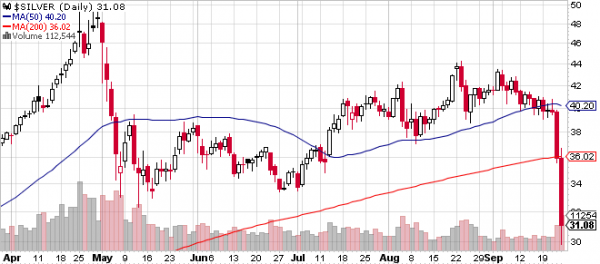
That announcement, made in the backdrop of the Eurozone debt crisis and news of slower growth in China, sent global stocks and commodity markets into a waterfall decline. This set up was ideal for the bullion banks who have massive gold and silver short positions. All they needed to do was to pull the trigger, and that’s exactly what they did on Thursday. Silver was pushed down sharply through its key 50 and 200 day moving averages, triggering an avalanche of tech funds selling the following day.

Going for the final kill of the week, news of yet another margin hike by CME (gold by 21%, silver by 16%) leaked into the market towards the end of Friday’s trading day. That further fuelled the selling, pushing silver briefly below $30 before closing at $31.08 – down 26.3% for the week.

In other markets this week, the Dow suffered its biggest loss since 2008. In four days U.S. stocks lost $1.1 trillion in value.  The MSCI all-country world share index (tracking thousands of stocks from developed and emerging countries) recorded its second worst quarter in 23 years and the 30-year bond rates dropped 55bps – the biggest move since the 1987 Black Monday.

So there you have it, Dr. Ben Bernanke, bullion banks & CME working together in perfect harmony. I don’t believe for a moment that the resulting market turmoil was any surprise to Bernanke. Despite saying that gold is not money, he’s smarter than most people made him out to be. After all, he achieved an SAT score of 1590 out of 1600, graduated from Harvard and has a PhD in economics from MIT. Contrary to its statutory mandate of foster maximum employment and price stability, this market turmoil I believe is a piece of precision engineering to achieve some larger agenda. This round is yours, congratulations Ben!

This engineered global markets take down could be part of the deflationary phase that Mike Maloney talked about, which is a prelude to the hyper-inflation phase. They have to assist the bullion banks cover their shorts and bring the Political Metals price down to a lower base before starting the next round of QE or equivalent. Marc Faber told ThomsonReuters that “if the S&P drops to around 900-950, we’ll get QE3 for sure”.

Four ways to view the developments over the past week

If you’re reading this blog, you’re not a professional or a day trader, possibly someone already invested in gold or silver, someone holding some Political Metals (I distinguish between investing & holding here) or someone in the process of researching the matter. As non professional traders, we have to look through and not at the turmoil unfolding before us. All of the bloody carnage above are on “paper” or bits on silicon – illusionary financial derivatives of something tangible (like gold and silver) or derivatives of something totally virtual and non-physical (like interest rates, bonds, debts, CDS, etc). Real or imaginary, they are all derivatives backed by nothing more than a promise or lies of a third party.

Unfortunately, in so far as gold & silver is concerned, the outcome of the imaginary paper price wars above gets applied to the physical world. Price discovery currently comes from the paper derivatives market. Banks and multi billion dollar hedge funds throwing thousands of futures contracts or bets at each other (most of which are done through computerised High Frequency Trading algorithms) determine the price of the coin or bar you pick up at your local bullion dealers. Until such time when this absurd situation of the tail wagging the dog changes, I suggest 4 possible ways for you to view the developments over the past week, using silver as an example.

4 ways to view the Sep 11 price action of silver
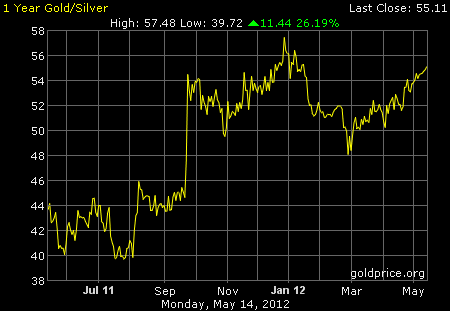
There’s a big difference between Investing(1) & Holding(2). If you adopt approach (1), and are smart enough to handle scenario (3), congratulations! Trading this dip or swapping silver for gold just before the GSR shot over 56 would have reaped a handsome return. After years of following newsletter writers, both paid and free, I came to the conclusion that attempting to achieve (3) is at best illusionary, and at worst risky. This is particularly true in a manipulated market. Take a look at some of the forecasts by well respected industry players here. Either they missed this week’s price action or are not telling us something. Richard Russell puts it this way:

I look at gold and silver, not as a play for profits, but as an accumulation of hard assets, in a world that it drowning in fiat money, and a world that will probably print trillions more of irredeemable paper.

Finally, if you’ve been waiting patiently (4) or have spare dry powder, congratulations! While the paper price of gold & silver gets whacked, physical demand is very strong. KWN reported that Sprott Money temporarily runs out of physical silver. So, get ready to pick up your discount. Not necessarily immediately, but then again, picking the absolute bottom can also be illusionary. Best industry advise is cost averaging.

Updated:

-

Has gold reached an intermediate top and entered into a multi-month correction phase?

September 13, 2011 2 comments

After the massive silver take down on May 1, and after several weeks of consolidation, there was much uncertainty as to the direction of silver. On June 21, we featured an article from Richard Guthrie which helped answer the question Silver: Will it be Up or Down? He wrote:

I implore all those still nervous about getting onto this silver rocket to take a long hard look at the following graph.

Based on his analysis, he was certain it was going to be UP. Sure enough, 1 week later, silver started its climb from $33.50 right up to $44, when it was taken down yet again on Aug 23, together with gold. Now, after about 3 weeks of consolidation, there’s this lingering question – Has gold reached an intermediate top and entered into a multi-month correction phase?

True to form, Rich has written another great analysis on why he think it has not, this time by looking at the gold miners price action. This is his story, told with a series of 7 convincing charts.

-

By Richard Guthrie (Live from ‘The Bridge of the Silver Rocket Ship’)

Much of the technical commentary I’m reading is still short term bearish on the direction in the precious metals and there are concerns we’re started a multi-month correction.

However they have conveniently forgotten to include within their analysis the recent action of the miners.

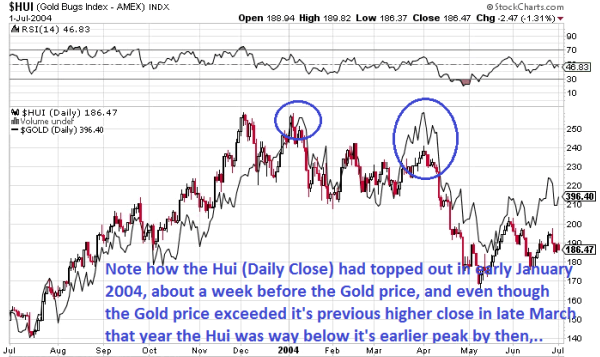
I have charted below the action of the Price of Gold and circled each occasion in the last 8 years when the Price of Gold has topped out and has entered a multi-month correctional phase.

-
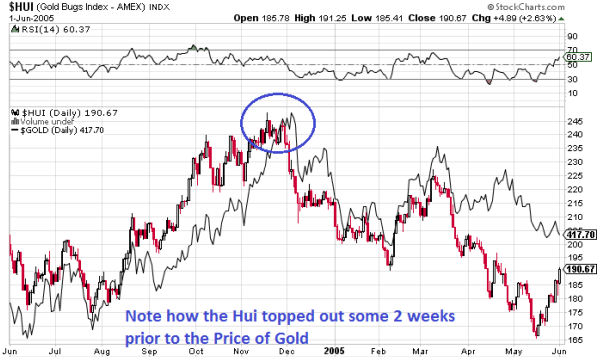
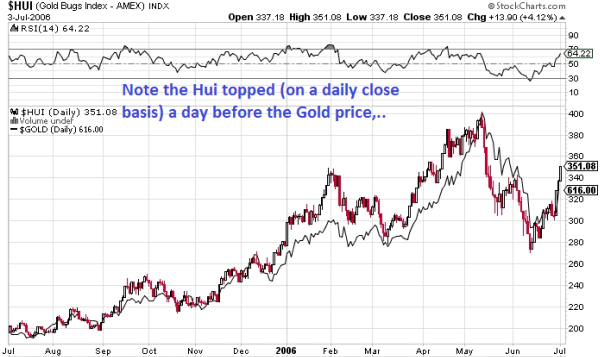
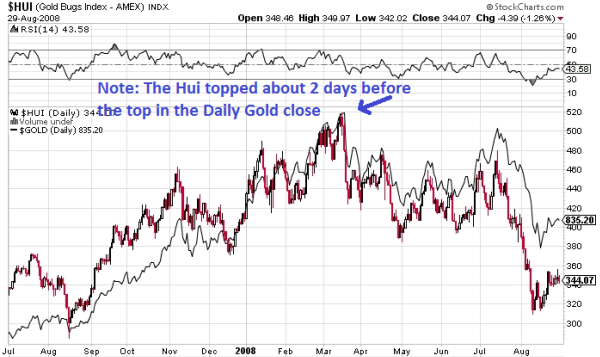
Now let’s look in further detail at the action of the Hui (Gold Miners) Index during those periods of topping out.

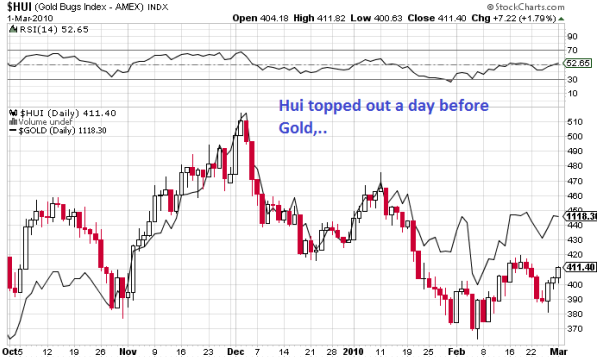
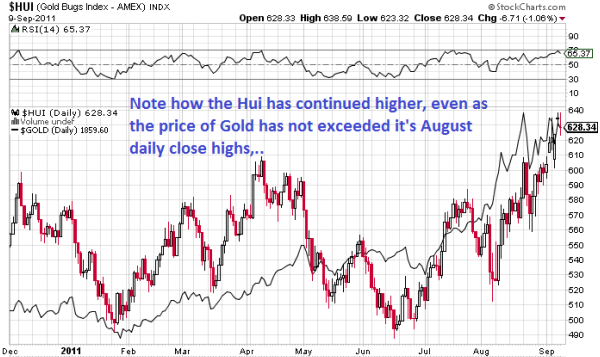
The charts below show the Hui price action (Candlestick) with the Price of Gold overlaid (Black line).

-
Early 2004:

-
-
Late 2004:


-
May 2006:

-
-
March 2008:


-
December 2009:

So on every multi-month Top in the price of Gold throughout the duration of this Bull Cycle to date the Hui index has always topped out before the price of Gold.

Now let’s look at the present action in Gold and the Hui Miners.

-
As the graph clearly attests while the Gold price peaked (on a daily close basis) some 3 weeks ago in mid August, the Hui Index has been continuing higher and has risen a circa 5% more since then.

In summary, the action of the miners does not indicate that we have reached an intermediate top in the Gold price. If history is to be our guide we should be back to record highs in Gold in the very near future and this present up leg should have plenty more upside to come.

It’s ironic that the ‘Corrective Bear Callers’ always like to make a mockery of the phrase, ‘This Time It’s Different’. Well if indeed we have just topped out in the Gold Price then this time ‘It would truly have to be different‘ from every other intermediate top in this Bull Cycle to date!

I personally don’t believe it will be different and still have every confidence we’ll be well over $2,000 within the next month or so, And that’s where my money lies,

It seems Bully Boy’s shaking a few more weak longs out of his saddle before the next charge north, And who can blame him, No one likes to run with too much weight on his back!

-

The Gold Bubble – Rebuttal by Jonathan Kosares

September 13, 2011 1 comment

by Jonathan Kosares | USAGold

-

Caveat Lector
“Let the Reader Beware”

Members of Wells Fargo’s wealth management team released an article recently entitled, “The Gold Bubble,” where it is claimed, in no uncertain terms, that gold is in a bubble. While I would not normally spend time rebutting an entity that would shock me far more if they actually put out a recommendation to buy gold, the subsequent readership this article has received (it was referenced in the business section of the Denver Post, for example) suggests it might be an entertaining, and perhaps useful exercise, to dissect their claims point by point to see what, if any, validity they carry. I also am of the impression that, as coverage on gold becomes increasingly mainstream, gold owners will also be faced with an increasing sum of articles of this type that seek to challenge their resolve. My hope is that this analysis will provide something of template of skepticism, that not everything you read, no matter how credible the source, is necessarily giving you the complete picture.

In their introduction, Wells Fargo Wealth Management (WFWM) writes,

“As with all bubbles, we know that we run the risk that our view may turn out to be wrong (“early” would be our preferred euphemism) in the short run; however, we believe that we will be proven right in the long run. Some will vehemently call us “crazy” and “naïve” for being unenlightened to gold’s zero gravity investment properties, but that will only help to steel our convictions (we similarly took our licks from critics in the past when we expressed concerns about speculative bubbles in technology stocks and housing).”

I’m immediately suspicious of an argument that seeks to so craftily rebuff and undermine any response before it is even presented. Yet, I find myself willing to risk ridicule, to ‘steel the conviction’ of Wells Fargo, to show that while even the craziest prediction can be proven right given enough time, in this case Wells Fargo isn’t just ‘early’, they’re way too early, and they aren’t ‘crazy’ or ‘naïve’, they’re just plain wrong. In defense of their conclusion, WFWM presents seven arguments. They are as follows:

WFWM – Volatile Price Movements: With very little warning, the bottom can drop out on gold prices very quickly. For example, during six short months in 2008, gold lost more than 30 percent of its value. In the 1980s, in a little more than two years, the price of gold dropped approximately 65 percent. When fear subsides, inflation doesn’t sky-rocket, and everything begins to return to “normal,” demand for gold can fade away quickly. Last week in response to rising volatility in gold prices the Chicago Mercantile Exchange (CME), the world’s largest futures market, raised the margin requirements for trading gold futures contracts by 22 percent. The CME has a history of raising margin requirements on futures contracts when price volatility increases as a way of further protecting investors’ interests.

JK - Gold did lose 30% of its value in six months during the last half of 2008. However, over the exact same six months referred, the DOW lost 47% of its value. Moreover, it only took gold a little over three moths to recover its losses and ultimately surpass its value before the drop. Three years later the Dow has yet to recover its pre-drop levels. The second statement is also true, however it needs to also be noted that gold doubled twice in the year preceding the referenced drop, going from just over $226/oz to $875 at its peak (that’s a 387% increase in one year!). At the writing of this article, even granting this advisory the very top in gold at $1919, gold has increased a manageable 47% in the last year, a mere fraction of what it did in a year’s time in 1980. Put another way, the pace of gold’s performance this August (a 22% gain) would have to increase to 30% monthly, and continue for an entire year to accomplish the same percentage gains seen in 1979. The next claim that gold will fall ‘when fear subsides…’ is nebulous, at best. At a minimum, this supposition should be led with an “if”. Much is assumed by the word “when”. When is “when”? Next year? Five years from now? To say a lot can happen between now and when ‘when’ is a reality would be an understatement.

In continuing, the authors of this article are doing a serious disservice to their readers by suggesting the practice of raising margin requirements carries some ‘profound significance’ to a market, specifically the gold market. Futures are priced in terms of fixed dollar figures, not percentages. So as the price of an asset increases, the margin, or the amount of money it takes to control a futures contract, while remaining constant in dollar terms, is gradually reduced percentage-wise. In essence, by not raising margin requirements as the underlying asset appreciates, the CME indirectly adds leverage to the market (it takes the same amount of money to control increasingly valuable contracts). By raising margins, the CME simply recalibrates the nominal, or dollar, amount required to control a contract to be more appropriately balanced against the value of the contract, thereby removing this added leverage. This process most frequently and logically occurs when a market makes a sharp, one-directional move. Not because of a general environment of ‘increased volatility’ as is suggested here. For some added context, it had been about a year since CME had hiked rates for gold futures at the time of this notice by WFWM. In that time, the price of gold appreciated 47%, so the referenced hike of 22%, and subsequent 27% hike on August 24th, are exactly equivalent to the underlying rise in the gold price, plus a small cushion.

WFWM – No Income: Most investments have some sort of cash flow potential: stocks have dividends, bonds have coupons, and real estate has rent. This flow creates intrinsic value. However, gold, like many other commodities, does not have any simple, inherent cash flow. In fact, when one factors the incumbent costs of ownership (transportation, storage, insurance, protection, assay fees, etc.), gold, in its physical or derivative form, can actually be considered to have a negative yield.

JK - This has long been the argument against gold ownership by the financial community in favor of alternative asset classes. But to be fair, gold ownership shouldn’t be in competition with the asset classes listed here. What gold ought to compete with in an individual’s portfolio are money market accounts, savings accounts, CD’s and other cash instruments. Most of the analysts calling gold a bubble are missing the key role gold serves, which is as an international currency, and savings vehicle, separate from the eroding effect of government policy. Those who understand the true value of gold ownership know ‘income’ isn’t the true goal.

WFWM – Greater Fool Dependence: Because it has no inherent earnings power and little intrinsic value, investors in gold are hoping that other investors will come along to bid up their holdings in the future. While a common tactic of speculators, the “greater fool” approach is rarely a good long-term investment strategy. In fact, it was this strategy that led us to the recent housing market crisis. During that period, lenders, homeowners and real estate investors assumed that home prices would continue to climb into perpetuity.

JK – If this is an attempt to refute supply/demand economics, it takes more than three sentences. Moreover, by this broadly stated and poorly supported metric, nearly every freely traded investment vehicle on the planet is governed by the same dependence on the “greater fool”. Stocks are certainly no different. In fact, it is the premise of one personAllan Greenspan believing something is worth more or less than another that ultimately makes a ‘free’ market. The only market that would not have the presence of a ‘greater fool’ would be the one that never came down, or traded at a constant value, which in truth, is no market at all. Where this argument is truly flawed however is by failing to acknowledge again the evolving role of gold as a currency within the international monetary system. It is the only currency that cannot be printed and debased, and whose value is not subject to the stability (or instability) of a local government. Though gold is indeed of ‘little intrinsic value’ when viewed solely for its uses as a pure commodity, its bull run has nothing to do with the metrics that drive the value of pure commodities like food, grain and energy. As Alan Greenspan stated recently, “Gold, unlike all other commodities, is a currency. And the major thrust in the demand for gold is not for jewelry. It’s not for anything other than an escape from what is perceived to be a fiat money system, paper money, that seems to be deteriorating.” To put it another way, gold ownership is an expression of a belief that those who blindly retain currency in this environment are perhaps the ‘greatest fools’ of all.

WFWM – Central Bank Activity: Lately, there has been a great deal of attention in the news about central bank purchases of gold. However, it is important to note that, in aggregate, the central banks of developed countries have been net sellers of gold in recent years. That trend may change since the political back-drop of future supply and demand dynamics of central banks is quite difficult to predict.

JK – Wait a second…this is a bearish argument for gold? So central banks for the first time in a decade are net buyers of gold, suggesting a broad-based shift in sentiment, and that’s a bearish indicator? And the trend may change because it is difficult to predict the political back-drop of future supply and demand dynamics? Not to be cynical, but would it not be equally difficult to predict the political backdrop of future bail-outs should banks find themselves undercapitalized in the future? That aside, central bank activity is not extraordinarily complex, as this would insinuate. Central banks are responding to the current environment in the same way as individual investors. As a general practice, central banks hold a basket of currencies, so they are buying gold, not necessarily to make a return, but to hedge the inherent risk within their reserves. As long as nation states as a group pursue policies meant to debase their currencies, central banks, and in many cases those same central banks, will continue to be buyers of gold for the same reasons most private investors own it.

WF – Inflation Fighting Properties are Overstated: The chart below challenges the idea that gold is an effective hedge against inflation, as it shows that stocks have experienced a far superior after-inflation-adjusted return over the past 25 years. This longer time-frame view of gold puts into perspective a more realistic time horizon for many investors.

Graph Stocks Beat Gold

JK – I have a chart too, courtesy of Ronald Stoferle and the Erste Group. And mine goes back farther, with a longer time-frame view, 1971 to be exact, and there isn’t even a worthwhile comparison. The problem with the graph above is that it comprises the greatest 20-year bull market in stock history, while also including the most disheartening 20-year bear market in gold. Wells Fargo has chosen an awfully convenient date range to make their argument.

Gold vs. S&P Graph

Warren Buffet’s View on Gold Values: In a recent interview on CNBC, the renowned investor Warren Buffett crystallized the concerns that prudent investors have with gold at current price levels:

Warren Buffet“. . .if you took all of the gold in the world it would roughly make a cube 67 feet on a side and that would be the whole thing. Now for that same cube of gold it would be worth at today’s market prices about $7 trillion. That’s probably about a third of the value of all the stocks in the United States. So you could have a choice of owning a third of all the stocks in the United States or you could have a choice of owning that little block of gold, which can’t do anything but kind of shine there and make you feel like Midas or Croesus or something of the sort.

Now, for $7 trillion, there are roughly a billion of farm-acres of farmland in the United States. They’re valued at about $2 1/2 trillion. It’s about half the continental United States, this farmland. You could have all the farmland in the United States, you could have about seven ExxonMobils, and you could have $1 trillion of walking around money. And if you offered me the choice of looking at some 67-foot cube of gold and looking at it all day, you know, I mean touching it and fondling it occasionally, you know, and then saying, you know, `Do something for me,’ and it says, `I don’t do anything. I just stand here and look pretty.’ And the alternative to that was to have all the farmland of the country, everything, cotton, corn, soybeans, seven ExxonMobils. Just think of that. Add $1 trillion of walking around money. I, you know, maybe call me crazy but I’ll take the farmland and the ExxonMobils.”

JK – This isn’t the first time these comments by Warren Buffett have been utilized in an argument against gold ownership. I think its use in this case is due some context, however. First, this interview wasn’t all that ‘recent’. In fact, it was conducted with Ben Stein on October 19, 2010, when the gold price was $1335.00… not during the very recent run up in the gold prices, as this article suggests. Second, Buffet’s recommendation in lieu of gold?… buy the VTI, or Vanguard total market index ETF. At the time of the above interview, VTI was trading at $62 and change, which is exactly the same price it is trading for today, versus a 35%+ increase the gold price. Last, and most importantly, this is an unrealistic comparison for the everyday investor. Buffett speaks of owning all of the gold in the world, versus what all of that gold could buy. In the vacuum of extremes, perhaps Buffett’s thoughts aren’t incorrect. They make a sort of sense to me. But the reality is that no one could buy all of the farmland in the United States. Nor could one individual own all of the gold. It isn’t a practical comparison. Cases for or against owning an asset need to be made in reality, and the reality is that gold ownership is spread across millions of owners, who all believe it has a value beyond ‘looking pretty’. Because of this universal belief, gold commands a relevance that should not be so cynically dismissed.

You Can’t Eat Gold: For all the talk of gold’s antidotal properties vis-à-vis fiat currencies, beyond its few industrial and jewelry uses, it is hard to see that gold has much intrinsic value. Gold doesn’t readily produce cash flow, doesn’t provide shelter, can’t be eaten, nor does it provide efficient clothing. There is certainly some intrinsic value, but, in our view, not $1,800 per ounce worth of intrinsic value. Further, all sound investments provide some element of societal benefit. However, digging gold up out of the ground, refining it, forming it into bars, and then burying it back in the ground again—specifically in elaborate, highly-protected underground vaults—doesn’t seem to provide substantive economic value to society, other than being a short-term speculative store of value.

JK - I think I’ll reflect on the thought above while snacking on a salad of $100 bills beneath the shade of my stock certificates. Mmmmm, so satisfying. Yes, this argument is that silly. And to the thought of providing an economic benefit to society, I’d say simply this: Nothing is of greater economic detriment to society than government policy that uses debt, currency debasement, and leverage to produce the illusion of perpetual economic growth. So if gold, since it is uniquely detached from the eroding effect of these government policies, protects its owners against their repercussions, it is certainly of substantive economic benefit to the individual. For nothing else so efficiently provides the protection and peace of mind otherwise absent in the majority of today’s investment options.

-


Jonathan Kosares graduated cum laude from the University of Notre Dame, earning a double major in Finance and Computer Applications. He has been an account executive for the firm since 2002.

This newsletter is distributed with the understanding that it has been prepared for informational purposes only and the Publisher or Author is not engaged in rendering legal, accounting, financial or other professional services. The information in this newsletter is not intended to create, and receipt of it does not constitute a lawyer-client relationship, accountant-client relationship, or any other type of relation-ship. If legal or financial advice or other expert assistance is required, the services of a competent professional person should be sought. The Author disclaims all warranties and any personal liability, loss, or risk incurred as a consequence of the use and application, either directly or indirectly, of any information presented herein.

Follow

Get every new post delivered to your Inbox.

Join 175 other followers