Archive

Posts Tagged ‘Currency’

Commodity Money and Fiat Money: A Bushel of Wheat for a Penny

April 12, 2012 2 comments

A Bushel of Wheat for a Penny Part 1

by Steve Elwart, IDB Folio Specialist
Republished with permission from Koinonia House 

-
This is Part 1 of a three-part series on money: where it comes from, how governments use it to control our lives, and how modern money policy makes the prophecies in the Book of Revelation seem very close to fulfillment.

Everyone reading this article is being robbed. We all use paper money and every day, governments are lowering its value. That value is being stolen from us. To understand how this is happening, we need to get to the basics of money. What is it?

Commodity Money

We learn in Genesis that Abram (renamed later by God to Abraham) was a rich man. How do we know? We are told that “he had sheep, and oxen, and he asses, and menservants, and maidservants, and she asses, and camels.”1 In Biblical times, these things were all media of exchange. No king decided this; he didn’t call in his magi to decide what the medium of ex-change would be. Ordinary people, or “the market” made the decision. Let’s say a king did decree that rocks could be used as money. Would anyone use them? Probably not, because they would not know the value of those rocks. Unless you are building a lot of things (or stoning a lot of adulterers), rocks fail to meet a standard for money: they have no intrinsic value.

If a civilization was to advance though, it had to come up with a convenient way to save and exchange value to buy things. Leather was used in ancient Rome. (Contrary to popular belief, Roman soldiers were not paid in salt. The term salary [from the Latin salārium] was money given to Roman soldiers to buy salt.2) Animal pelts, whiskey, and tobacco leaves were used in the former British Colonies, wampum (strings of beads) was used by the American Indians, dried fish were used in the Canadian maritime colonies, maize or corn was used in Mexico, and salt, iron and farming tools were used in Africa. These things are called “commodity money.” As civilizations became more complex, most forms of commodity money be-came very cumbersome. (Who would want to give or get 300 sheep to buy a car?) Another medium of exchange had to be found.

Over the centuries, the answer came to be the precious metals, gold and silver. These two metals became the basis for money in most of the world. Gold and silver were used as money for very specific reasons and they were chosen by “the market.” People decided that these two metals had all the qualities that made for a good medium of exchange:

  • They were easily portable. They had high value to weight ratios. (So if you want to buy a car, you only have to bring 16 ounces of gold rather than 300 sheep.)
  • They are fungible. Every ounce is like every other ounce no matter where they were mined. People didn’t have to worry about the quality of the pure metal.
  • They are highly divisible. They can be divided into very small parts or coins. The term “pieces of eight” came from the practice of taking a Spanish dollar, a real de a ocho and breaking it up into eight pieces or reales to make change. Diamonds fail the test of being divisible because if you break up a gem-quality diamond, it loses its value. (For that matter, sheep aren’t easily divisible either unless you are very hungry.)
  • They are highly durable; the thirty pieces of silver paid to Judas are still in existence today.
  • They are naturally scarce. They can’t be multiplied.

Fiat Money

There is another type of money besides commodity money, called fiat money. (Fiat from the Latin fiat, meaning “let it be done.”) This is an item, usually paper or low value metal coins, that is decreed to have value by a government.

A government puts fiat money into circulation first by connecting it to a gold or silver standard, but then cuts the link and says that gold and paper are no longer convertible, making the piece of paper “legal tender for all debts public and private.” It is obvious that debtors would be very happy if the pa-per money lost its value because they could pay their debts with inflated currency. In a letter to Edward Carrington in 1788, Thomas Jefferson wrote, “Paper is poverty … it is only the ghost of money, and not money itself.” Jefferson died bankrupt because of the early United States money (monetary) pol-icy based on paper.

It is not that fiat currency is a new invention. Fiat currency actually made its appearance over 1,000 years ago. China was the first country to issue true paper money around the 10th century A.D. Although the notes were valued at a certain ex-change rate for gold, silver, or silk, conversion was never allowed in practice. The bills were supposed to be redeemed after three years in circulation, but as more bills were printed with the older notes being refused redemption, inflation became evident. Government measures to prop up the currency were unsuccessful and it fell out of favor.3

In Europe, fiat money came into being around the 12th century. Villagers would store their gold and other valuables in their lord’s castle for safekeeping. But during this time of the Crusades and other European Wars, noblemen were always strapped for cash. When times were particularly bad, the noblemen would confiscate the villagers’ gold and silver and issue notes for it, to be redeemed later. Needless to say, the notes weren’t always honored or if they were redeemed, the holder of the note received less of their gold back than what they were promised. This is an early case of price inflation.

Today, fiat money will always bring on inflation for two reasons: 1) Politicians like to induce inflation because it gives the people the illusion of prosperity and 2) its declared value is much higher than the cost of producing it. Whether it is a $1 or $100 bill in fiat money, it costs only 4 cents to produce. In today’s electronic age, the production cost for new money is zero since money creation is just a keystroke and an entry in cyber-space. On the other hand, in history, if you had a $20 gold piece, the cost of that gold piece, less the cost to produce it, was about $20.

The Gold Standard

History of Gold Standard

If the relative value of gold is tracked over the years, one can see how fiat money loses its value over time.

By the 1400s, most countries that had complex trading systems were using gold and silver for transactions. Prices held relatively steady through the early 20th century, except for lo-cal shortages and wars. In the United States the price of gold and the things it bought held its value with exceptions for war-time when the government printed paper money to cover its war debts. After the emergencies and the country went back on the gold standard, prices went back to about where they were. During the First World War, most countries involved in the war suspended the gold standard so they could print enough money to pay for their involvement in the war. After the war, these countries went back to a modified form of the gold standard, but abandoned it during the “Great Depression.”

In 1941, most countries adopted the Bretton Woods system, which set the exchange value for all currencies in terms of gold. Countries that signed the Bretton Woods agreement were obligated to convert their currencies held by foreign countries into gold valued at $35 per ounce. However, many countries just pegged their currency to the U.S. dollar, thus making it the de facto world currency.

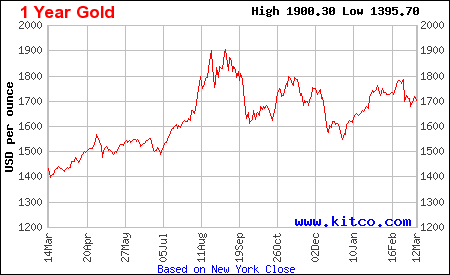
In the 1960s the United States had done something unprecedented in its history. The country fought two wars at once. The United States fought a war halfway around the world in Vietnam and a second war at home, the “War on Poverty.” To do this, the United States started to borrow massively and brought on double digit inflation. To curb the inflation, the United States government started to deflate the dollar. 1963 marked the entrance of the new Federal Reserve notes and the disappearance of the $1 silver certificate. This marked the point that no longer did the U.S. Government have to pay in “lawful money.” Finally, in late 1973, the U.S. government decoupled the value of the dollar from gold altogether and the price shot up to $120 per ounce in the free market.4 Since the United States went off the Gold Standard, a dollar is worth only one-sixth of what it was in 1973. (At this writing, gold is priced at $1,220 per ounce.5)

Inflation Always Follows Fiat Money

The history of price inflation in the United States is repeated in every country that uses paper money. Keep in mind, rising prices are not always bad. If a good becomes scarce, its price will go up and may provide the motivation to introduce a new, better product for the market. The reason petroleum became so popular so quickly was because of the rising cost of whale oil. If governments propped up the price of whale oil to keep whalers and whale oil processors employed, it would have taken decades for the world to embrace petroleum as a substitute. And someday, petroleum will go the way of whale oil as long as market forces dictate the transition.

When a government inflates its currency, it increases prices by reducing the purchasing power of the money. The short-term effects though, can seem to be positive. Like a drug addict, inflated money gives the illusion of prosperity, making people feel good. But like the addict, withdrawal follows the high.

At first, the surge of more money makes people feel good be-cause they can pay off their debts with cheaper money and they seem to have more disposable income. As prices catch up, people then find it more expensive to live. In addition, their tax burden goes up, since many government taxes are progressive in nature, meaning the percentage tax increases as in-come or asset values (houses, cars, etc.) increase. Eventually the market will try to correct itself and a depression will follow.

At this point, people start to feel the pinch of their money buying less. They demand that their government do some-thing. Since studies have shown that voters only have a memory of one year when it comes to politics, politicians will make sure that the economy is good in an election year.6 They will artificially stimulate the economy to give voters the illusion that times are good again and reelect the incumbents. This lasts only so long and inflation, with its problems kick in again. This cycle of increasing the currency supply and price inflation ultimately ends with the collapse of the currency, sometimes preceded by hyperinflation. (Hyperinflation and its cultural effects will be covered in Part 3 of this series.) Surprisingly, the country has not learned its lesson and the devalued fiat currency is replaced with yet another fiat currency. Greece is a perfect example of this cycle.

The Greek drachma was minted in gold and silver in ancient Greece and made its reappearance as a fiat currency in 1841. Since then, the value of the drachma decreased. During the German-Italian occupation of the country from 1941-1944, hyperinflation ravaged the country, ending with the issuance of 100,000,000,000 (100 billion)-drachma notes in 1944. After Greece was liberated from Germany, old drachmae were ex-changed for new ones at the rate of 50,000,000,000 to 1. Only paper money was issued, again a fiat currency. Greece then went on a program of deficit spending for social programs and inflation started once again.

In 1953, in an effort to halt inflation, Greece joined the Bretton Woods system and the drachma was revalued at a rate of 1000 old drachma to one new drachma. In 1973 the Bretton Woods System was abolished; over the next 25 years the official exchange rate gradually declined, from 30 drachmas to one U.S. dollar to a ratio of 400:1. On January 1, 2002, the Greek drachma was officially replaced as the circulating currency by the Euro (again a fiat currency).7

Today, Greece is once again is in trouble. After years of continued deficit spending and the government’s easy monetary policy, Greece’s financial situation was badly exposed when the global economic downturn struck. Very quickly, the government’s “creative accounting” practices were exposed. The national debt, put at €300 billion ($413.6 billion), is bigger than the country’s entire economy, with some estimates placing it at 120 percent of gross domestic product in 2010. The country’s deficit—how much more it spends than it takes in—is 12.7 percent.

This time though, Greece just can’t inflate their way out of the problem. Now that they are on the Euro (in the “Euro-zone”), they have little control over their monetary policy. All their loans are in Euros and they must pay back the loans in Euros. One way to balance the national books is to implement harsh and unpopular spending cuts. Another way is to default on their debt. This would seriously damage the Euro as other countries look at default as a way out of their financial problems. (In fact, financial experts are predicting the demise of the Euro in as early as five years.8) A third way out is to separate itself from the Euro, go back on the drachma (fiat currency again) and then set an exchange rate of the drachma to the Euro at an artificially high number. The cycle of fiat money would then begin again.

As long as a country is on a fiat currency, inflation is sure to follow. Using a fiat currency could well reduce a civilization to work an entire day for a “bushel of wheat.”

In Part 2 of this series we will look at central banking and how the banks can change a society.


Notes:

  1. Genesis 12:16b (KJV).
  2. “The American Heritage Dictionary of the English Language, 4th edition”. Answers.com. Retrieved 2010-06-05.
  3. Ramsden, Dave (2004). “A Very Short History of Chinese Paper Money.” James J. Puplava Financial Sense.
  4. History of the Gold Standard: http://useconomy.about.com/od/monetarypolicy/p/gold_history.htm
  5. Monex Precious Metals: http://www.monex.com/monex/controller?pageid=prices.
  6. “Voters Respond to Economic Woes” Economics and Public Policy: http://knowledge.wpcarey.asu.edu/article.cfm?articleid=1668.
  7. Greek Drachma, Wikipedia: http://en.wikipedia.org/wiki/Greek_drachma#First_modern_drachma.
  8. “Euro ‘will be dead in five years’”: http://www.telegraphic.com.uk/finance/financetopics/budget/7806065?Euro-will-be-dead-in-five-years.html

150 Years Of U.S. Fiat Currency

April 9, 2012 1 comment

-

5 days ago saw the 150th year anniversary of an event so historic that a very select few even noticed: the birth of US fiat. Bloomberg was one of the few who commemorated the birth of modern US currency: “On April 2, 1862, the first greenback left the U.S. Treasury, marking the start of a new era in the American monetary system…. The greenbacks were originally intended to be a temporary emergency-financing measure. Almost bankrupt, the Treasury needed money to pay suppliers and troops. The plan was to print a limited supply of United States notes to meet the crisis and then have people convert the currency into Treasury bonds. But United States notes grew in popularity and continued to circulate.” The rest, as they say is history.

In the intervening 150 years, the greenback saw major transformations: from being issued by the Treasury and backed by gold, it is now printed, mostly in electronic form, by an entity that in its own words, is “set up similarly to private corporations, but operated in the public interest.” Of course, when said public interest is not the primary driver of operation, the entity, also known as the Federal Reserve is accountable to precisely nobody. Oh, and the fiat money, which is now just a balance sheet liability of a private corporation, and thus just a plug to the Fed’s deficit monetization efforts, is no longer backed by anything besides the “full faith and credit” of a country that is forced to fund more than half of its spending through debt issuance than tax revenues.

More on the history of American fiat from Bloomberg:

At the start of the Civil War, the U.S. didn’t have a national paper currency. Instead, the money supply consisted of U.S. coins and a collection of paper notes issued by private banks. Technically, the federal government began issuing its own paper currency in 1861. That year, the Lincoln administration issued $60 million in demand notes, a variant of a Treasury note that was redeemable “on demand” for gold coins at the Treasury or any sub-Treasury.

These notes were overshadowed in 1862 by the issue of $150 million in a new fiat currency officially known as United States notes and popularly known as greenbacks or legal tenders. By the end of the war, close to $450 million worth of greenbacks were in circulation.

The name greenbacks referred to the reverse of the notes, which were printed in green. The name legal-tender notes referred to the text that originally appeared on the back, which began, “This note is legal tender for all debts, public and private.” This provision made the currency a valid form of payment on par with gold and silver, which was a very controversial action at the time. It made the United States note a fiat currency — meaning its value was established by law alone and wasn’t based on some other unit of value, such as gold, silver or land.

Many Americans during and after the Civil War believed the creation of a fiat currency was unconstitutional. The Constitution explicitly stated that only gold and silver could be considered legal tender. In 1871, in the case of Knox v. Lee, the Supreme Court settled the matter by declaring that making United States notes legal tender was indeed constitutional.

By this time, the greenback was at the center of a countrywide debate on monetary policy. When the post-Civil War economic boom ended in the panic and depression of 1873, many people, especially farmers, blamed the Treasury’s policy of contracting the currency — that is, removing United States notes from circulation in an attempt to go back to the gold standard, which would require that a $1 note could be redeemed for $1 in gold.

As a consequence, there was a call for the expansion of United States note circulation or an inflation of the currency. This belief became joined with a political ideology that opposed big business and banking interests, resulting in the birth of the Greenback Party in 1874.

Opposing the Greenbackers were more conservative interests, sometimes known as “gold bugs,” who found support in the Republican Party and in elements of the Democratic Party. Gold interests proved the stronger contestant in the debate and in 1878, the total circulation of United States notes was fixed at a little over $346 million and the notes eventually became redeemable in gold (at least until 1933, when this provision was removed).

During the 20th century, United States notes became ever less important in the nation’s money supply, though Congress supported their continued circulation. They were increasingly replaced by currency issued by the Federal Reserve System, which came to look almost identical to the United States note. The Federal Reserve note thus became the new greenback.

In 1966, Congress allowed the Treasury to start removing United States notes from circulation. The last delivery of the notes by the Bureau of Engraving and Printing to the Treasury was made in 1971. In 1994, the Riegle Community Development and Regulatory Improvement Act eliminated the issuance of the notes altogether.

So instead of real money, America has an impostor “which came to look almost identical to the United States note” with the full complicity of everyone in charge, just so that when needed, any and all untenable debt burdens can be inflated away. And while the latter is a topic of a whole different discussion, we present another chart which, unlike the 150th anniversary of fiat, should be something discussed far more broadly… Because in a fiat world superpower status is always relative.

-

Source: ZeroHedge

Related Articles:

Government admission of price suppression: Report by South Carolina State Treasurer’s Office

April 6, 2012 1 comment

South Carolina Treasury Office Seal-
[Active updates: Developing stories] The South Carolina Treasurer’s Office, acting upon a directive from the state legislature, has recently published a report on the advisability of investing in gold and silver. Basically, the state legislature wanted to know if it’s wise to invest public funds under it’s custody in gold & silver.

 Here’s what the Treasurer’s Office has to say about itself:

Our mission is to serve the citizens of South Carolina by providing the most efficient banking, investment and financial management service for South Carolina State Government. Our commitment is to safeguard our State’s financial resources and to maximize return on our State’s investments.

This is a tall order, hence we can assume that the report must be well researched and credible.  It concluded that it is not advisable to invest public funds in gold & silver because:-

  1. There’s escalating market speculation
  2. Current value (I think they mean price) is too high
  3. Market possibly in a bubble
  4. South Carolina Code of Laws states that the Treasurer has “ full power to invest” in  debt instruments of the US government and corporations, but makes no mention of investments in derivatives of gold & silver. Hence investing in gold & silver derivatives may “create a legal conflict”

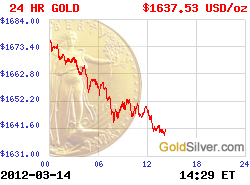
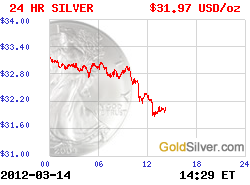
South Carolina Treasurer Office's conclusion on the advisability of investing in gold & silverWhile the timestamp of the document was 27 Feb 2012, it can be assumed that the report was prepared soon after the end of September 23, 2011 due to this inclusion. Scuth Carolina Treasurer Office Report - Price of GoldFrom the perspective of a short term investment, that was a pretty good call, considering the fact that gold and silver have been taken down to $1624 and $31.40 respectively as I write.

However, this piece is not about how good the Treasurer’s Office was at making an investment call based on price. Neither is it about whether gold & silver is in a bubble. These conclusions (2) & (3) are opinions of the Treasurer’s Office, which are subjective. Of greater interest are the facts revealed in the body of the report.

Regular readers of this blog would have noticed that there are several key issues that are repeatedly discussed or highlighted here (through news feeds or third party contributions). They include:-

  1. Gold & silver prices are being suppressed
  2. Central Banks & major bullion banks are suppressing their prices
  3. Naked short selling is one of the price suppression mechanism
  4. Bullion Banks and exchanges practice fractional reserve bullion banking
  5. Stay out of gold or silver bank accounts, ETFs, Certificates, and all forms of derivatives
  6. The safest way to own gold & silver is to hold physical gold & silver

Items (1) to (4) are often disputed by the mainstream media and investors, sometimes referring to them as conspiracy theories. Hence, it is most interesting to see what this government published report has to say about these 6 issues.

Price Suppression is Real

Fed, JP Morgan, HSBC, LBMA in naked short selling & fractional reserve banking

In one short paragraph, this report confirms in no uncertain terms the truth behind the so called “conspiracy theories”. Not only does it confirm the existence of price suppression, it discloses the WHOs and the HOWs!

Risks of holding gold through ETFs, Certificates, Bank Accounts & other Derivatives

It has been repeatedly emphasized here that the only secure means of owning gold & silver is by holding physical coins and bars in your own possession or stored in a private vault outside the banking system. Anything else is a derivative – a paper or electronic representation of the real thing.

This report explains the nature of these derivatives and lists the risks associated with each, together with reasons why the Treasury’s Office advised against investing in them.

The full report in pdf is available for download at the South Carolina Treasurer’s website. Text from relevant sections is reproduced below with comments related to the 6 items above highlighted. Most of the remarks are self explanatory. There are, however, two groups of comments that warrant some discussion.

1. Allocated & Unallocated Accounts

Ways to Invest: Certificates
Unallocated gold certiñcates are a form of fractional reserve banking and do not guarantee an equal exchange for metal in the event of a run on the bank’s gold on deposit. Allocated gold certificates should be correlated with speciñc numbered bars, however it is difficult to prove whether a bank is improperly allocating a single bar to more than one investor.

Ways to Invest: Accounts
One of the most important differences between accounts is whether the gold is held on an allocated or unallocated basis. Another major difference is the strength of the account holder’s claim on the gold, in the event that the account administrator faces gold-denominated liabilities, asset forfeiture, or bankruptcy.

The above describes two products offered by banks to clients who want to invest in gold (or silver) without having to deal with the physical metals. For example, when a bank accepts $2,000 from a customer and issues a gold certificate or credits the customer’s gold account under the unallocated system, the bank is not obliged to buy and store 1.2 oz (at current price) of gold on behalf of the customer. It holds only a tiny portion of that amount in gold. Hence when many of its the customers decide to redeem their certificates at the same time, the bank will not have sufficient gold to deliver. This is what’s referred to as a “run on the bank’s gold on deposit”. The same applies when depositing cash in your bank. The practice of keeping only a tiny fraction of what’s rightfully belonging to the customers (gold or cash) is referred to as fractional reserve banking.

When selling allocated gold products, the bank is legally required to hold 100% of the customers deposit in physical metal. For example, if a customer deposits sufficient cash to own a 400 oz gold bar and is assigned a bar bearing serial No: AGR Matthey 156571, how can one be sure that the same bar or a portion thereof is not assigned to another customer at the same time? That’s the issue raised by the report – and the risk is real.

This brings us back to “the only secure means of owning gold & silver is by holding physical coins and bars in your own possession or stored in a private vault outside the banking system”. If you have to use a third party to store your metals, use specialized private vaults instead, because banks operate on a fractional reserve banking system.

There are many companies outside the banking system that offer secure vaulting services. Generally, they have very high transparency, including publishing audited client holdings on the web for public scrutiny (without any login required). Of course clients’ ID are anonymous, and known only to the operator and the client.

Try these links:
GoldMoney bar list and BullionVault client holdings. Their reviews can be found here.

Learn more about private vaulting services, including issues like ownership, custody, bailment, counter-party risks, and performance risks. 

2. Reason for not investing in physical gold & silver

The report listed 5 ways to invest in gold & silver – ETPs, Certificates, Accounts, Derivatives and physical coins & bars. Notice how it highlights & explains all the risks associated with ETPs, Certificates, Accounts and Derivatives and the reasons why it is not advisable for the Treasury to invest in these.

Notice also that there are NO risk associated with physical metals. The only reason given for not investing in coins and bars is “South Carolina does not have the capacity to store or funding to secure gold and silver bullion”.

What a lame excuse! Do they not know that in April last year, “The University of Texas Investment Management Co., the second-largest U.S. academic endowment, took delivery of almost $1 billion in gold bullion“?

-

Proviso 89.145 GP:
Gold & Silver Investments
Office of State Treasurer

-
GOLD AND SILVER AS AN INVESTMENT:

Historically, investors have purchased gold as a hedge against an economic, a political, or a currency crisis. A decline in investment markets, a growing national debt, a weak currency, increasing inflation, military conflicts and social unrest are the most common reasons for investment in gold. Currently, gold and silver are at historic highs leading many expert investors to conclude that a bubble has been created in the precious metals market. Since the US recession began, the value of gold and silver has increased as investment markets perform poorly, troublesome economic news is announced, and when uncertainty in international markets intensifies.

Similar to other commodities, the value of gold and silver is determined by supply and demand, as well as speculation. The Federal Reserve, The London Bullion Market Association, JP Morgan Chase, and HSBC Holdings have practiced fractional-reserve banking and engaged in naked short selling causing artiñcial price suppression.

There are several ways to invest in gold and silver: bars, coins, ETP’s, certificates, accounts, and derivatives. If a state were to choose to invest in gold (and silver), it would likely choose to invest by:

1. ETP’s-Exchange Traded Products. This allows the stakeholder to invest in bullion without having to store bars and coins. The ñrst gold ETF (Exchange Traded Fund) was created in 2003 and has been viewed largely as a success, but has also been compared to investing in mortgagebacked securities. The annual expenses of the fund (storage, insurance, and management fees) are charged by selling a small amount of gold represented by each certificate, so the amount of gold in each certificate will gradually decline over time. ETF’s are investment companies that are legally classified as open-end companies or Unit Investment Trusts (UIT), but differ from traditional open-end companies and U]T’s. The main differences are that ETF’s do not sell directly to investors and they issue their shares in what are called Creation Units. Also, the Creation Units may not be purchased with cash but a basket of securities that mirrors the ETF‘s portfolio. The Usually, the Creation Units are split up and re-sold on a secondary market.

2. Certificates- allow investors to avoid the risks and costs associated with the transfer and storage of bullion by taking on a set of risks and costs associated with the certificate itself. Banks may issue gold certificates for gold which is allocated (non-fungible) or unallocated (fungible). Unallocated gold certiñcates are a form of fractional reserve banking and do not guarantee an equal exchange for metal in the event of a run on the bank’s gold on deposit. Allocated gold certificates should be correlated with speciñc numbered bars, however it is difficult to prove whether a bank is improperly allocating a single bar to more than one investor. The US ñrst authorized the use of gold certificates in 1863. By the early l930’s the US placed restrictions on private gold ownership and therefore, the gold certificates stopped circulating as money, but certificates are still issued by gold pool programs for investment purposes.

3. Accounts- Many banks offer gold accounts where gold can be instantly bought or sold just like any foreign currency on a fractional reserve (non-allocated, fungible) basis. Pool accounts, facilitate highly liquid, but unallocated claims on gold owned by the company. Digital gold currency systems operate like pool accounts and additionally allow the direct transfer of fungible gold between members of the service. Different accounts impose varying types of intermediation between the client and their gold. One of the most important differences between accounts is whether the gold is held on an allocated or unallocated basis. Another major difference is the strength of the account holder’s claim on the gold, in the event that the account administrator faces gold-denominated liabilities, asset forfeiture, or bankruptcy.

4. Derivatives- The product symbol for gold futures is GC, and it is traded in a standard contract
size of 100 troy ounces. In the US, gold futures are primarily traded on the New York Commodities Exchange (COMEX). As of 2009 holders of COMEX gold futures have experienced problems taking delivery of their metal. Along with chronic delivery delays, some investors have received delivery of bars not matching their contract in serial number and weight. Because of these problems, there are concerns that COMEX may not have the gold inventory to back its existing warehouse receipts.

ADVISABILITY:
There is no statute preventing the State from investing in gold and silver. The various methods of investment in gold and silver each carry different and often significant risks, the foremost being speculation. As the US has experienced the recent bursts in the housing and tech bubbles, it is important to take caution when contemplating an unconventional investment. Taxpayer money (state funds and state pension) across the US has not typically been used to invest in gold or silver bullion.

Recently, with the uncertainty in global markets, the devaluation of the dollar, rising inflation, and a flat US economy, there has been a renewed interest in either moving back to a gold standard, investing in gold or both. The value of gold and silver has significantly increased in the last decade, meaning it would cost a great deal to invest at this time.

Risks:
1. Bars and coins- South Carolina does not have the capacity to store or funding to secure gold and silver bullion. For these reasons the State Treasurer’s Office does not advise investing in gold and silver bars and coins.

2. ETP’s- The armual expenses and costs associated with this type of investment are high. In recent years there have been issues surrounding gold ETP’s. The purchase price provides the investor with a fluctuating amount (in weight) of the metal. Over time, as value increases and more investors participate in the fund, the amount of metal owner by the investor decreases. ETP’s can also be split and sold on the secondary market. For these reasons the State Treasurer’s Ofñce does not advise investing in ETP’s for gold and silver.

3. Certificates- Certificates for allocated gold present an accountability problem. Allocated gold certificates are supposed to be correlated with speciñc numbered bars; however, it is difficult to verify whether a bank is improperly allocating a single bar to more than one investor. Also, unallocated gold certificates are a form of fractional reserve banking and do not guarantee an equal exchange for metal in the event of a run on the bank’s gold on deposit. This is in conflict with S.C. Code of Laws 1976 SECTION 11-9-660. For these reasons, the State Treasurer’s Office cannot advise investing in gold and silver certificates.

4. Accounts- Similar to the risks associated with gold and silver certificates, allocated and unallocated metals held in accounts produce similar accountability problems. The strength of the account holder’s claim on metals is subject to the account administrators liabilities, assets, and/or solvency. Per S.C. Code of Laws 1976 SECTION 11-9-660, the State Treasurer’s Office cannot advise investing in gold and silver accounts.

5. Derivatives- Over the last three years, gold futures traded on the New York Commodities Exchange (COMEX) have encountered significant accountability problems. Holders of COMEX gold ñltures have frequently experienced delivery delays of their metals. Once delivered, there have been many reports of inaccurate weights and serial numbers on bars that do not match the holder’s contract. For these reasons the State Treasurer’s Office does not advise investing in gold and silver derivatives.

-

April 2012 God & Silver Smash

Gold: April 2012

-

Having read the above, it may now be easier to make sense of the sharp price decline for both gold & silver over the past 2 days. Lets now ask some questions. Was the price action due to:

  • Market forces or Price Suppression in action?
  • Falling Demand or Naked Short Selling?
  • Human Traders or High Frequency Traders (HFTs)?
Historically, investors have purchased gold as a hedge against an economic, a political, or a currency crisis. A decline in investment markets, a growing national debt, a weak currency, increasing inflation, military conflicts and social unrest are the most common reasons for investment in gold
Have any of the issues above that formed the rationale for purchasing gold (and silver) been resolved?
Recently, with the uncertainty in global markets, the devaluation of the dollar, rising inflation, and a flat US economy, there has been a renewed interest in either moving back to a gold standard, investing in gold or both.

The mainstream media attributed this week’s sharp price decline to  improving economy, low inflation and no imminent QE announcements following the release of the latest FOMC meeting minutes. Given that the above statement was published just 5 weeks before the FOMC minutes, who is lying?

-

Developing Stories

12 Apr:
Jason Hommel explains what Blythe Masters actually meant by “the underlying client position that we’re hedging”.

11 Apr:
Ted Butler, the pioneer of silver manipulation investigation finally broke his silence over the Blythe Masters denial video clip. By far, this is THE best, most level-headed, objective rebuttal to Masters’ famous words that they are “not running a large directional position”. Read “JPM’s TV appearance” posted at Silverseek.com.

10 Apr: 

-

7 Apr:
Mike Maloney on RT discussing gold & silver manipulation, Blythe Masters denial of JPM’s role in price manipulation, “First government admission of price suppression” & High Frequency Sheering. Must Watch!

-

6 Apr: 

Further Reading:

-

Malaysian gold & silver buyers, look at what your US peers are doing.

March 30, 2012 Leave a comment

-

Shortly after BuySilverMalaysia.com launched its webstore on Feb 2, I learnt from its proprietor that he has received numerous emails asking if he would offer buyback as part of the service. “It seems like Malaysians’ concern is about selling back their silver”, he lamented. You’ll notice that it is one of only two dealers amongst those reviewed here without a buyback service.

This is one of the tell-tale signs that many Malaysians who have recently caught wind of the gold & silver story are erroneously looking at gold & silver as speculative investments. They are interested in making a quick buck by buying these metals with the hope of selling them back to their dealers when prices move up in short order.LowYat forum discussing gold & silver Some are even excited about gold or silver savings accounts offered by various banks and are happy to invest in paper gold or silver. To get an idea of the general sentiment, check out some lively threads at the Lowyat forum (start here, here or here).

Meanwhile, over in the US, it has been reported that bullion dealers who’ve been serving their customers for decades see very little buybacks. Their long term customers have been accumulating these metals, buying when prices are rising and buying even more when there’s a price dip. How is that so?

In a recent interview by SGTreport, Andy Hoffman of Miles Franklin said:

There are no buy-backs. Customers are not selling anything. They haven’t been selling any gold & silver back to Miles Franklin or any of our competitors for years, and they’re never going to. So don’t ever ever think that when you see a big smash in gold or silver that it’s people selling. It has nothing to do with it. It is the gold cartel naked shorting paper, and it’s only a matter of time before they completely and uterly are destroyed as they were in 1968 with the London Gold Pool, and as they have been every single time in history when they attempt to subvert the forces of real money with paper.

You’re not even investing, you’re just owning real money… and you’re doing it for defense. We’re here to protect ourselves.

People should not think of silver & gold as investments. They are savings.

There you have it. They buy gold & silver for different reasons. Not for speculation. Not even as an investment. They buy whenever they wanted to convert their savings from one form of money into another. It is like someone having more confidence in the SGD than RM looking for opportunities to buy more SGD whenever exchange rates are favorable. They buy and hold gold and silver as savings because they know that these monetary metals store value (retain purchasing power) much better than paper currencies. Most importantly, they own gold & silver fully aware that these are political metals, whose prices are actively managed or manipulated by central banks.

[Note: It may appear from the paragraph above that Americans are astute investors or savers. Far from it. Retail ownership of gold & silver on a per capita basis is much higher in India and many Asian countries than in the US. The "they" refers to a very tiny group of well informed Americans who understand gold & silver for what they are.]

For a better understanding of the issues discussed above, listen to SGTreport’s interview with Andy Hoffman discussing a range of topics including Price Manipulation using High Frequency Trading (HFT), Quantifiable Criminality, Exponentially off-the-chart Methods of Attacking, Silver Subsidies, Gold Silver Ratio (GSR), and more.

Part 1

High Frequency Trading (HFT) is now something like 75% of all NYSE trading as well as a big percentage of COMEX trading.

Goldman Sach is trading 1 out of every 6 trades on the NYSE everyday, which is basically the government controlling the market.

Avoid all paper investments. The only way you can beat them is with physical gold & silver that’s not margined.

Computers have taken over the market.

Part 2

Back in 2008, when silver was knocked down [to] $8 or $9 an ounce, the real price never got lower than $17 or $18 and most people don’t realise that.

You’re not even investing, you’re just owning real money… and you’re doing it for defense. We’re here to protect ourselves.

People should not think of silver & gold as investments. They are savings.

Silver sales in dollars is pretty darn close to gold sales in dollars.

-

Further Reading:

PAGE is Dead. New Allocated Silver Exchange in the Making.

March 3, 2012 12 comments
Pan Asia Gold Exchange (PAGE) Building, Kunming City, Yunnan, China

Pan Asia Gold Exchange (PAGE) building in Kunming City, Yunnan, China

-
The much awaited China-based Pan Asia Gold Exchange (PAGE) was scheduled to start trading this June after a ‘soft’ launch at the end of 2011. This exchange that could potentially bring down the Ponzi bullion banking system has been killed before it could see the light of day, according to recent disclosures by Ned Naylor-Leyland and London whistleblower Andrew Maguire.

So “dangerous” was this exchange to the status quo that it faced interference from “a New York based entity with very strong Chinese relationships” soon after the much publicized soft launch. Another factor that helped derail PAGE was the People’s Bank of China’s (PBoC) announcement about control over domestic Gold trading outside of Shanghai.

Before we go into the details of this news, let’s revisit why PAGE managed to send chills down the spine of the powers that be. Consider the following:-

  • Currently the prices of gold & silver bullion you pay at your favorite bullion dealers are pegged to or based on the prices of gold & silver contracts transacted at the COMEX in NY and the LBMA in London.
  • These contracts are merely paper or electronic representations of gold & silver with little or no physical metals actually changing hands. They are highly leveraged, with approximately 100 oz of paper gold contracts backed by 1 oz of physical gold. For silver, the ratio is about 350:1
  • A very very small number of bullion banks (2 to 4) control up to 95% of these paper contracts, and hence are able to influence the price of physical bullion. As ridiculous as it sounds, this is the current price discovery mechanism – virtual paper metals setting the price for physical metals or the classic “tail wagging the dog” mechanism.
  • These contracts are denominated in USD.
-
Enter PAGE…
  • PAGE was designed to trade in 100% allocated gold & silver contracts with metals backing paper contracts on a 1:1 ratio.
  • The contracts would be denominated in RMB
-
What could have happened had PAGE gone “live”
  • Investors would switch from COMEX/LBMA to PAGE because of the 1:1 ratio. When they enter into a long (buy) contract, they can be sure there’s physical metals available when they want to take delivery. This is especially so after the MF Global failure. That’s loss of business from the former to the later.
  • The price discovery mechanism will no longer be a monopoly. Your bullion dealers would most likely peg their prices closer to the 1:1 contract price than the 350:1 contract price. After all, they are dealing with the real stuff – physical bullion. Without a monopoly in price discovery, the bullion banks will be less effective in their interventions of the gold & silver markets. The decades long price suppression of these political metals may finally come to an end.
  • Investors need to sell USD to buy RMB when entering into these RMB denominated contracts. Another “commodity” bites the dust as far as dependence on the USD is concerned (after Japan, China, Russia, India and Iran joins the Asian Dollar Exclusion Zone to trade using their national currencies).
  • Physical gold & silver would be moving from west to east at an even more rapid rate, speeding up the transfer of economic, financial and political power in that direction. Whichever way you look at it, gold and silver are political metals. Recall what Nixon did after physical gold started flowing out of the US following Charles de Gaulle’s demand to exchange dollar for gold.
Intervention

When such a potential game changer was being conceived, something had to be done, and sure they did. In his recently published research notes “P.A.G.E. Squashed: And now for something completely different…“, Ned Naylor-Leyland of Cheviot Asset Management explains how PAGE was killed.

Just after the publicized ‘soft launch’ (with Central government mandarins in attendance) and the noise made on the internet about its implications, the one shareholder in PAGE that had a foreign listing (in the US) suddenly and stealthily increased its share-holding from 10% to 25%, acquiring additional board directors along the way. The rationale for this sudden change in the weighting of shareholders is shrouded in mystery, however what we do know is that this entity then insisted that they be allowed to build the trading platforms for PAGE from the ground up, rather than buying a working platform off the shelf to get PAGE operational in a timely manner.

This blocking tactic at board level effectively stopped the progress of the fully-allocated spot contract in its tracks, and it was immediately clear to the international-facing people that something fundamental had changed internally. Interestingly, the key Independent Director of this small listed entity that blocked the timely roll-out of PAGE is a well-known Western banker within China, whose CV includes work for the Federal Trade Commission, the Sloan Foundation (related to MIT) and his wife is a member of the Council on Foreign Relations.

-
London whistleblower Andrew Maguire told King World News:

I’d like to briefly remind King World News listeners just what PAGE (the Pan Asian Gold Exchange) was going to be.  This was going to be a Chinese Exchange that was to completely change the way gold and silver trade globally.

If you recall from our previous interview, it posed an immediate threat to the current fractional reserve bullion banking system.  It was the competition of a brand new fully allocated gold and silver contract being pitched up against unbacked paper contracts.  It’s not a stretch to imagine what a threat these contracts posed to the bullion banks.

The whole thing was killed and we recently found out how PAGE was interfered with.  Within hours of our King World News interview last July, I mean you sure get some hits on your show, Eric, the interference stemmed out of a New York based entity with very strong Chinese relationships.  It delayed it enough to kill it and it was killed.

-
Silver Lining

All is not lost. The people originally behind PAGE have begun work on developing another independent exchange which is more streamlined and better funded, focusing on 1:1 silver contracts to bypass the new PBoC ruling on gold. According to Ned, it is expected to go ‘live’ this summer (northern). Let’s give the bullion banks a few more months!

The aforementioned change in domestic Chinese rules mean that along with every other regional Precious Metals exchange, the new unnamed 1:1 allocated exchange is launching with Silver initially, which of course is the Achilles Heel of the Bullion banking system. This in my opinion is far more bullish and exciting short and medium-term than the Gold contract would have been, as the physical Silver market is so tight.

Furthermore, all the regional exchanges mothballed by the PBoC rule change can switch, and are switching to Silver trading which is not covered by the change in rules. The contract itself will be, as before, an international rolling 90 day spot one, denominated in RMB, and the new entity is supported by the same serious players within the Chinese political and military establishment as before. The physical will be acquired ahead of closing each monthly tranche and will be vaulted entirely outside of the Bullion Banks (i.e. private vaulting facilities). From there the allocated receipts will be recorded on an electronic register and the issue will be tradeable in the secondary market with the register adjusted real-time.

This is extremely good news for holders of real Silver and extremely bad news for holders of fake paper Silver who rely on the 350:1 leverage being maintained as the world’s sole price discovery mechanism for large purchases of the white metal. This effectively will be like dealing in an RMB-denominated and fully allocated version of some of the popular Silver Bullion Trusts, but rather than trading at a premium, the premium will price the issue ahead of purchase, affecting global price discovery, as previously mooted.

-
Read the rest of Ned’s report at TFMetalsReport.com. There also an podcast of Ned’s interview with Turd Ferguson on the same page. Listen to Andrew Maguire’s interview with Eric of KingWorldNews here.

-

Related Articles:

-

Peaks and Troughs

February 6, 2012 Leave a comment
Machu Picchu
-
While I was travelling over the Andean mountains soaking in the majestic sceneries and virtually out of touch with the financial world for over 10 weeks, the PMs market seemed to be having its own mountain-valley experience.  Unknown to me, gold and silver took a 15 and 24 percent plunge respectively against the USD towards the end of the year. While they were down against most fiat currencies, it did not affect me, nor others who’ve saved and done their accounting in ounces of gold and silver. Not one bit. Neither did they do us much good when their USD prices soared 11% and 19% respectively in January. Life goes on while the powers that be continue to play their paper shenanigans.

For the benefit of readers who continue to do their accounting in units of fiat currencies, I’ve summarised the performance of gold and silver in several currencies through the charts below. Hope they help to put things into perspective.

-

Gold & silver performance relative to various currencies in 2011
Gold & Silver in various Currencies (2011)

In 2011, gold appreciated by an average of 14.3% against all 75 fiat currencies tracked by goldsilver.com, while silver averaged a corresponding loss of 6.8%. Among the selected currencies of interest charted above, only the Indian Rupee recorded a loss against both gold and silver.

-
Gold & silver performance over 12 years

Gold & Silver in various Currencies (2000-2011)

Going back to the beginning of this secular bull market in PMs, both gold and silver charted impressive gains against all tracked currencies. If you’ve been earning or saving in Indian Rupees over the past 12 years, you’d have lost over 500% against both gold and silver. If you think the Indian Rupee had it bad, spare a thought for those who’ve saved in Iranian Rial or Argentinian Peso, which depreciated by 3,368% and 2,240% respectively against gold.


Gold & silver performance before April’s price take downs

Gold & Silver in various Currencies before price takedowns (2000-2011)

Silver’s 2011 performance was extremely volatile peaking in late April.  Silver’s peak and subsequent drop in price mirrored what we witnessed in its 2008 price action when the silver spot price dropped 50% peak to trough intra-year. This chart shows how silver has been leading gold’s performance just before the April price take downs.

Be prepared!

If you’ve been following recent geo-political and macro-economics news, you’d be much better informed than me. Doing a quick review of what transpired during the period I left this blog idle, here’s what I consider noteworthy developments:

  • The Fed’s announcement of its zero-rate policy through 2014, requiring it to print more money to buy US Treasuries.
  • ECB engaging on its own campaign of printing money hoping to “solve” Euro zone’s deepening debt crisis.
  • Start of a countdown to the war with Iran.
  • MF Global’s $6.3 billion “repos” saga leading to its collapse and potentially bringing down the Futures/Options (and other derivatives) market along with it.

Bottom line is things are getting worse, not better (as the MSM would have you believe), especially for savers and retirees. 2012 and 2013 are setting themselves up to be potentially disruptive years. Be prepared!

Updates to static pages:

  • GoldMoney Review: Discontinued services, Gold & Silver “Client holdings by vaults” charts as at 30 Dec 2011
  • BullionVault Review: Gold & Silver  ”Client holdings by vaults” charts as at 30 Dec 2011
  • Compare AFE, BullionVault, GoldMoney: Comparative gold & silver holding charts as at 30 Dec 2011 and Alexa comparative traffic rank chart as at 01 Feb 2012.
  • Fees Comparison: Highlighting GoldMoney’s zero-spread trading advantage.
  • Forecasts: All close ended PMs price action forecasts by industry leaders were off target! New ones are being tracked.

-

On the lighter side…

Land EguanasEndemic to the Galápagos Islands, these bright golden land iguanas (Conolophus subcristatus) are incredible friendly and approachable. If not for the 2-meter rule, you could easily reach out to touch them!

Follow

Get every new post delivered to your Inbox.

Join 175 other followers