Home
> Articles from external sources, Commentaries [Video] > Fractional Reserve Banking, Government, and Moral Hazard
Comments (0)
Trackbacks (0)
Leave a comment
Trackback
Leave a Reply
Featured Reviews


05Sep: Bill Murphy (GATA)
$50 silver by year end
13Aug: James Turk (GoldMoney)
We won’t see $1580 gold & $27 silver again
12Aug: Bill Murphy's source
We could see a 100% increase in 90 days.
03Aug: HSBC Analysts
Gold to rally above $1,900 by end 2012
05June: David Bond (SilverMiners)
Gold & Silver may bottom at $1,200 & $18
02June: Don Coxe (Coxe Advisors)
Europe to issue Gold-backed Euro Bonds within the next 3 months
21May: Gene Arensberg (GotGoldReport)
Gold and Silver are very close to a bottom, if one has not already been put in last week
9May: Eric Sprott (Sprott Asset)
Gold over $2000, Silver over $50 by year end
>> More forecasts & forecast accuracy


Daily GOLD US$/oz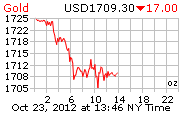
Daily SILVER US$/oz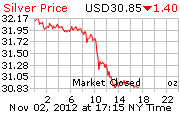
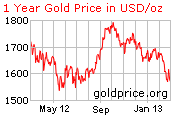
More Gold Charts: 1 Month to 660 Years
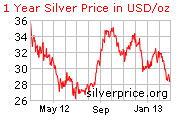
More Silver Charts: 1 Month to 660 Years
 Gold & Silver Interviews (KWN)
- More Stunning Developments In The Gold & Silver Markets October 14, 2012
- Exclusive - Riots & Money Fleeing The Euro Into Gold & Silver October 13, 2012
- Art Cashin - We Are At Risk Of A Frightening Hyperinflation October 12, 2012
- Fleckenstein - Gold & Insane Central Banks Printing Trillions October 12, 2012
- Embry - This War In Gold & Shorts Getting Overrun October 12, 2012
- The $2 Trillion European Bailout Package Is Coming October 11, 2012
- Turk - Expect A Massive Short Squeeze In Gold & Silver October 11, 2012
- Lost Confidence Can’t Be Restored & Gold’s Final Move October 11, 2012
Finance & Economics
- 23 Miles Of Free Fall - Live Webcast Of Felix Baumgartner's Third World Record Attempt From The Edge Of Space October 14, 2012 Tyler Durden
- More Middle East Escalation: Turkey, Syria Bar Flights Over Each Other's Airspace October 14, 2012 Tyler Durden
- Shuffle Rewind 08-12 Oct " Sleeping Satellite " (Tasmin Archer, 1992) October 14, 2012 AVFMS
- The REAL Reason America Used Nuclear Weapons Against Japan October 14, 2012 George Washington
- The 21st Century Monolith October 14, 2012 Tyler Durden
- Beta Testing QE 4 - "Large Amount" Of $100 Bills Stolen From Federal Reserve October 13, 2012 Tyler Durden
- Guest Post: The Problem With Centralization October 13, 2012 Tyler Durden
- The US Fiscal 'Moment': Cliff, Slope, Or Wile E. Coyote? October 13, 2012 Tyler Durden


Fractional Reserve Banking, Government, and Moral Hazard
By Ron Paul | Texas Straight Talk
Last week my subcommittee held a hearing on fractional reserve banking and the moral hazard created by government (taxpayer) insured deposits. Fractional reserve banking is the practice by which banks accept deposits but only keep a fraction of those deposits on hand at any time. In practice, nearly 100% of deposits are loaned out, yet depositors believe that they can withdraw the full amount of their deposit at any time. Loaned funds are then redeposited and reloaned up to the limit of the bank’s reserve requirements, compounding the effect.
As Murray Rothbard put it, “Fractional reserve banks … create money out of thin air. Essentially they do it in the same way as counterfeiters. Counterfeiters, too, create money out of thin air by printing something masquerading as money or as a warehouse receipt for money. In this way, they fraudulently extract resources from the public, from the people who have genuinely earned their money. In the same way, fractional reserve banks counterfeit warehouse receipts for money, which then circulate as equivalent to money among the public. There is one exception to the equivalence: The law fails to treat the receipts as counterfeit.” *
-
While mainstream economists extol this “money multiplier” as a nearly miraculous process that results in a robust economy, low reserve requirements actually enable banks to create trillions of dollars of credit out of thin air, a process that distorts the structure of production and gives rise to the business cycle. Once the boom phase of the business cycle has run its course and the bust commences, some people will naturally look to hold cash. So they withdraw money from their bank accounts in order to hold physical currency. But bank deposits consist of a huge amount of credit pyramided on top of a small of amount of original cash deposits. Each dollar of cash that is withdrawn unwinds the multiplier, resulting in a contraction in credit. And if depositors en masse attempt to withdraw more funds than are available in reserves, the entire of house of cards comes crashing down. This is the very real threat facing some European banks today.
Since the amount of deposits always exceeds the amount of reserves, it is obvious that fractional reserve banks cannot possibly pay all of their depositors on demand as they promise – thus making these banks functionally insolvent. While the likelihood of all depositors pulling their money out at once is relatively rare, bank runs periodically do occur. The only reason banks are able to survive such occurrences is because of the government subsidy known as deposit insurance, which was intended to backstop the stability of the banking system and prevent bank runs. While deposit insurance arguably has succeeded in reducing the number and severity of bank runs, deposit insurance is still an explicit bailout guarantee. It thereby creates a moral hazard by encouraging bank deposits into fundamentally unsound financial institutions and contributes to instability in the financial system.
The solution to the problem of financial instability is to establish a truly free-market banking system. Banks should no longer have a government backstop of any sort in the event of failure. Banks, like every other business, should have to face the spectre of market regulation. Those banks which engage in sound business practices, keep adequate reserves on hand, and gain the confidence of their customers will survive, while others fall by the wayside.
Banking, like any other financial activity, is not without risk – and the government should not continue its vain and futile pursuit of trying to eliminate risk. Get government out of the way and allow the market to function. This will result in a more stable system that meets the needs of consumers, borrowers, and investors.
* Murray N. Rothbard, The Mystery of Banking, 2nd ed. (Auburn, Alabama: Ludwig von Mises Institute, 2008), p. 98.
-
Congressman Ron Paul of Texas enjoys a national reputation as the premier advocate for liberty in politics today. Dr. Paul is the leading spokesman in Washington for limited constitutional government, low taxes, free markets, and a return to sound monetary policies based on commodity-backed currency. He is known among both his colleagues in Congress and his constituents for his consistent voting record in the House of Representatives: Dr. Paul never votes for legislation unless the proposed measure is expressly authorized by the Constitution. In the words of former Treasury Secretary William Simon, Dr. Paul is the “one exception to the Gang of 535″ on Capitol Hill.
-
For further reading:
Rate this:
Share this:
Like this: